
Basic balancing gets a practitioner most of the way there — a pose per centre, a mantra, a colour to visualise. Mastery starts on the far side of that, once the seven centres already run in reasonable working order and the question shifts from “how do I open this” to “how do I actually work the subtle architecture underneath it.” This guide is for that next stage: the nadis and psychic knots most beginner material never mentions, the pranayama and bandha work that moves real energy rather than just attention, and the fusion practices that treat the seven centres as one instrument instead of seven separate ones.
01What “Beyond Balancing” Actually Means
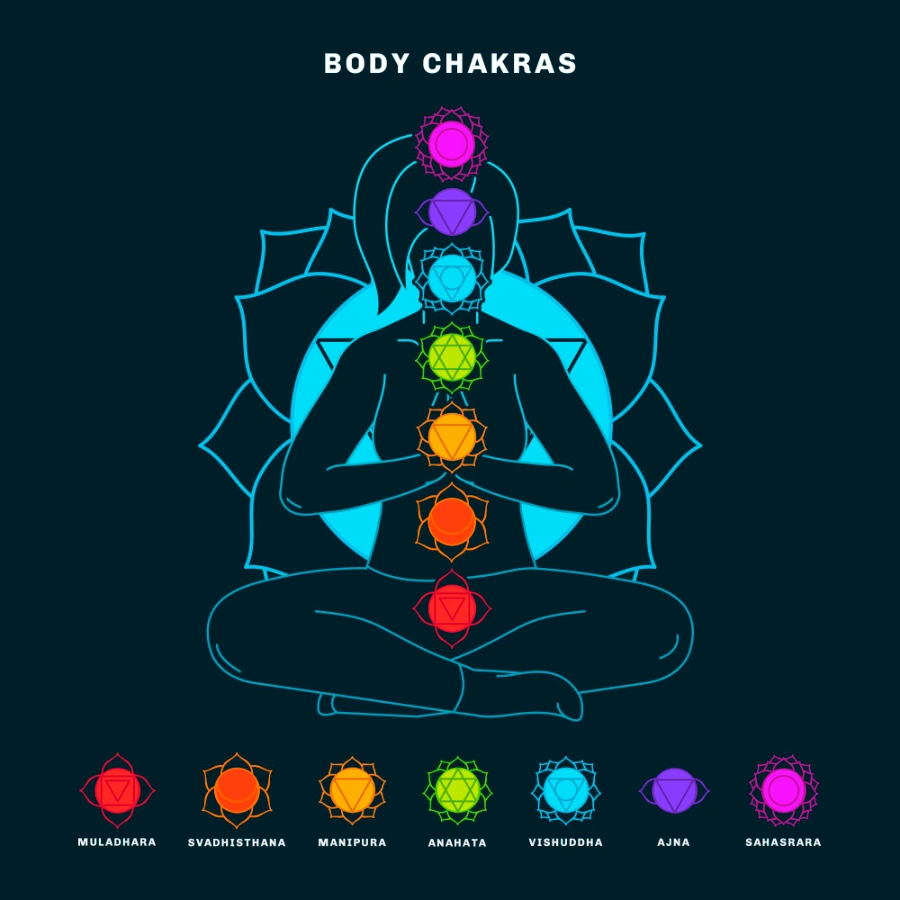
Balancing asks a fairly simple question of each centre in turn: open or closed, flowing or stuck. Mastery asks a different, harder question of the whole system at once: how does energy move between centres, where does it get stuck in transit rather than at a single point, and what happens when two or three centres are worked together rather than one at a time. A practitioner who has done the basic work for months or years, and still feels a plateau despite consistent practice, is usually running into exactly this gap — the individual centres are reasonably clear, but the connective tissue between them has never been addressed directly.
None of what follows replaces the fundamentals. A shaky foundation makes advanced work genuinely risky rather than simply less effective, so before any of this, the basics deserve to actually be solid: a working knowledge of the seven main chakras and real experience with a consistent chakra-balancing routine over real weeks, not days.
02Nadis and Granthis: The Architecture Underneath
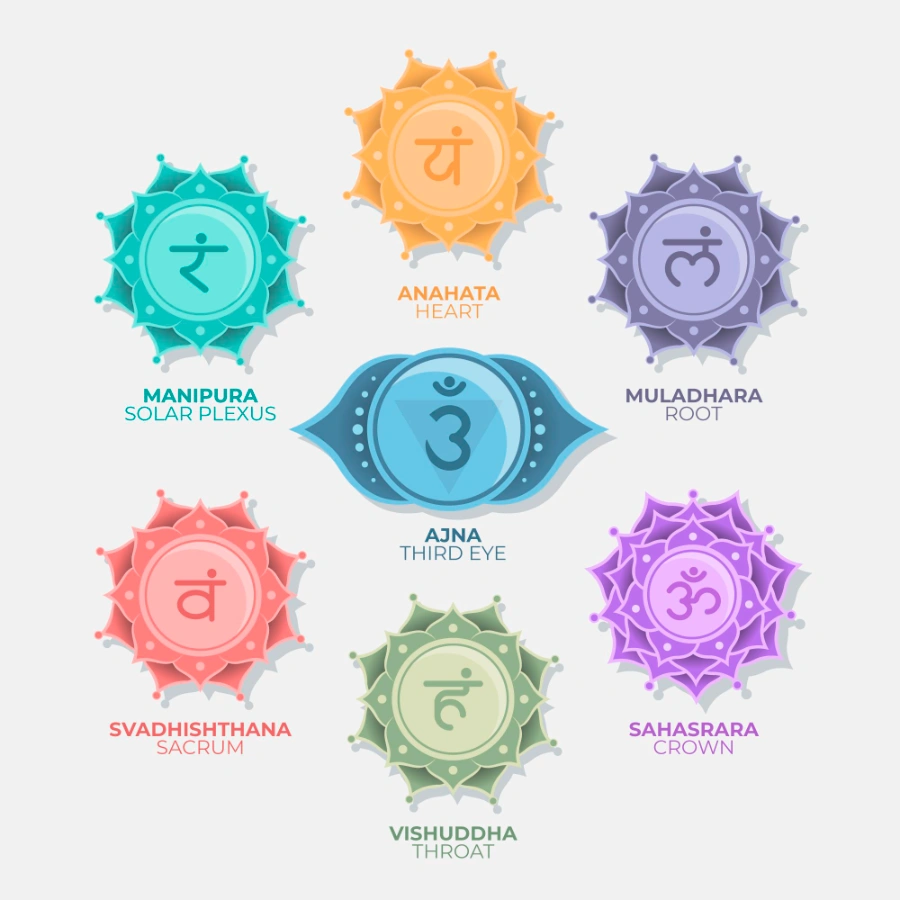
Beginner material treats the chakras as seven isolated points along the spine. A more accurate picture involves three primary channels, or nadis: sushumna running straight through the centre of the spinal column, and ida and pingala spiralling around it, crossing at each chakra along the way. Ida carries a cooling, lunar, receptive quality; pingala carries a heating, solar, active one. Most people run predominantly through one or the other without realising it — a habitually anxious, overstimulated system usually leans pingala-dominant, while chronic fatigue and low motivation often point to an ida-dominant pattern instead. Balancing the two through alternate-nostril breathing is not just a calming exercise; it is literally rebalancing which channel carries the greater load.
Along sushumna itself sit three granthis, or psychic knots, each one a point where energy characteristically stalls rather than passing through freely. The Brahma granthi, near the root and sacral centres, knots around survival fear and material attachment. The Vishnu granthi, near the heart, knots around emotional attachment and the fear of loss. The Rudra granthi, near the third eye, knots around ego identification and the fear of dissolving into something larger than the self. Each knot tends to produce a fairly recognisable plateau: stuck at the Brahma granthi, physical and financial anxiety dominate no matter how much lower-chakra work is done; stuck at the Vishnu granthi, spiritual practice deepens everywhere except in actual relationships; stuck at the Rudra granthi, insight arrives easily but never quite translates into a change in how the ego actually behaves day to day. Naming which knot is active is often the single most useful diagnostic step in advanced practice, since it tells you exactly where to direct the work that follows rather than balancing every centre equally and hoping something shifts.
03Advanced Pranayama and Bandha Work
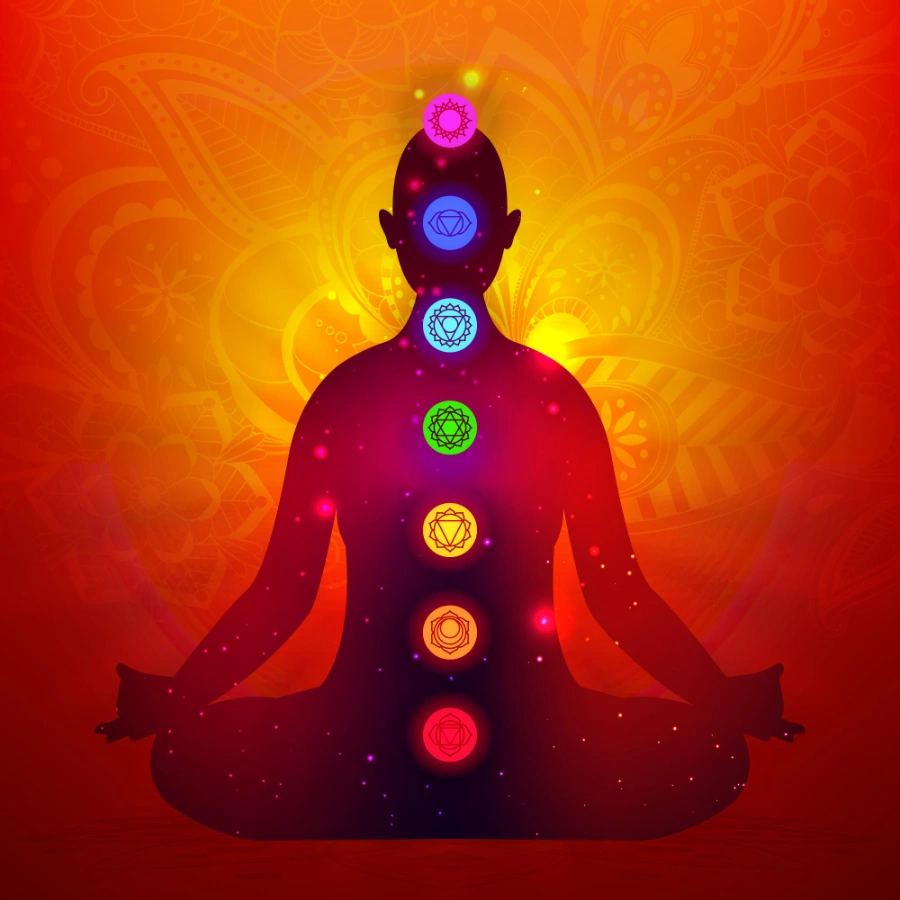
Basic breathwork moves attention. Bandha work — the yogic energy locks — actually redirects the physical pressure and blood flow that carries prana through the body, which is why it belongs to the intermediate-to-advanced stage rather than the beginner one.
Mula bandha, the root lock, contracts the pelvic floor and directs energy upward from the base rather than letting it dissipate downward and out. Uddiyana bandha, the abdominal lock, draws the belly in and up after a full exhale, creating a vacuum that pulls energy up through the solar plexus and heart. Jalandhara bandha, the chin lock, presses the chin toward the chest to seal energy at the throat rather than letting it escape upward too early. Practised together in sequence — root, then navel, then throat — these three form maha bandha, the great lock, traditionally used to draw energy the full length of the spine in a single controlled movement rather than centre by centre.
A structured pranayama training is genuinely the right setting to learn bandha work properly, since the breath-retention practices that typically accompany it — extended kumbhaka, ratio breathing at 1:4:2 or beyond — carry real physiological demand and are best learned under direct supervision rather than from a page. Attempted correctly and gradually, this combination is what actually moves the deeper, stuck energy that basic pranayama circulates around the surface without ever quite reaching.
04Mudras for Deeper Chakra Work
A mudra is a specific hand or body seal that redirects subtle energy along a particular circuit, and while gyan mudra (thumb to index finger) covers most beginner meditation, a mastery-level practice draws on a wider set, one per centre.
Root: prithvi mudra, thumb to ring finger, stabilising and grounding. Sacral: shakti mudra, thumb tucked beneath ring and little finger, index and middle extended, working directly with creative and reproductive energy. Solar plexus: rudra mudra, thumb to ring and index finger together, building willpower and digestive fire. Heart: hridaya mudra, index finger folded to the base of the thumb with ring and middle fingertips touching the thumb tip, used traditionally alongside cardiac and emotional work alike. Throat: akasha mudra, thumb to middle finger, opening the element of space associated with authentic expression. Third eye: kalesvara mudra, hands folded with index fingers extended and touching at the tip, directing focus inward and upward at once. Crown: the simple gesture of hands open and raised, palms up, held in complete stillness — the crown responds less to a specific seal and more to the absence of any effort at all.
Hold any of these for a minimum of three minutes to feel a genuine effect — a mudra held for thirty seconds is a gesture, not a practice.
05Chakra Fusion and Advanced Meditation
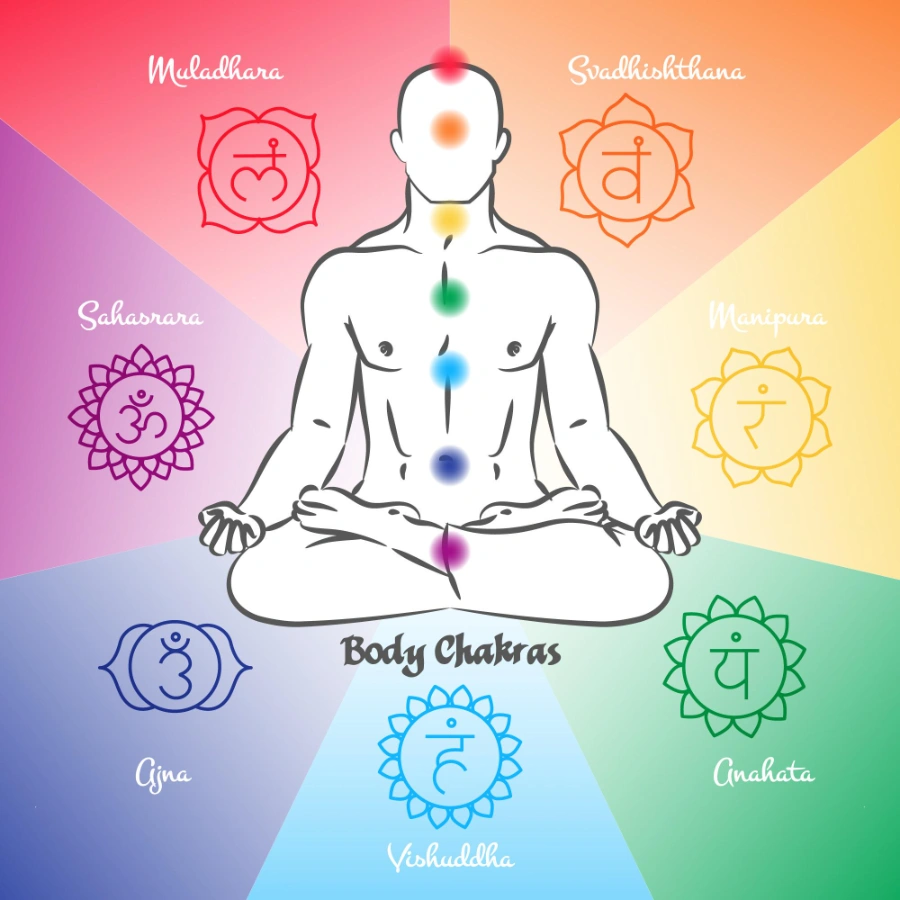
Basic meditation moves through the seven centres one at a time, in sequence. Fusion work holds two or three simultaneously, deliberately blending their qualities rather than visiting them in turn.
In heart-throat fusion, hold awareness at the heart and throat together, feeling compassion and honest expression as a single combined sensation rather than two separate ones — this is the specific practice behind speaking a hard truth with genuine kindness rather than either brutal honesty or diplomatic avoidance. In root-crown fusion, hold awareness simultaneously at the base of the spine and the crown of the head, feeling both the earth underneath and the sky above at once — a practice that steadies a mind that tends to float into spiritual abstraction without any ground underneath it. In third-eye and sacral fusion, intuition and creativity merge into a single channel, often the exact combination behind genuinely inspired, non-formulaic work in any creative field.
A more advanced variant still, sometimes called the column of light, holds all seven centres lit simultaneously for the length of the sit, rather than emphasising any single one — less a technique for fixing a specific blockage and more a rehearsal of what the fully open system actually feels like, so the nervous system has a felt reference point to return toward between sessions. Advanced students preparing for a genuine kundalini awakening often spend months in exactly this kind of column-of-light practice first, since a system that has never held all seven centres open together tends to struggle when that same opening happens suddenly and involuntarily instead.
06Troubleshooting Plateaus
A plateau at this stage rarely means the practice has stopped working; more often it means the current practice has done what it can do, and a different angle is needed rather than more repetition of the same one.
If lower-chakra work feels stuck despite consistent practice, the Brahma granthi is the more likely culprit than the root chakra itself — shift toward addressing survival fear directly, through financial planning, through therapy, through anything that resolves the fear rather than simply visualising past it. If heart work deepens in meditation but never in actual relationship, the Vishnu granthi is probably active, and the more useful practice becomes a real, vulnerable conversation rather than another hour of loving-kindness meditation sat alone. If insight arrives easily but ego behaviour never actually shifts, the Rudra granthi likely holds, and service — genuinely useful action for someone else, without personal credit attached — tends to move that particular knot faster than further contemplation does.
A more subtle plateau shows up as spiritual bypassing: real, measurable progress in meditation and energy work that somehow never touches ordinary daily behaviour. The honest diagnostic question here is simple — has anyone who knows you well, outside the practice itself, actually noticed a change? If the answer is genuinely no after months of consistent work, the practice has likely become a private experience rather than a transformation, and that gap is worth naming directly rather than working around.
07Building an Advanced Daily Practice
An advanced sadhana does not simply add more time to a beginner routine; it restructures the same amount of time around fewer, deeper elements. A workable forty-five minute version: ten minutes of bandha-integrated pranayama, working mula and uddiyana bandha together with slow ratio breathing; fifteen minutes of chakra-fusion meditation, choosing one combination per week rather than rotating daily; ten minutes of mudra work held through a single extended meditation rather than switched between seals; and a closing ten minutes in complete stillness, simply noticing whatever the practice actually produced rather than moving straight into the next task of the day.
Track a single granthi per month rather than attempting to work all three simultaneously — a month on the Brahma granthi through grounding and practical action, then a month on the Vishnu granthi through relational honesty, then a month on the Rudra granthi through service, repeated in a slow cycle over a year or more. This kind of extended, unglamorous consistency is what actually distinguishes mastery from an intense but short-lived phase of practice.
08Deepening the Work Further
At some point the most useful next step stops being a technique and becomes direct guidance — a teacher who can actually observe the specific pattern in front of them rather than a general description written for everyone at once. A 300-hour yoga teacher training is where this kind of individualised bandha and pranayama refinement typically happens, and a full 500-hour teacher training goes further still, often incorporating dedicated energy work and sound healing alongside the physical and pranayama curriculum.
“Balancing asks whether a centre is open. Mastery asks how the whole system moves — and where, exactly, it still gets stuck in transit.”
The heart of it
- Mastery works the connective tissue between centres — nadis and granthis — not just the centres themselves.
- Bandha work moves real physical pressure and blood flow, not merely attention, and deserves proper supervision.
- A plateau usually points to a specific granthi rather than a general lack of practice.
- Fusion meditation, holding two or more centres at once, is the bridge between basic balancing and genuine mastery.
Take your practice past balancing and into genuine mastery, guided by experienced teachers.
Reserve Your Seat