At dusk
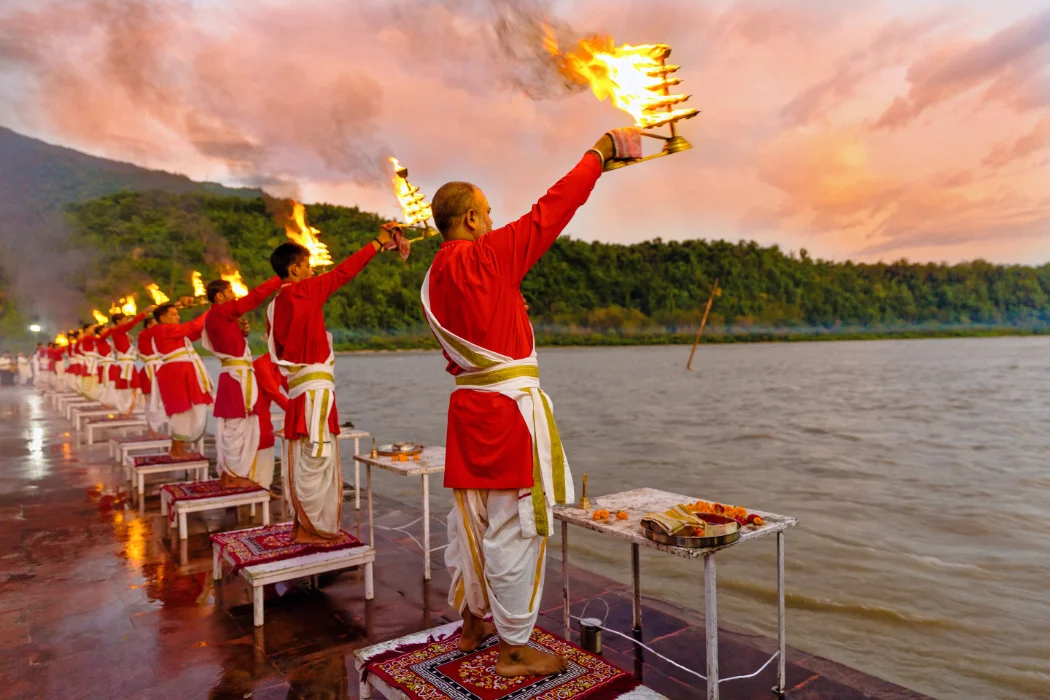
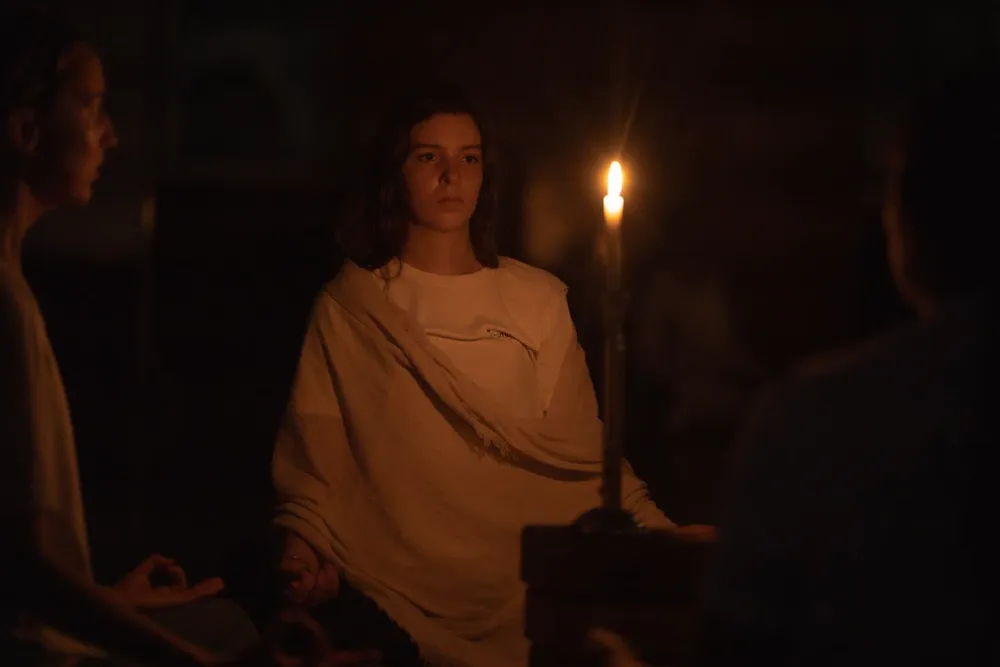
The evening Ganga aarti
Priests circle great brass lamps at Parmarth Niketan and the whole bank glows amber against the dark. A lot of people describe it as the first time in years they felt completely still.
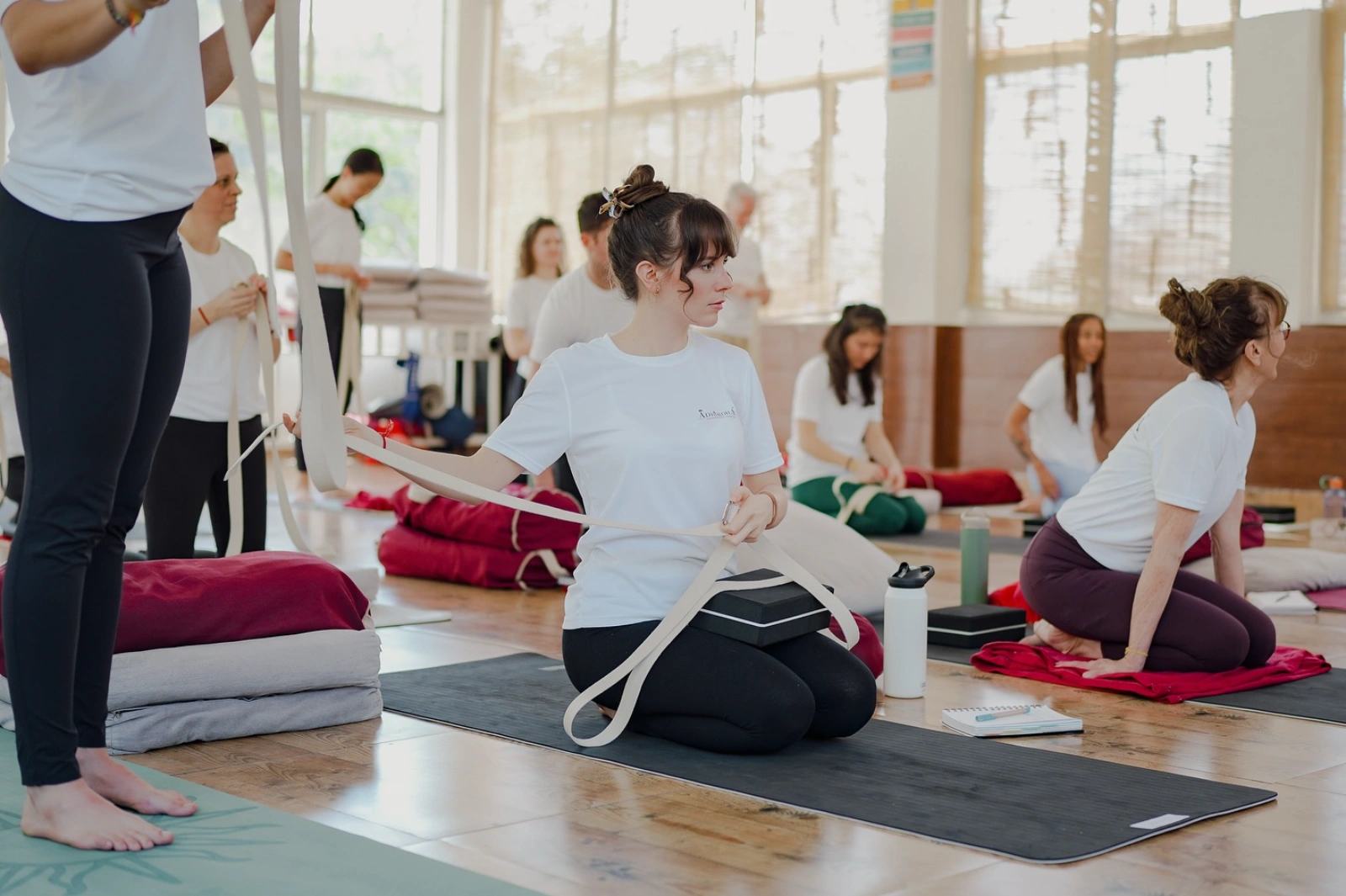
Three Yoga Alliance registered trainings at our school in Upper Tapovan, Rishikesh, on one continuous path. Two hundred hours to begin teaching, three hundred more to teach with authority, or all five hundred in a single stretch above the Ganga Ji.
Three Yoga Alliance registered trainings at our school in Rishikesh, on one path.
The three trainings are not three separate products. They are one path measured out in hours. The 200 hour covers the first stretch of it, the 300 hour covers the rest, and the 500 hour walks the whole thing in one go. If you are new to teacher training, the answer is almost always the 200 hour.
The foundation. Almost everyone who teaches this practice for a living began with a course exactly like this one.
Everything you need for the 24 days is already inside the fee: your room at the school, three meals a day, all training and materials, both excursions, airport pickup from Dehradun and your certificate.
Twelve subjects across 24 days, each carried by a teacher who has lived it. They sort into four pillars that run from the body to the front of the room.
Who want a strong foundation before anything else. The course assumes no prior teaching experience at all, and builds from the ground up at a pace that never leaves you behind.
Ready to understand the why behind postures they already love — moving from following along with videos to knowing, in your own body, what each posture is doing.
Anyone hoping to teach one day and wanting an internationally recognised certificate to do it, with the practised confidence to stand at the front of a room.
Looking for a month of clarity and quiet more than a career change. A stretch of days that make sense again, and space to hear yourself think.
You land, shake off the travel and meet the group you will share the month with. The first sessions are deliberately gentle. Nobody is thrown in the deep end.
This is the week the body complains a little. Muscles you had forgotten make themselves known. Stay with it — by the end of the week the aches fade and the pieces start to fit.
Almost without warning, something turns. You stop copying the teacher and start noticing alignment in the people beside you.
You plan and lead classes to your peers, take honest feedback, and sit your final assessment. Then the certificates, and the goodbyes.
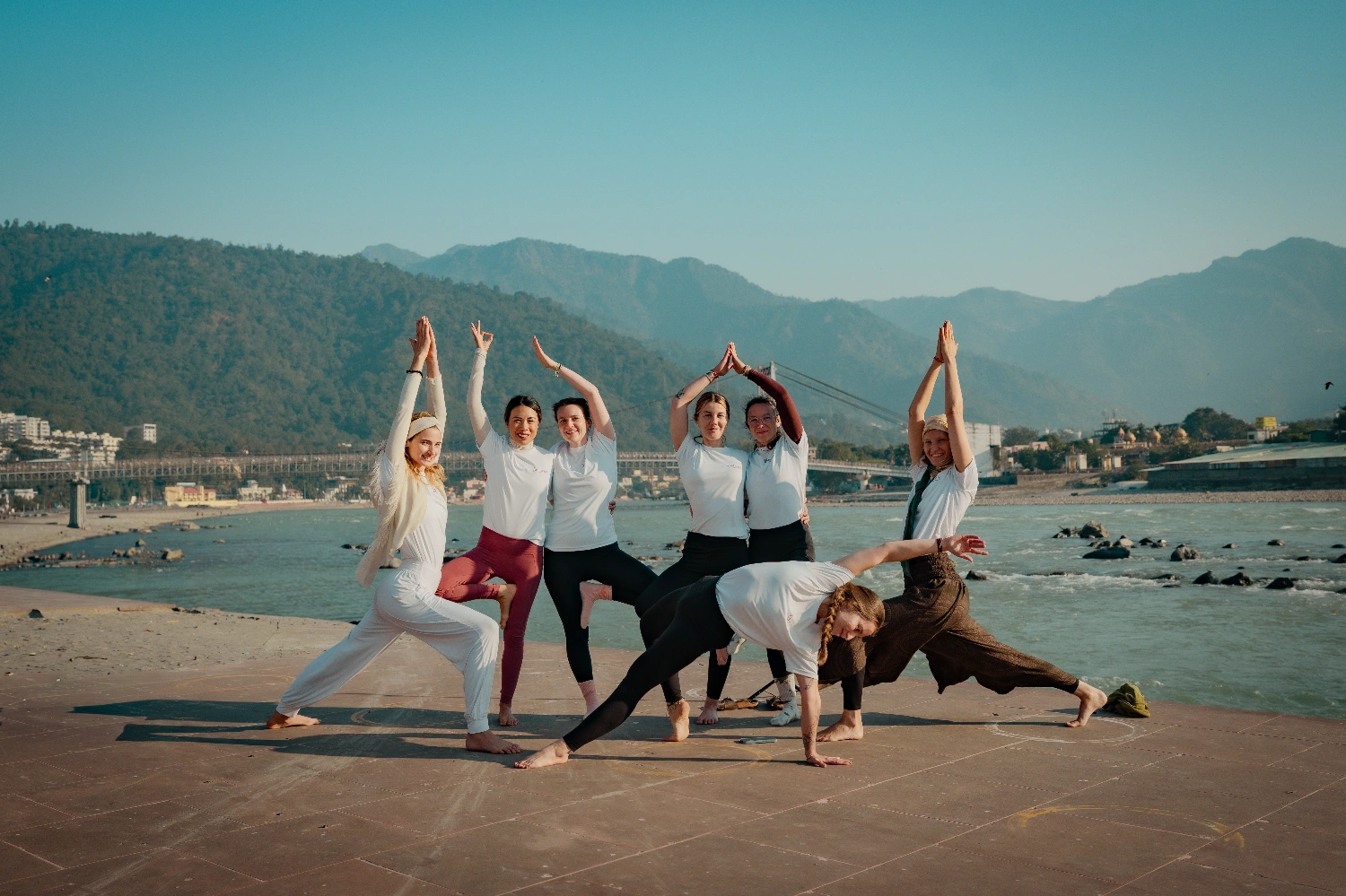
The advanced half. It begins where the foundation ended, and finishes the path to the full 500-hour credential.
Everything you need for the 30 days is already inside the fee: your room at the school, three meals a day, all training and materials, both excursions, airport pickup from Dehradun and your certificate.
Twelve subjects across 30 days, each carried by a teacher who has lived it. They sort into four pillars that run from the body to the front of the room.
Who finished the foundation, with us or elsewhere, and feel ready for more. We begin where the 200 hour left off and move straight into the advanced work.
Refining the craft: cleaner cueing, honest hands-on adjustments, thoughtful sequencing, and a deeper well of philosophy to teach from when a room asks hard questions.
The 300 hour is the second half of the full credential. Complete it and RYT 500 is within reach, opening advanced workshops and retreats worldwide.
Who trained a while ago and want to come back with fresh depth. A month to sharpen what has gone rusty and remember exactly why you began.
You meet a group who, like you, already practise and teach. The first sessions revisit the fundamentals so everyone settles back into their body before the advanced work begins.
The body remembers quickly. Within days you move past what the foundation covered — deeper backbends, inversions, the subtle body, the parts a 200 hour only hinted at.
You stop practising like a student and start seeing like a teacher: reading alignment in the room, understanding why a sequence is built the way it is.
You lead advanced classes to your peers, take mentored feedback, and sit your final assessment. Then the RYT 300 certificate, with RYT 500 now within reach.
The whole path in one journey. Two months, from the first posture to leading an advanced room.
Everything you need for the 60 days is already inside the fee: your room at the school, three meals a day, all training and materials, both excursions, airport pickup from Dehradun and your certificate.
Twelve subjects across 60 days, each carried by a teacher who has lived it. They sort into four pillars that run from the body to the front of the room.
Who want the whole thing in one stretch rather than a foundation now and the rest someday. You start from the first posture and leave a fully qualified teacher.
Ready to make yoga a living and wanting the strongest credential to do it. Two months earns the complete RYT 500 without spreading it over years.
Who would rather not split training across years and separate trips. The 500 hour folds the 200 and the 300 into one continuous immersion.
Looking for real change more than a certificate. Long enough in the hills above the Ganga Ji for the practice to reshape how you live, think and move.
You land, shake off the travel and meet the group you will share two whole months with. The first sessions are deliberately gentle, whatever level you arrive at.
The first weeks build the base, for many from the ground up. The classical practice is drilled slowly until it is genuinely yours. This is the 200 hour, lived properly.
Somewhere past halfway the foundation becomes advanced. Inversions, the subtle body, therapy, real teaching craft — and the quiet shift from practising to seeing like a teacher.
You lead full classes to your peers, take mentored feedback, and sit your final assessment. Then the RYT 500 certificate: the whole path walked end to end.
Every course begins on the 1st of the month, whichever level you take, and you arrive on the 30th or 31st of the month before. The nearest batches fill first.
| Batch | 200 hour | 300 hour | 500 hour | Seats |
|---|
Fees are €1275 for the 200 hour, €1500 for the 300 and €2790 for the 500, triple sharing and all-inclusive.
The same shala, the same teachers, the same kitchen, the same early mornings and the same two excursions. The level decides how long you stay and what you study. It does not decide how you live while you are here.
It looks like a lot written down, and the first two days can feel that way. Then something clicks, and by the end of the first week the rhythm carries you rather than the other way round.
Shatkarma — gentle cleansing practices as the light comes up over the valley.
Pranayama — breathwork while the air is still cool and the ashram is quiet.
Hatha asana — a strong practice to wake the body properly.
Breakfast — warm, simple, and eaten without hurry.
Philosophy & ethics — discussion far more than lecture.
Yin or alignment — a restorative session to open and release, or adjustment work to refine the postures.
Lunch, then rest — a real break through the warm part of the day.
Yoga anatomy — the science behind everything you practise.
Ashtanga & vinyasa — flow as the afternoon softens.
Chanting & meditation — the day winds down with sound, then stillness.
Dinner, lights out — early, because dawn comes early too.
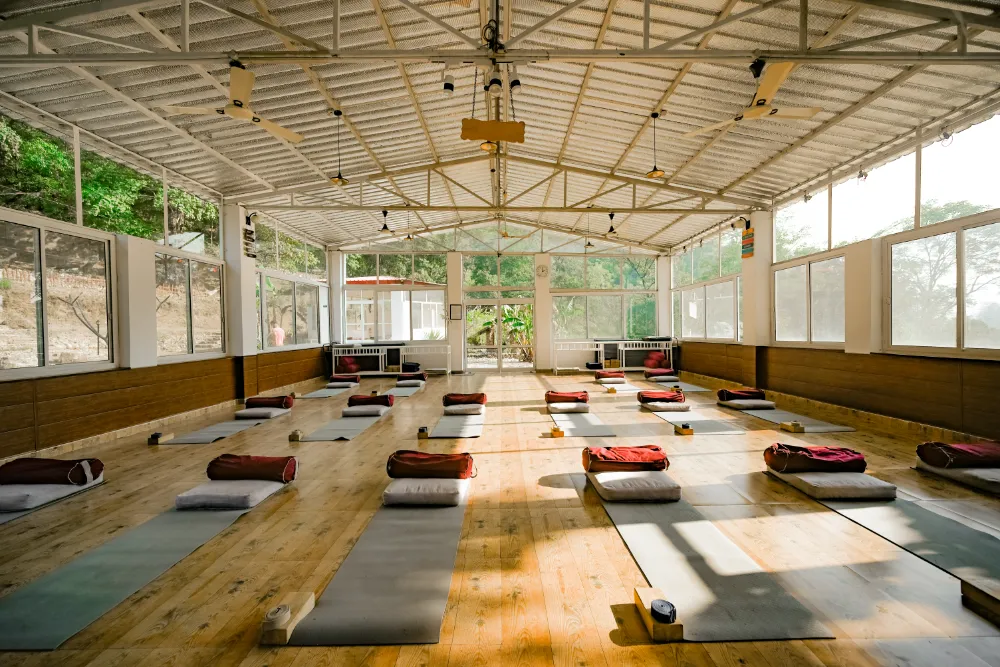
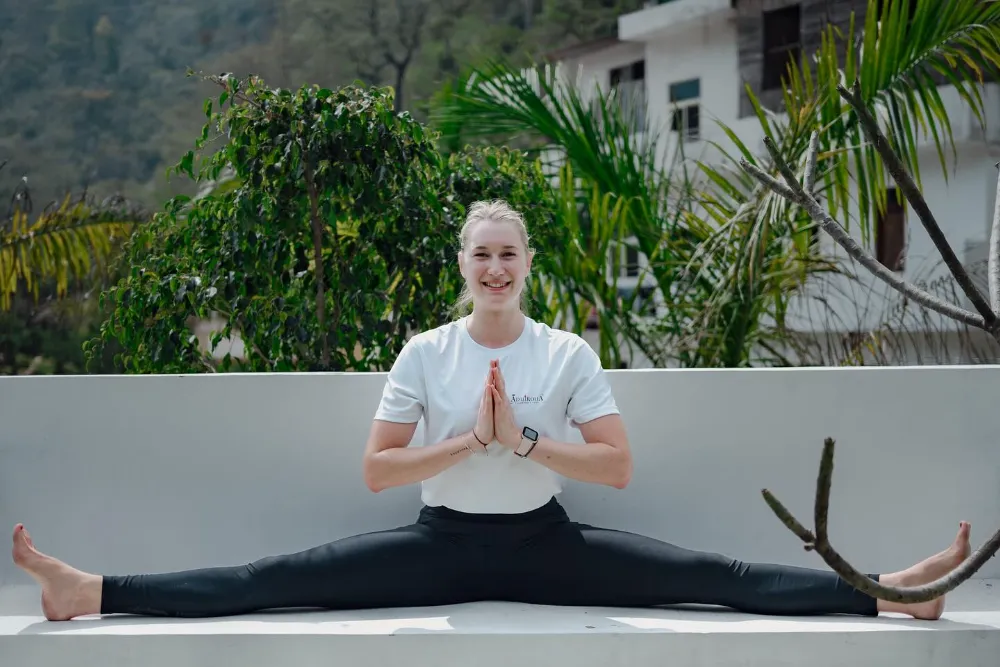
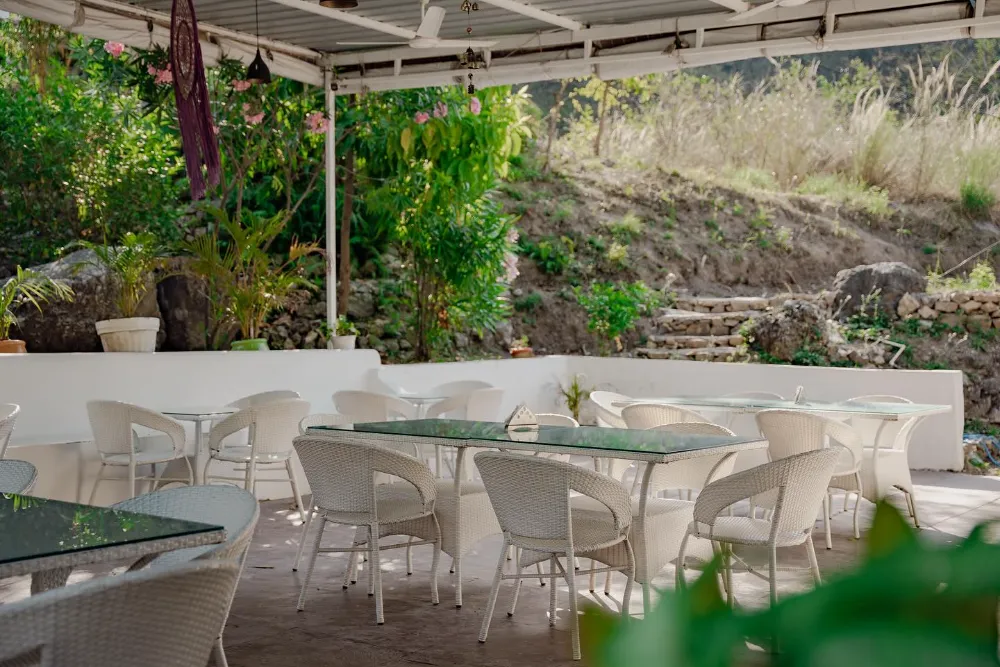
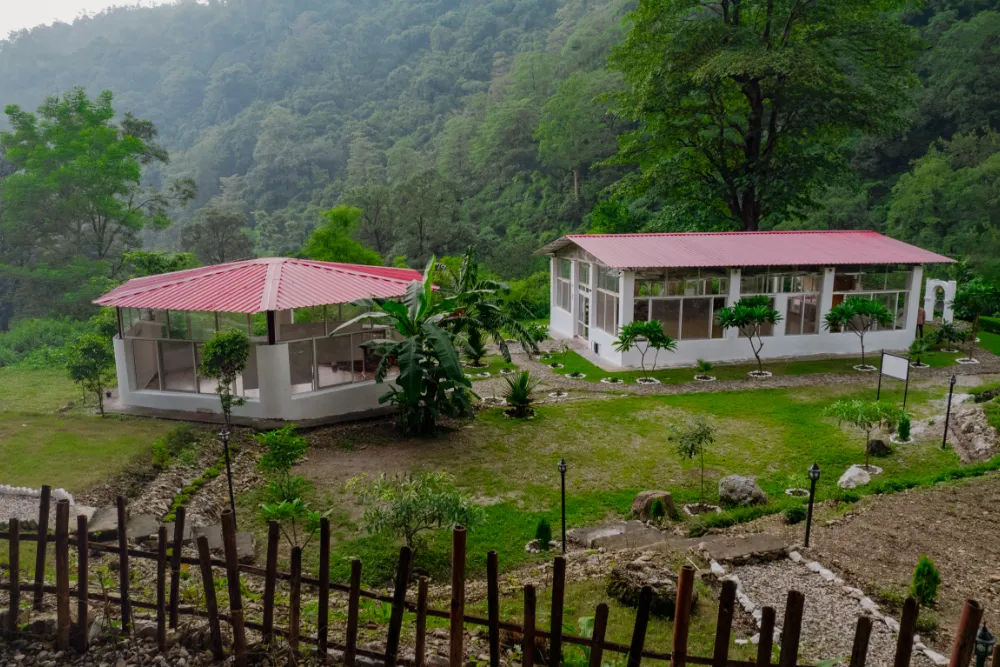
A practice takes on the shape of the space it happens in. Our school spreads across three quiet acres beside a flowing brook, ringed by hills and forest, and every corner of it exists for a reason.
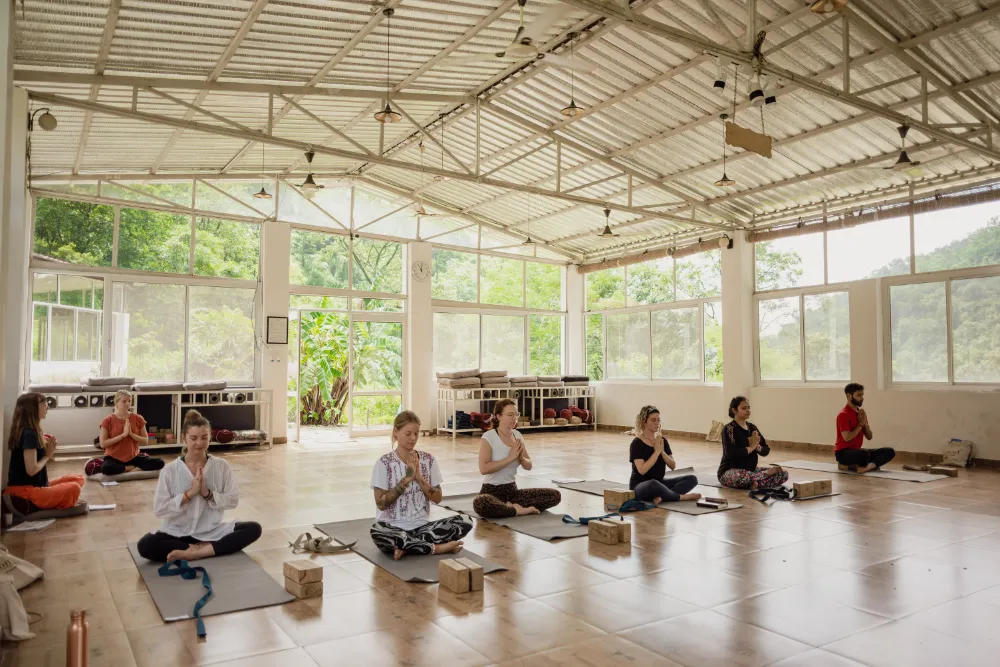
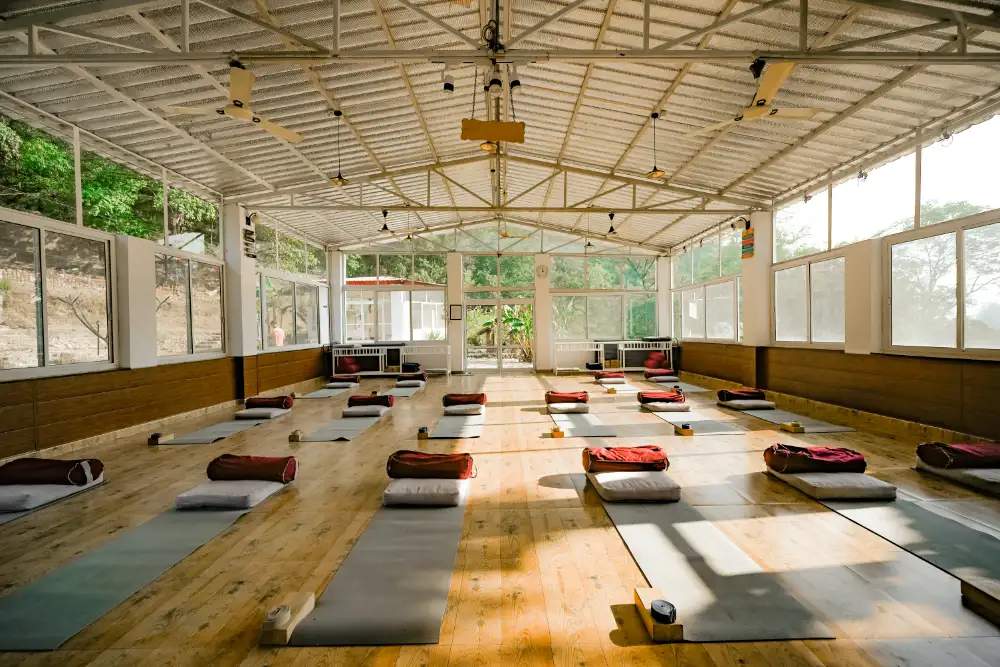
Bright and purpose-built, with props, a small library, and space enough that a class never feels crowded. Practising with green and sky all around you does something four studio walls simply cannot.
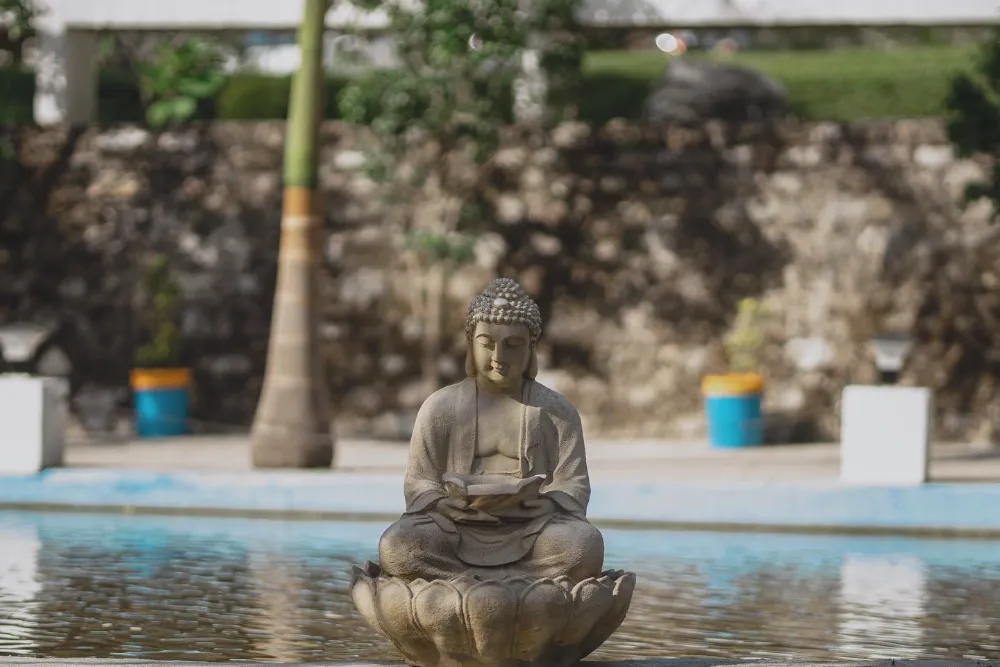
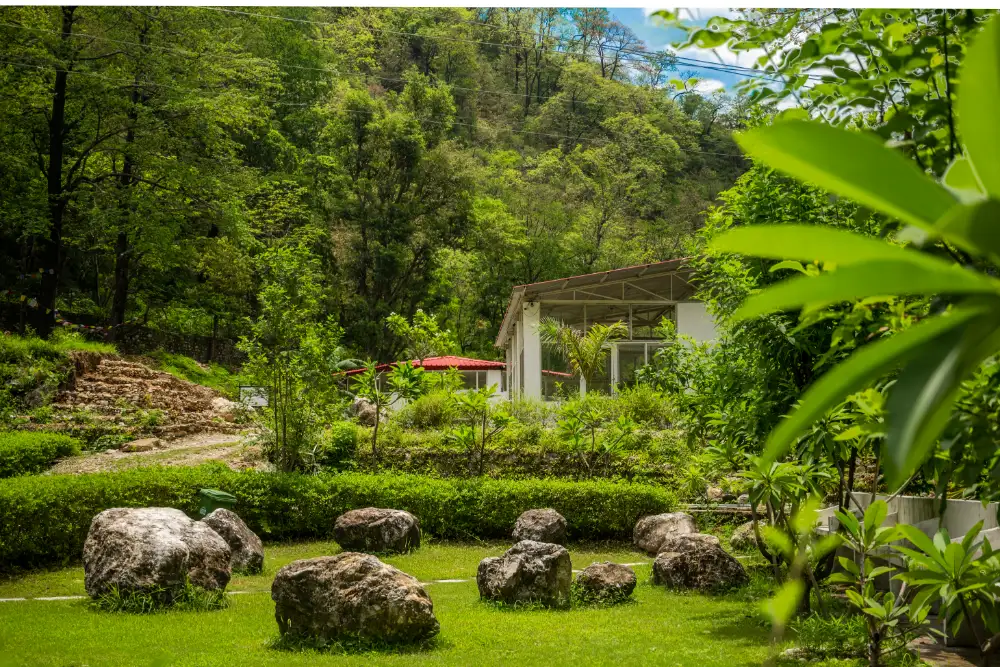
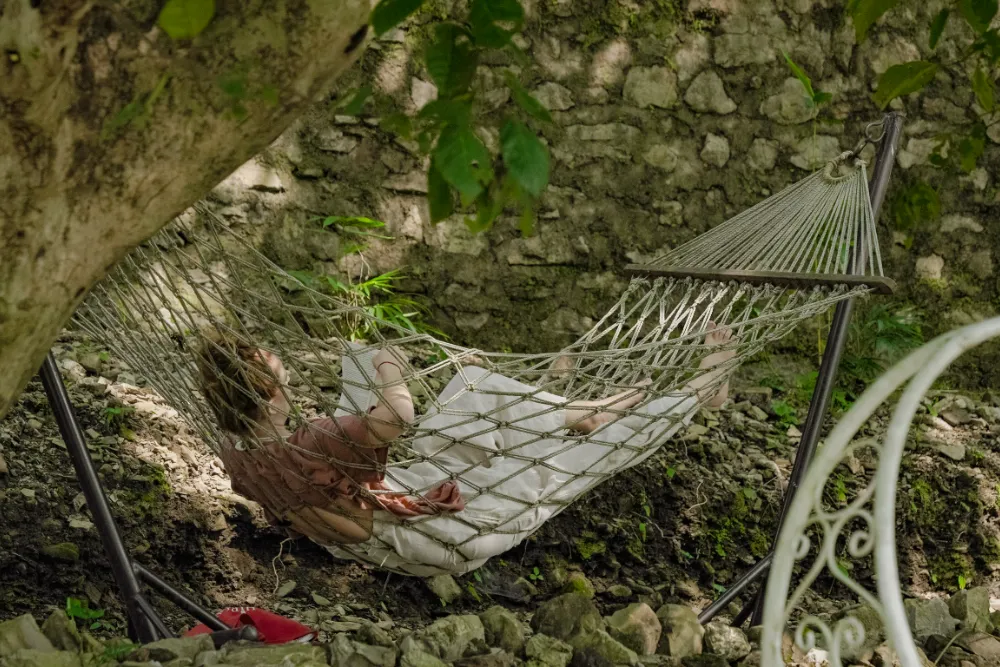
The grounds stay calm even when a full batch is in residence: a small Shiva temple for quiet sitting, shaded corners for reading, and the sound of running water that slows everyone down within a day or two.
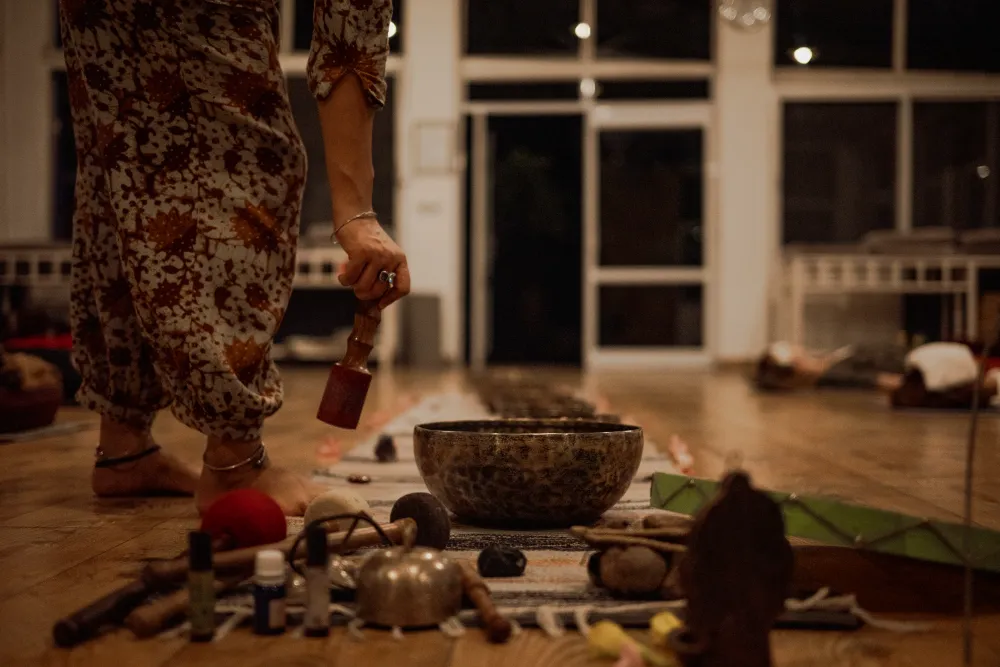
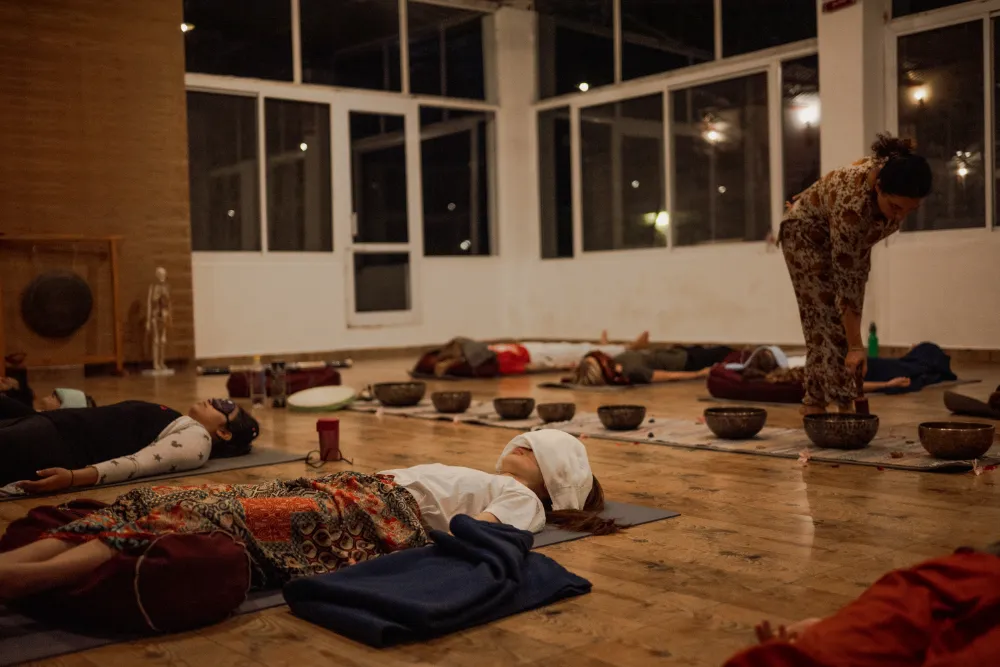
Sound healing with singing bowls and gongs, mantra, and the guided meditation that closes each day. It is where a lot of people find the part of the course they did not expect to matter most.
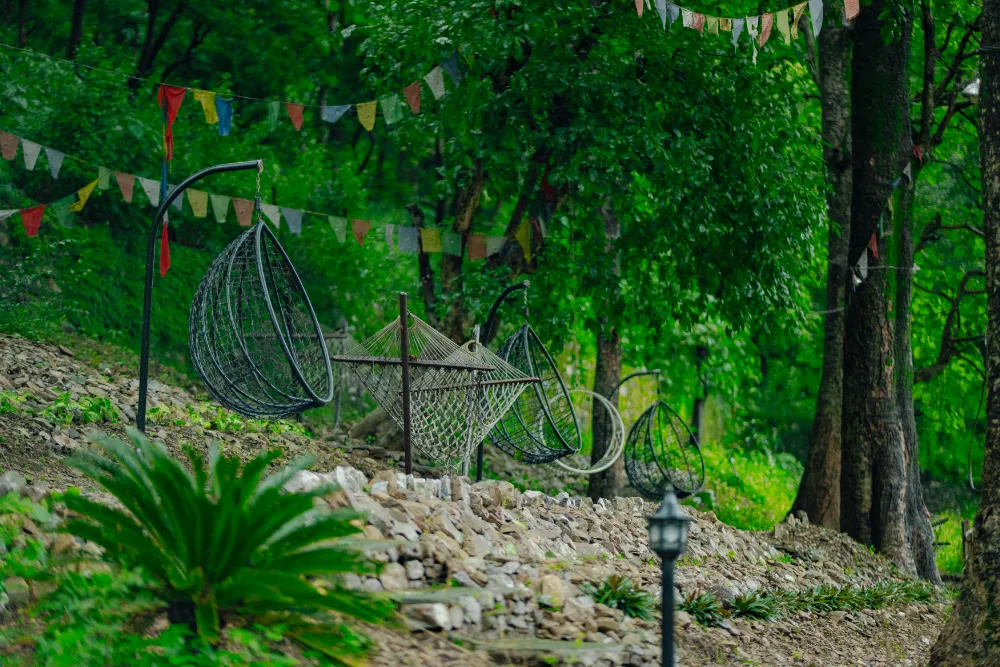
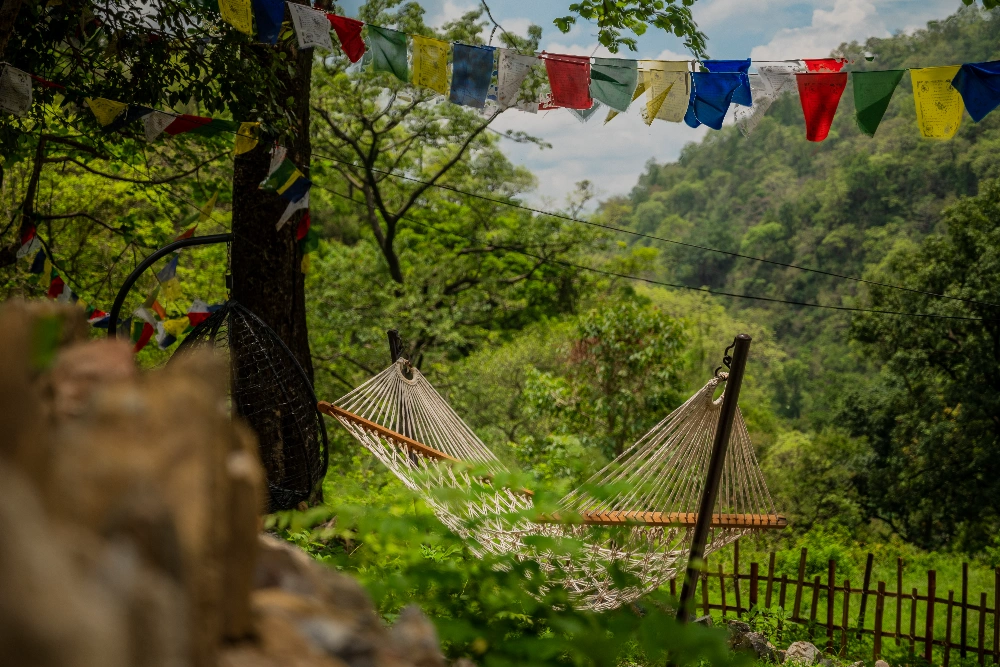
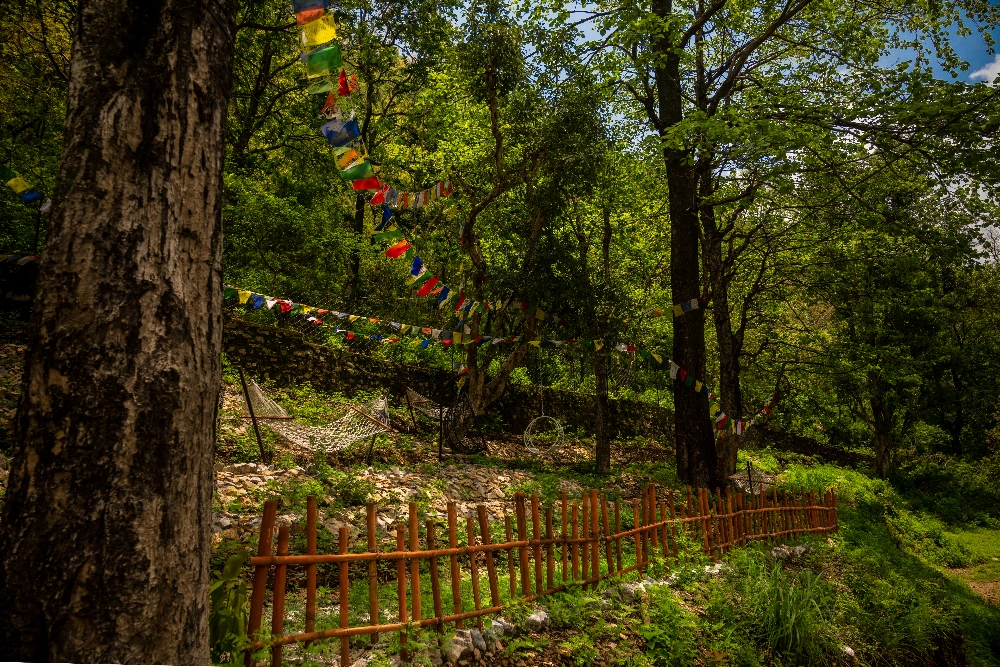
Reading nooks, garden hammocks and shaded benches dotted around the grounds. A surprising amount of the real learning happens in these unhurried in-between moments.
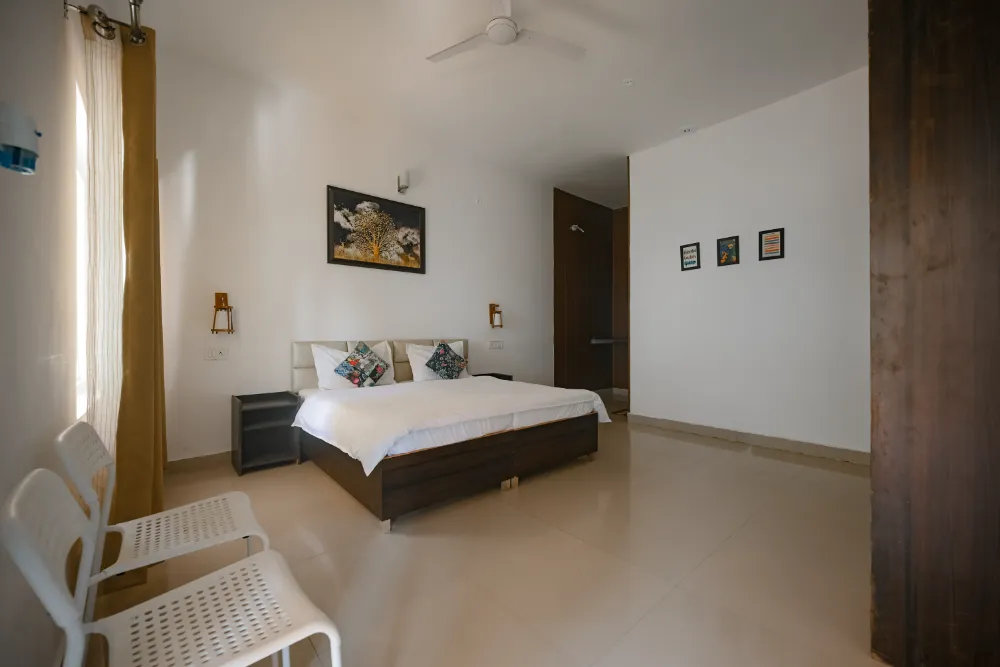
Clean, airy rooms full of natural light, most looking straight out at the mountains. Students often say it was the best they had slept in years.
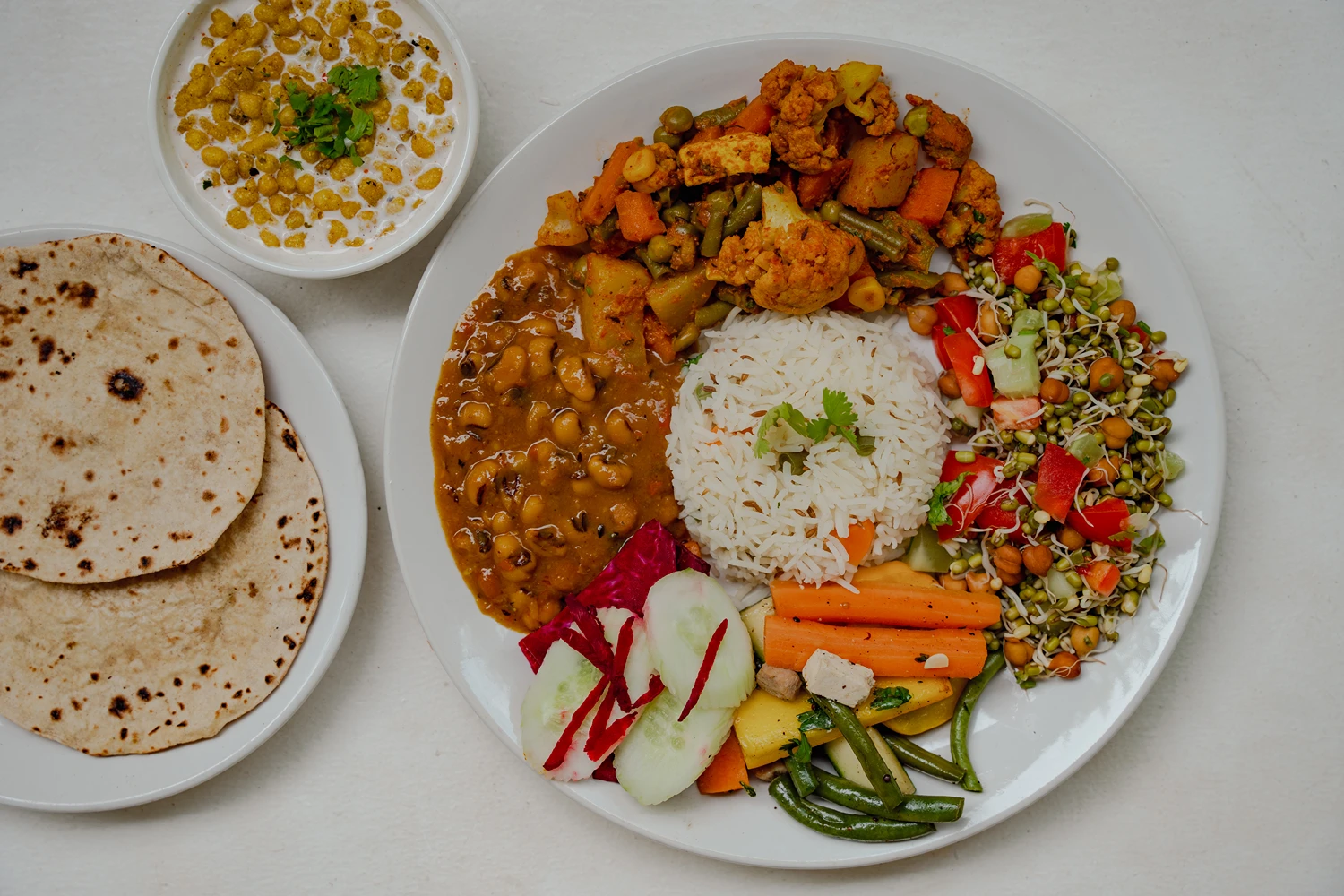
Three vegetarian meals a day, cooked the sattvic and Ayurvedic way, built around what a body under a full practice load actually needs. Do not mistake simple for plain.
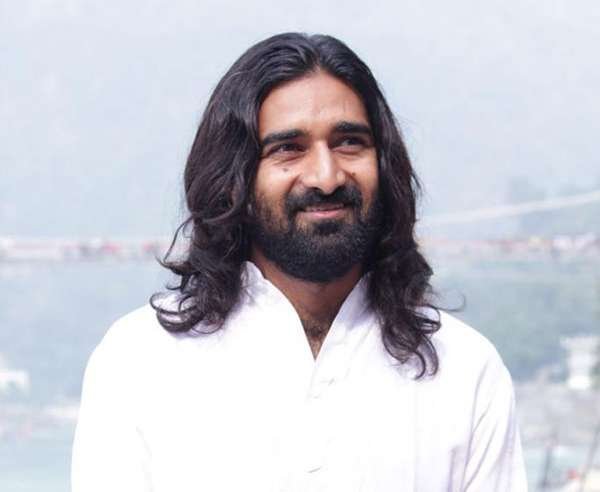
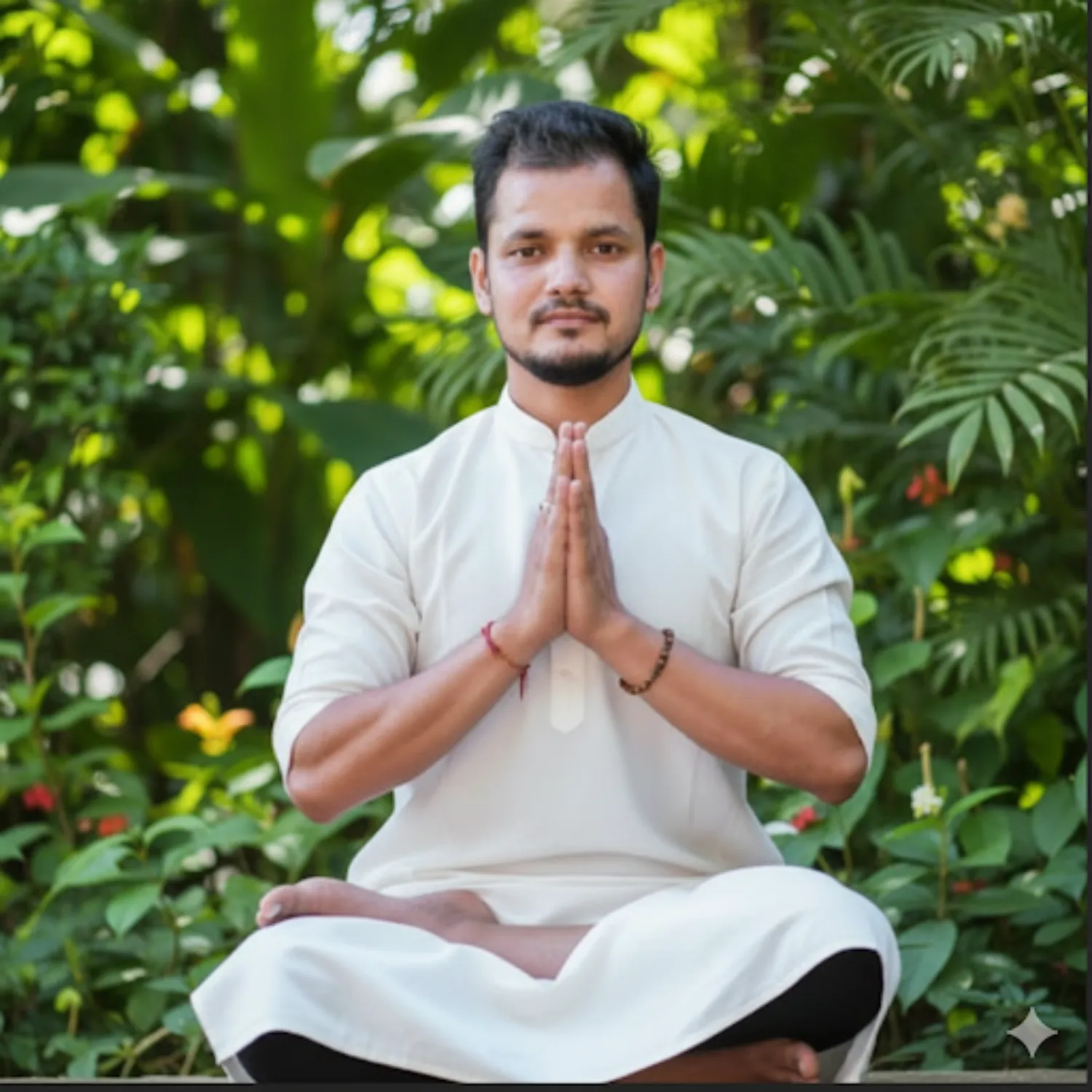
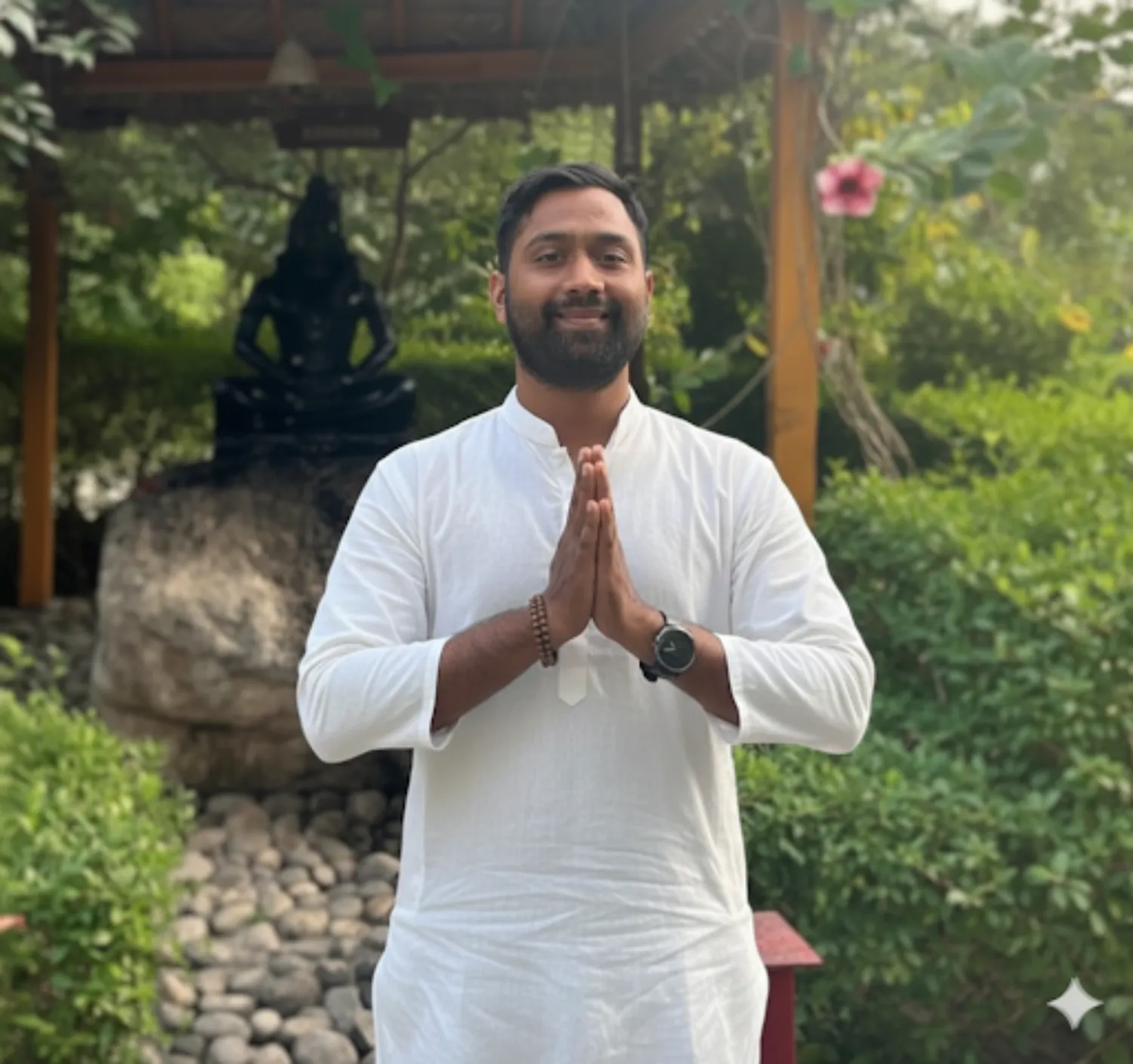
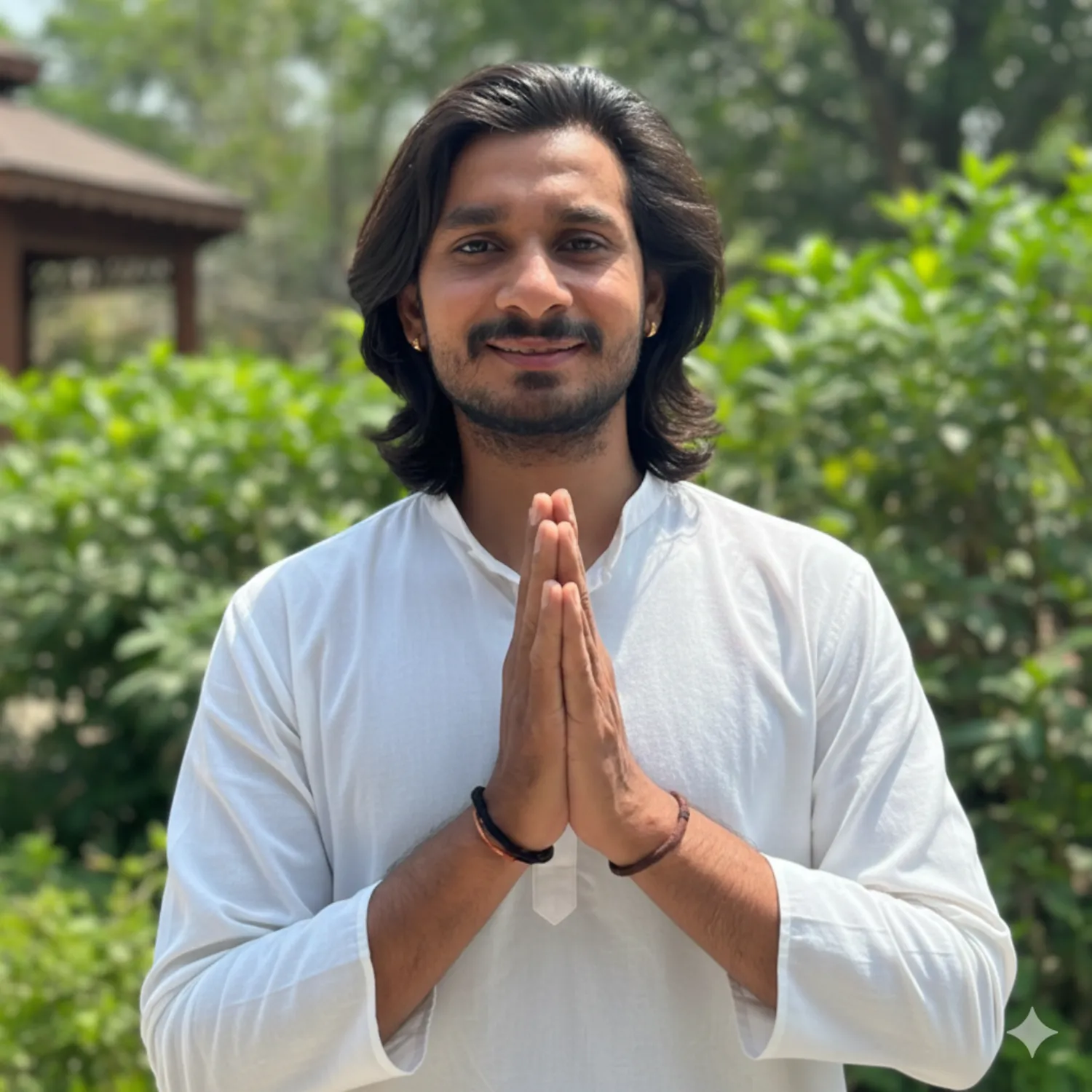
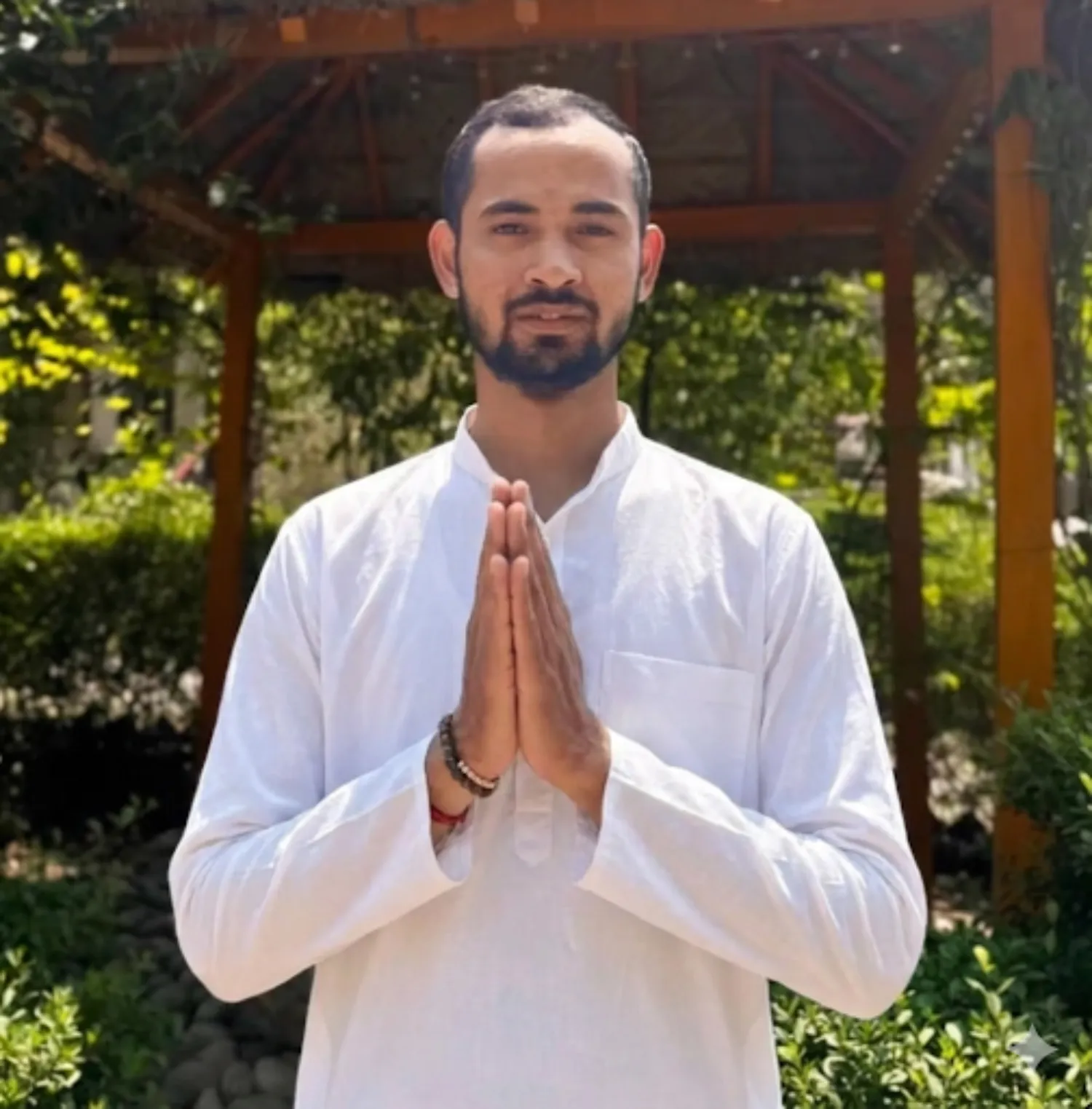
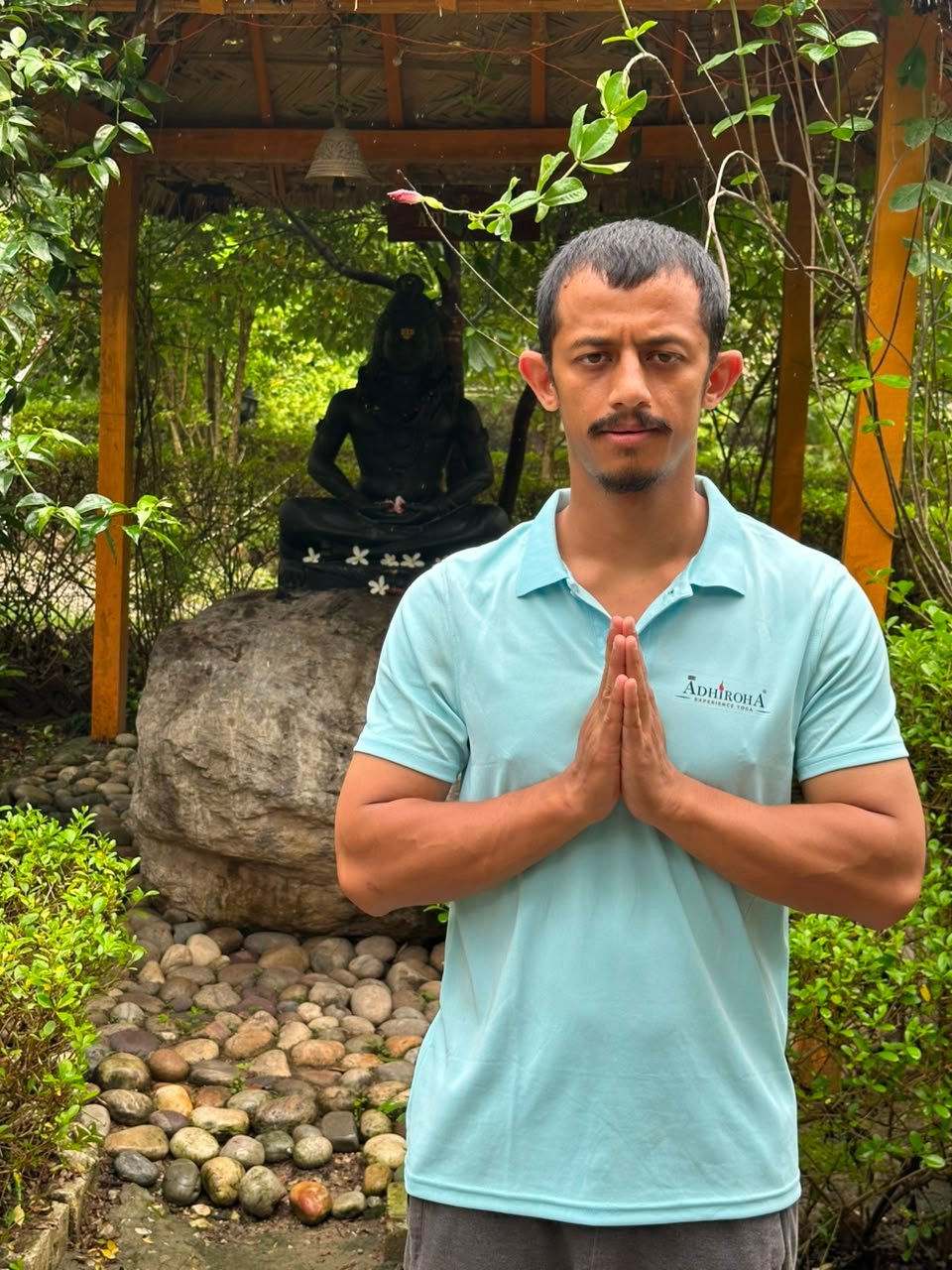
A school is only ever as good as the people teaching in it. We never hand a whole course to one person, and we never put an intern at the front — every subject is led by someone who has lived it for years. You can read more about each of them on the yoga teachers page.
A real education never stops at the edge of the shala. Woven through every course are two guided excursions and a handful of small rituals that tie you to the culture around you. For many students these turn out to be the memories they hold onto longest.
Priests circle great brass lamps at Parmarth Niketan and the whole bank glows amber against the dark. A lot of people describe it as the first time in years they felt completely still.
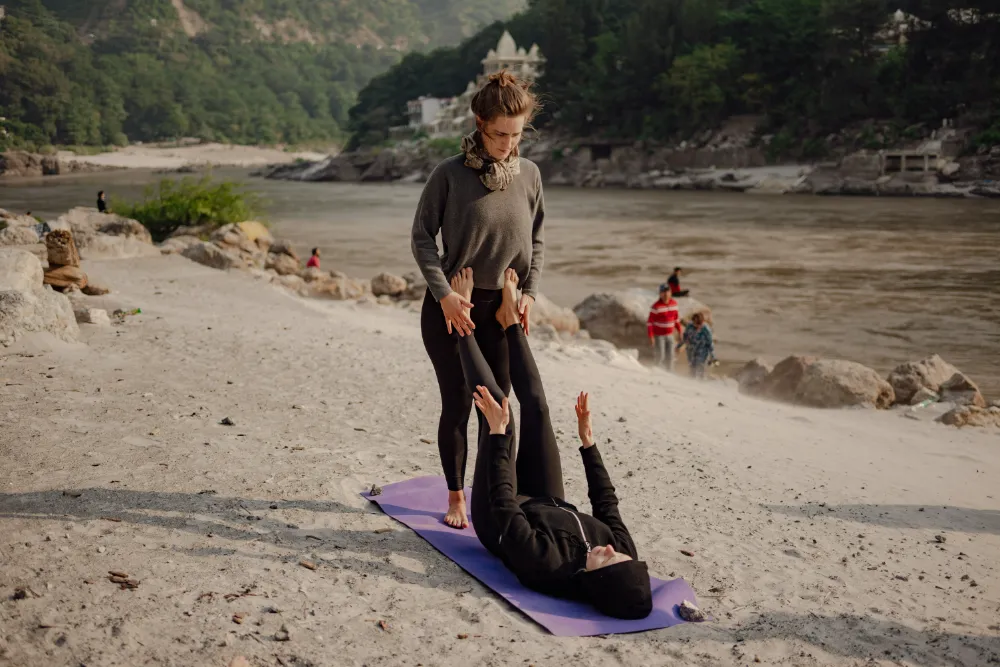
A short climb to the falls hidden in the hills above Rishikesh. Cold water, green shade, and the best kind of tired.
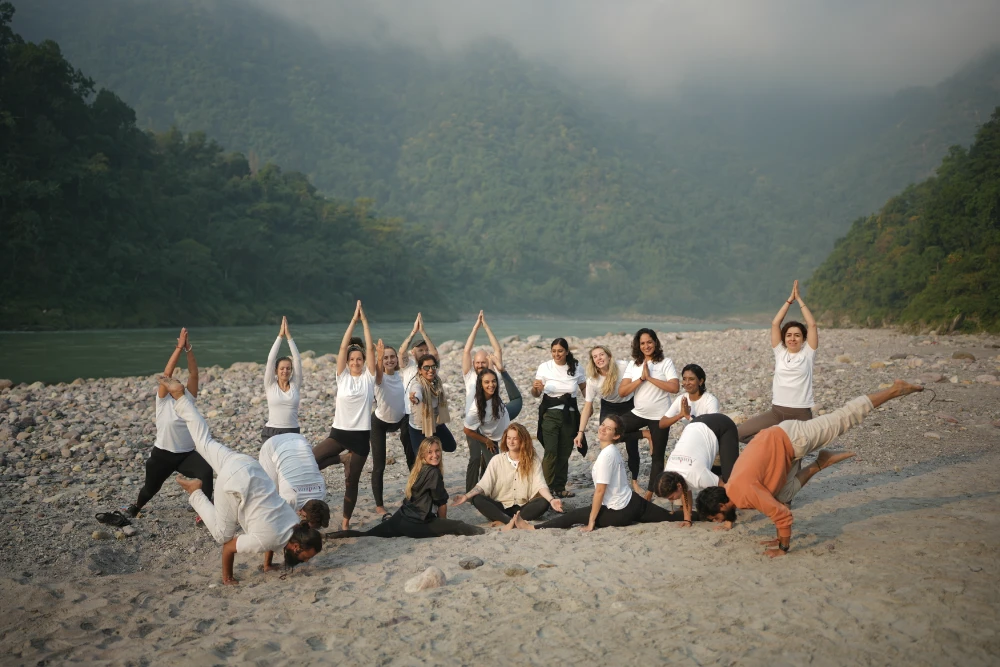
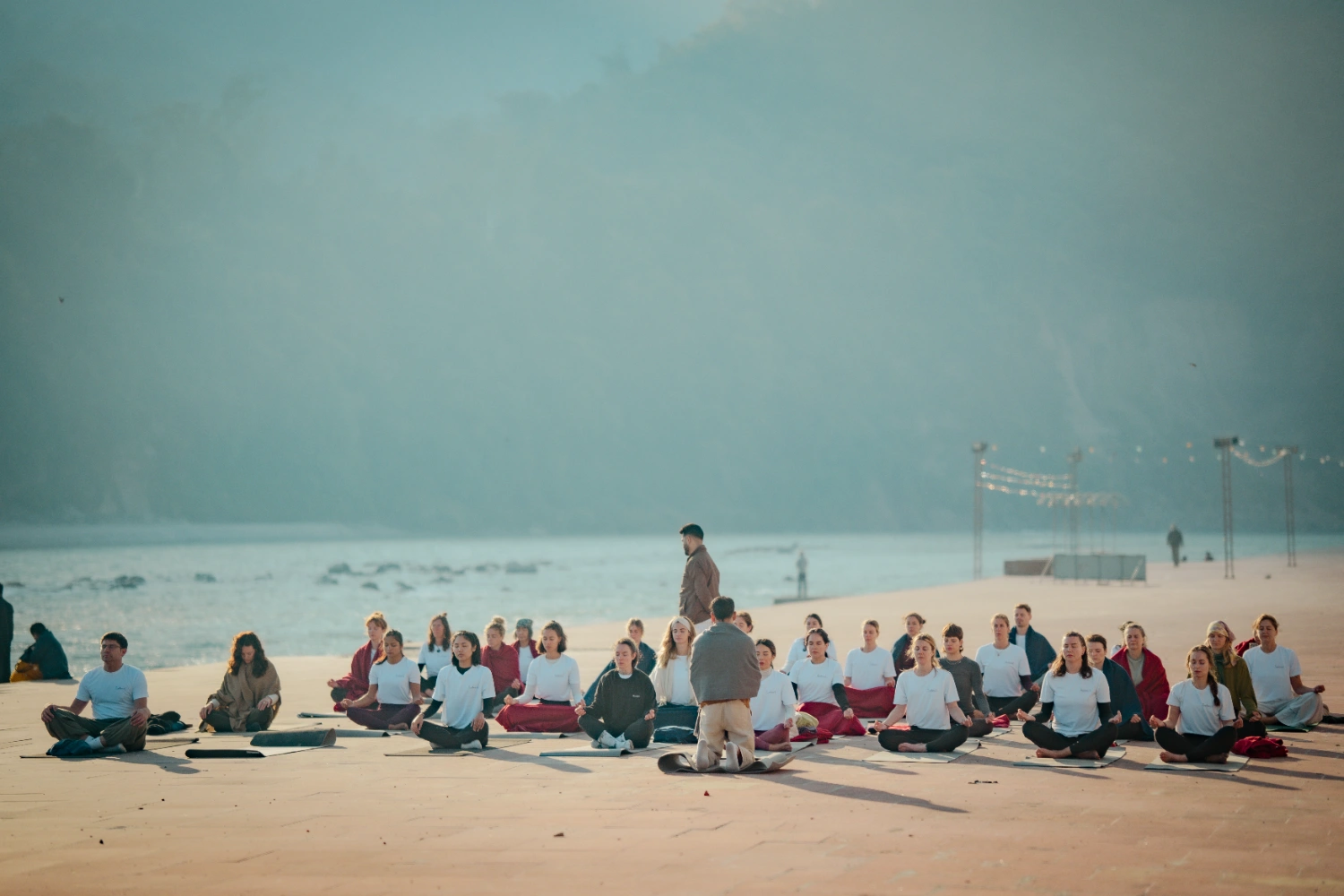
Some sessions leave the shala entirely: asana and meditation right on the ghat, with the Ganga moving past as your soundtrack.
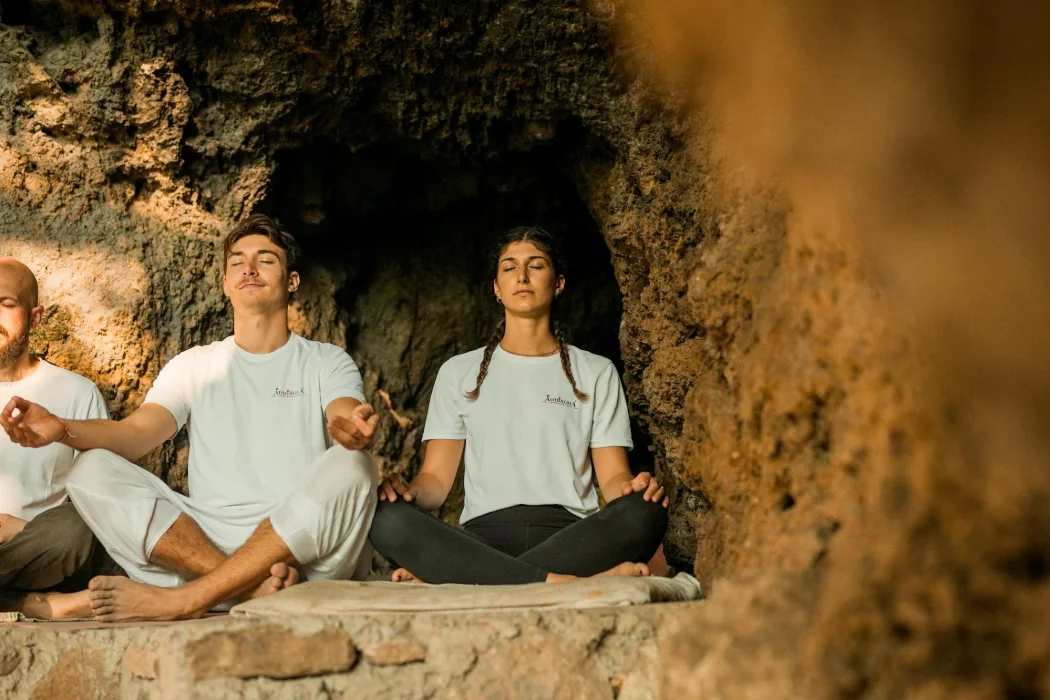
Sages have sat in these caves for centuries. Meditating inside, in the cool and the dark, is the kind of quiet that stays with you long after you leave.
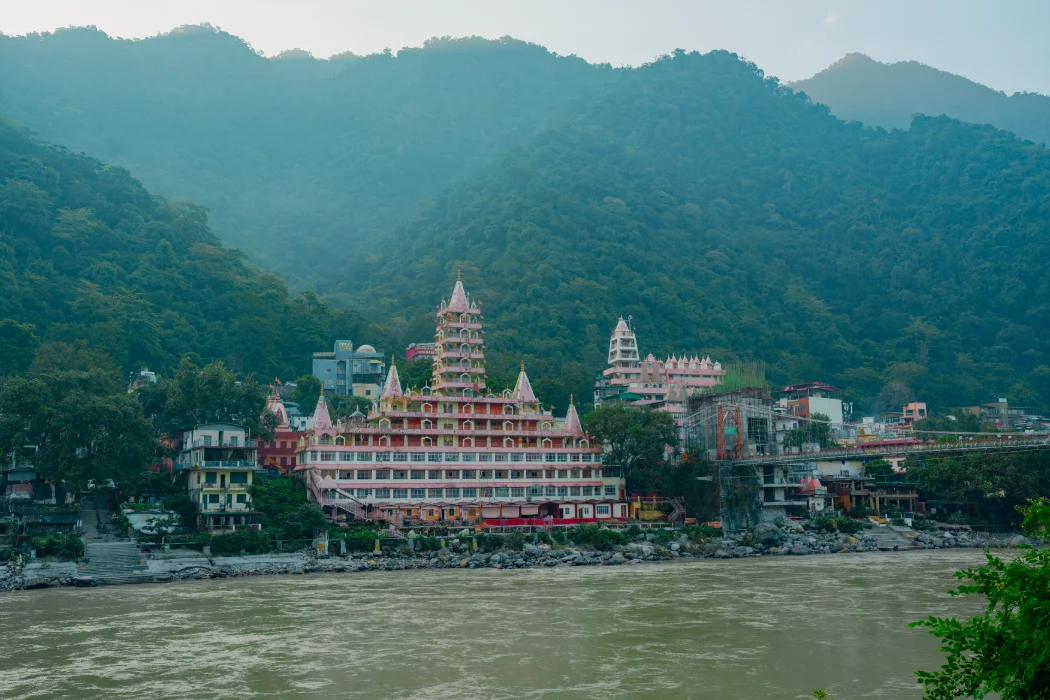
Guided visits to the temples of Rishikesh, including the thirteen storeys of Trayambakeshwar — places where the tradition you study in class has been practised without pause.
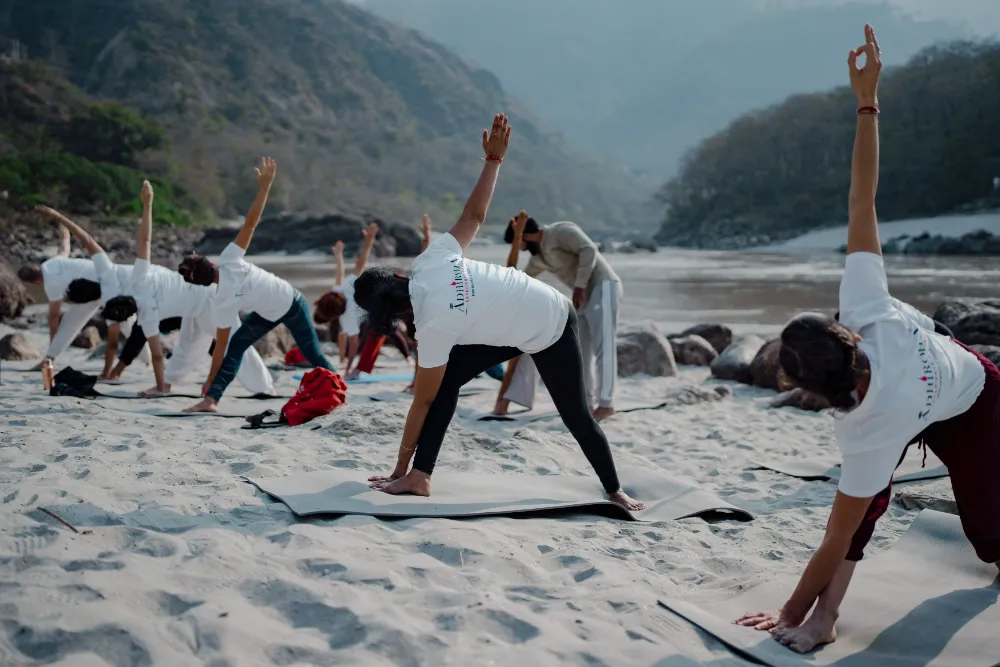
Gentle walks into the hills and slow time by the river. None of it compulsory, and all of it part of the course.
Adhiroha is a Registered Yoga School with Yoga Alliance at all three levels, and accredited by the Yoga Certification Board under the Ministry of Ayush. Finish your course and you leave with a single certificate carrying both, which is all a studio in Berlin, a gym in Melbourne or a retreat in Costa Rica needs to see. To receive it you need a minimum of 90% attendance and a genuine effort through the final assessment. Meet that and the qualification is yours for good, with no renewal fee and no expiry.
Meet the attendance requirement and you may register with Yoga Alliance as an RYT 200.
Meet the attendance requirement and you may register with Yoga Alliance as an RYT 300.
Meet the attendance requirement and you may register with Yoga Alliance as an RYT 500.
 Ministry of Ayush · Yoga Certification Board
 Verify Adhiroha on the Yoga Alliance register
Unscripted and unedited, students talking about the course in their own words, straight from the Adhiroha YouTube channel. Pick a story to play it.
 Student review · 014.5Yoga Alliance reviews
When I walked into this place, I was amazed. It is so beautiful that you feel like you are inside a dream, with all the nature around you, the plants, and the flowers.
Unlike many other schools, which sit right inside the city, this one was a little further away, and that distance turned out to be exactly what I needed.
We had different dishes every single day, so the food never got boring. The desserts were amazing, and the fresh fruit in the morning was something I still think about.
You can probably hear the water behind me. Just being here every day, you truly learn to enjoy the small things.
I think I loved the excursions most, the trips to the temple and the waterfall. They were simply beautiful.
The teachers stayed back until the last question was answered. That is what I tell people when they ask me which school to choose.
A few frames from recent batches. There are hundreds more in the yoga gallery.
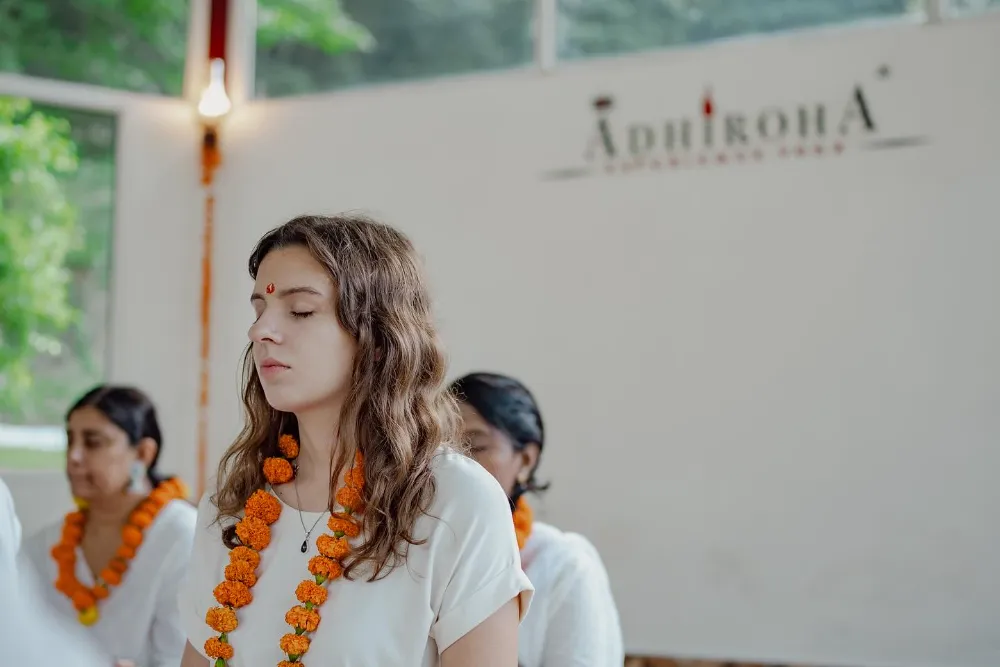
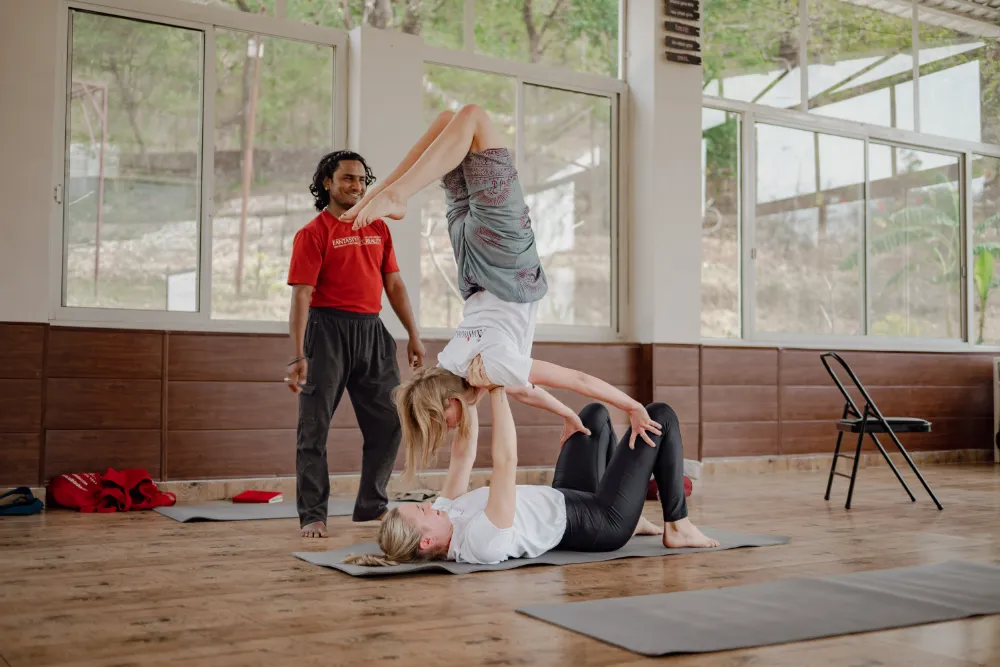

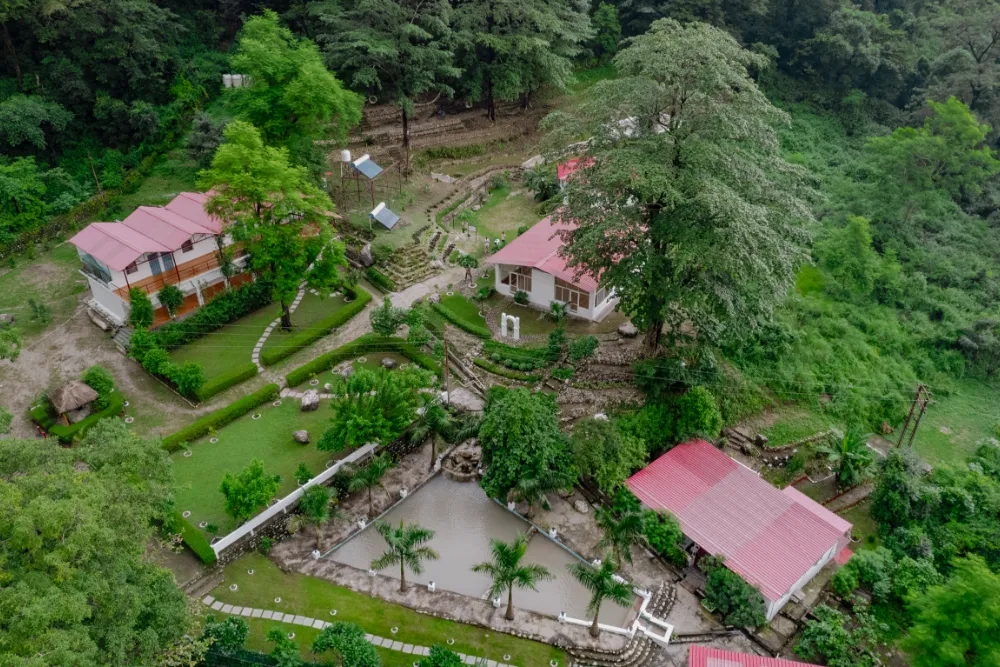
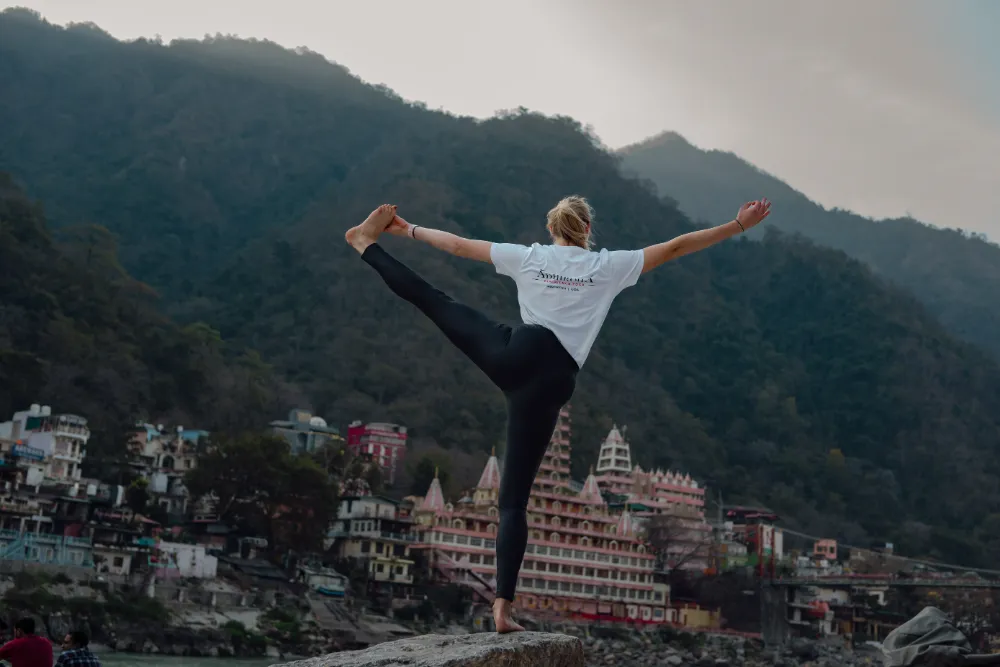
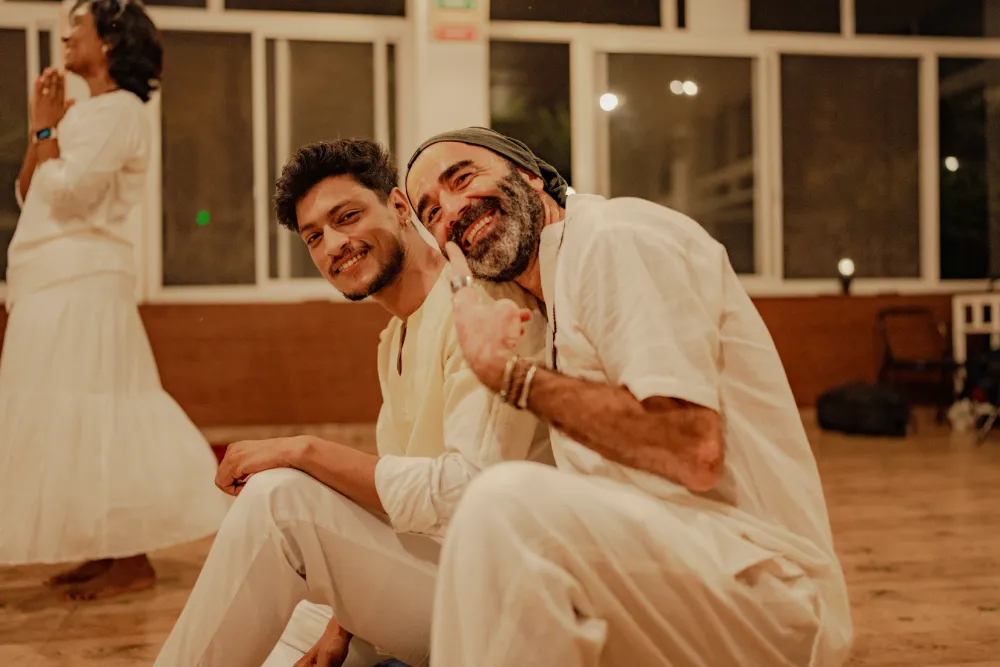
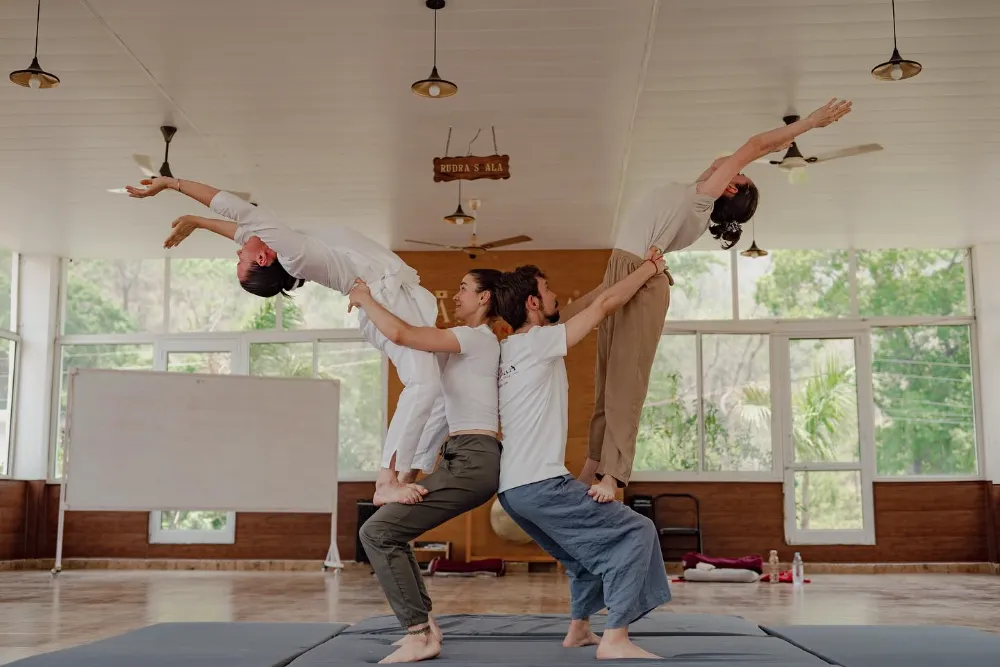
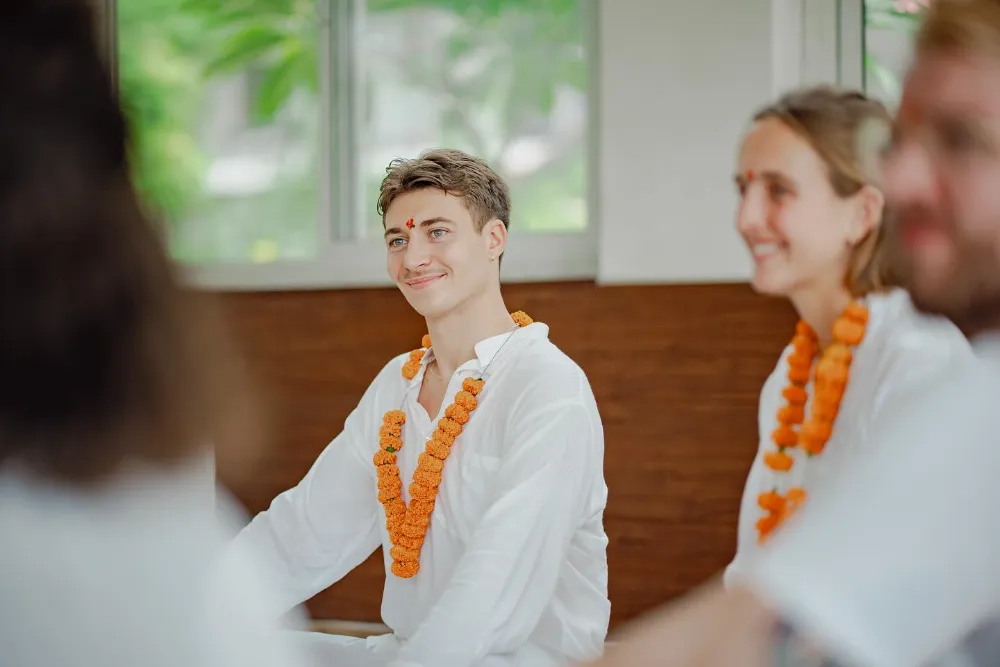
The same list applies at every level. From the moment you land, the practical worries are already handled.
We would rather say so plainly than bury it. Beyond this, what you see is what you pay.
If you have never trained before, book the 200 hour — it is the foundation everything else rests on. If you already hold a 200 hour certificate, book the 300. If you want the whole path in one journey and can give it two months, book the 500, which has no prerequisite at all.
No. What the course asks for is willingness, not flexibility or youth. Most people on any given batch are new to it, and the 200 hour assumes no prior teaching experience whatsoever.
One certificate, issued by Adhiroha, carrying both recognitions: accreditation by the Yoga Certification Board under the Ministry of Ayush, and Yoga Alliance registration at your level. It never expires.
Yes. Adhiroha is a Registered Yoga School with Yoga Alliance at all three levels — RYS 200, RYS 300 and RYS 500 — so a course completed here makes you eligible to register as an RYT at the level you trained.
You need to be eighteen or older, and there is no upper limit. Students range from their late teens well into their sixties and beyond.
Yes. A completed 200 hour training from any school qualifies you. Bring the certificate with you.
It reserves your seat, and it is always part of the total rather than an extra charge. The balance is paid on arrival, and there is nothing else to pay after that.
Every course begins on the 1st of the month, and you arrive on the 30th or 31st of the month before. There is almost always a batch coming up soon.
YTT, Yoga Teacher Training, is the course. RYT, Registered Yoga Teacher, is the professional title you can register for through Yoga Alliance once you have completed it.
Talk to us. Batches run every month, and moving to a later one is usually straightforward as long as there is a seat.
More answers on the full FAQ page, or write to us and a real person will reply.
Every course begins on the 1st of the month, and you arrive on the 30th or 31st before. If you are still deciding between levels, write to us — we will tell you honestly which one fits, even when it is the cheaper one.
This page is the overview. Each course has its own page with the full day-by-day syllabus, fees and dates.
The 24-day RYT 200 foundation, and the course most students begin with.
The advanced level for teachers who already hold a 200 hour certificate.
Both levels in a single two-month immersion, ending at the RYT 500 standard.
The founder’s letter, the accreditations, and what the school is actually like.