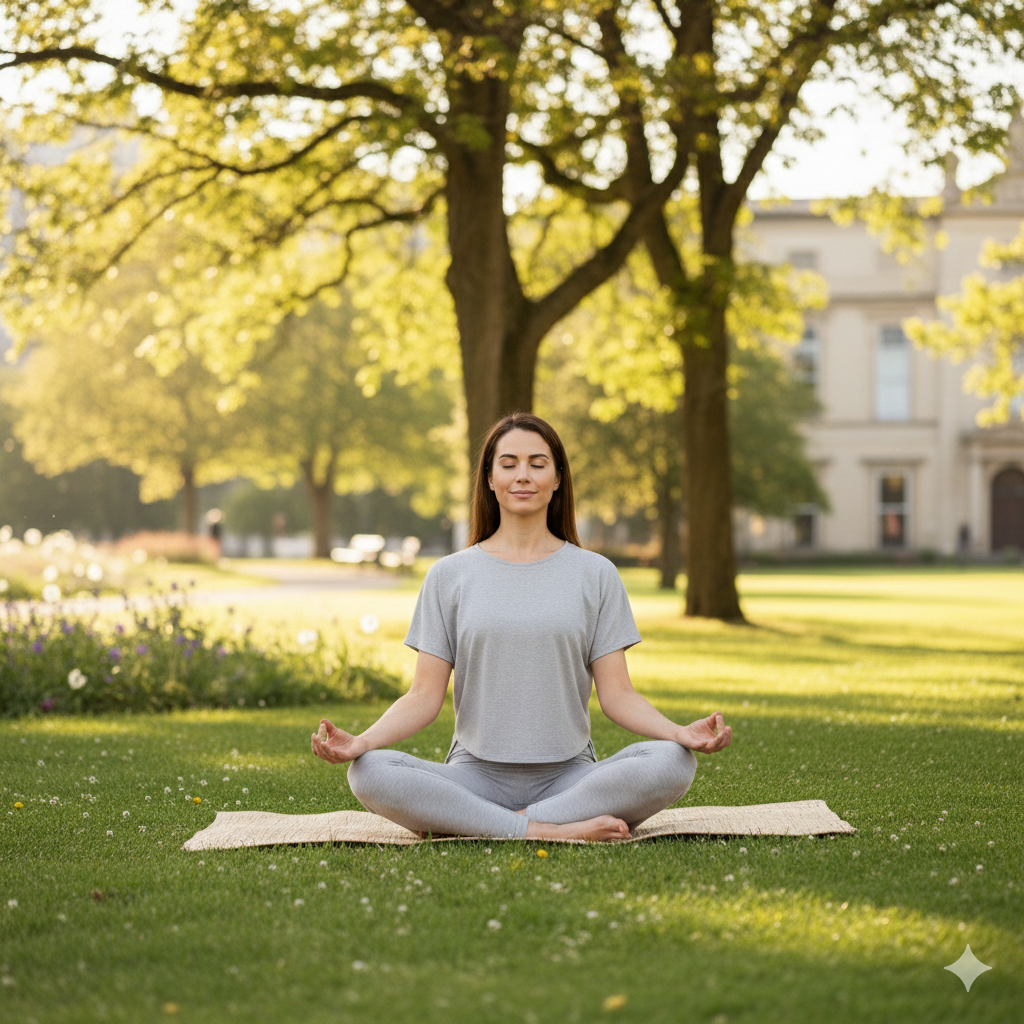

You have heard about kundalini awakening — energy surging up the spine, profound insight, genuinely life-changing transformation. Now you are curious, but also cautious, and you should be — if the terminology is new, our guide to understanding kundalini and yoga is worth reading first. Kundalini yoga is not a typical fitness class; it is ancient technology designed to awaken dormant energy at the base of the spine, energy that, activated improperly, can overwhelm an unprepared system. But here is the truth: kundalini yoga for beginners is genuinely safe when approached correctly. You do not need years of experience or exceptional flexibility — what you need is proper guidance, realistic expectations, and step-by-step practice built specifically for beginners.
01Can Beginners Safely Practice Kundalini Yoga

Yes — beginners can absolutely practise safely, and the myth that says otherwise keeps a lot of curious people from a practice perfectly suited to them. Yogi Bhajan, who brought kundalini yoga to the West in 1969, specifically adapted it for Western students with zero prior yoga experience, creating beginner-friendly kriyas designed to introduce activation gently, without overwhelming the nervous system. Dr Sat Bir Singh Khalsa at Harvard Medical School confirms that “properly taught kundalini yoga is safe for beginners. The key is appropriate intensity, qualified instruction, and gradual progression,” and his research in the International Journal of Yoga Therapy documents successful outcomes for beginners with zero adverse effects when safety protocols are followed.
What actually makes it safe for beginners is fairly simple: predetermined sequences mean you follow exact instruction rather than improvising, most kriyas offer modification, beginner sessions typically run eleven to thirty-one minutes, and clear contraindications protect anyone more vulnerable. Think of it like strength training — nobody starts with a two-hundred-pound deadlift, and nobody should start kundalini with its most intense kriyas either. The Hatha Yoga Pradipika (chapter 2, verse 15) puts this beautifully: “Just as lions, elephants and tigers are controlled by and by, so the breath is controlled by slow degrees.”
Certain conditions do call for waiting — an active mental health crisis, uncontrolled epilepsy, recent surgery, specific concerns in pregnancy, or active substance abuse. Address these with the right professional first, then return to kundalini from a stable foundation. For anyone else, healthy and simply curious about consciousness, it is genuinely accessible and safe.
02First Steps Before Attempting Any Kriya
Do not rush into complex kriyas immediately. A handful of foundational steps prepare both body and mind for practice that is safe as well as effective. Start with basic breath awareness: sit comfortably with a straight spine, close your eyes, and simply observe your natural breath for five to eleven minutes daily for a week, noticing its rhythm without trying to change it. Pairing this with a short morning meditation creates an ideal foundation.
From there, learn long deep breathing — kundalini’s foundational breath, used in most beginner kriyas: inhale slowly through the nose, filling the lower belly, then the mid-chest, then the upper chest, over five to eight seconds; exhale in reverse order over the same count, drawing the navel back toward the spine. Practise this for three to five minutes daily until it feels natural.
Every kundalini practice also begins with ‘tuning in’ — chanting the Adi Mantra, Ong Namo Guru Dev Namo (“I bow to the divine wisdom, I bow to the teacher within”), sitting in easy pose with hands at the heart centre, eyes closed, chanting three times on one breath if possible. This is not religious decoration; it is energetic preparation, and it matters. Beyond that, a simple dedicated practice space — a quiet corner, a mat or cushion, kept clean and clutter-free — signals your nervous system that this is where transformation happens, and a realistic time commitment of eleven to twenty minutes daily across a traditional forty-day sadhana period will take you further than an unsustainable ninety-minute plan you abandon within a week.
03Five Beginner-Friendly Exercises

Start with one of these, practise it for forty days, then add another rather than attempting all five at once.
- Ego Eradicator (3 minutes) — sit cross-legged, raise the arms to sixty-degree angles forming a ‘V’ overhead, curl the fingers into fists with thumbs pointing up, and begin long deep breathing or Breath of Fire, keeping the arms raised despite the burning sensation. Finish with a deep inhale, thumbs together overhead, then exhale and relax. It builds mental clarity, raises energy, and breaks negative thought patterns.
- Spinal Flexes (1–3 minutes) — hands on the knees, inhale to flex the spine forward as the chest lifts, exhale to flex it backward, rounding. Start with twenty-six repetitions and build gradually toward one hundred and eight, for spinal flexibility, energy circulation and chakra activation.
- Breath of Fire (1–3 minutes) — sit with a straight spine and pump the navel point rapidly inward on each sharp exhale through the nose, letting the inhale happen automatically. Start with thirty seconds and build to three minutes over several weeks; avoid this one during menstruation, pregnancy, or with uncontrolled hypertension.
- Alternate Nostril Breathing (3–5 minutes) — close the right nostril with the right thumb, inhale left for a count of four, close both and hold for four, open the right and exhale for four, then reverse. Five to ten rounds brings genuine mental balance and anxiety relief.
- Sa Ta Na Ma Meditation (11 minutes) — hands on the knees in Gyan Mudra, thumb to index finger, chanting ‘Sa Ta Na Ma’ while touching the thumb to each finger in sequence: five minutes aloud, one minute whispered, five minutes silent. It supports mental clarity, memory and emotional balance.
For twenty or more further exercises with complete instruction, see our guide to essential kundalini practices and kriyas.
04Common Mistakes Beginners Should Avoid
Practising too intensely, too quickly, is the most common one — kundalini works through accumulation, not force, so if a kriya suggests three minutes, do not stretch it to ten on day one; the nervous system needs gradual adaptation. Skipping the tuning-in mantra because it feels unfamiliar or you’re in a hurry is another — it is not optional decoration, it creates real energetic protection and signals the nervous system into a receptive state.
Forgetting to ground after practice is a genuinely common one too: finishing an intense session and immediately returning to normal activity while still in an altered state can create spaciness or anxiety. Always close with five to eleven minutes lying flat, something grounding to eat afterward — an apple, some nuts, warm soup — a few minutes barefoot on the earth if possible, and thirty minutes free of intense mental work.
Comparing your own experience to someone else’s is another trap — symptoms vary dramatically between people, and neither intense heat nor subtle warmth is ‘more advanced’ than the other; track your own experience in a journal instead. Practising at the wrong time matters too: avoid Breath of Fire and inversion during menstruation, skip vigorous practice during illness, wait two to three hours after a heavy meal, and keep evening practice calming rather than energising, since a stimulating kriya before bed reliably causes insomnia. And finally, self-teaching entirely from videos and books has real limits — nothing there can observe your technique, correct a dangerous error, or judge whether you are actually ready to progress.
05Finding Genuinely Qualified Teachers
Not every yoga teacher understands kundalini specifically. Qualified kundalini teachers typically complete Level 1 training of two hundred or more hours, Level 2 of three hundred or more, or Level 3 of a thousand or more, through the Kundalini Research Institute or an equivalent programme — a more specialised path than a general 200-hour Yoga Alliance certification. Look for genuine embodiment — calm presence, compassion, clear communication — a minimum of five years of daily personal practice, and a real emphasis on safety, with contraindications and modifications clearly explained. Adhiroha’s own yoga teacher training programmes are built around exactly this standard.
Red flags worth taking seriously: a teacher promising rapid enlightenment, pushing students past their stated capacity, forming inappropriate relationships, demanding excessive money for ‘secret’ teaching, or discouraging genuine questions.
Many studios offering Ashtanga open practice or a Yin yoga class also provide kundalini instruction, so it is worth asking directly rather than assuming a studio doesn’t offer it.
06A Simple Daily Practice

This twenty-minute sequence offers a complete, balanced practice — commit to it for forty consecutive days. Minutes one to two: tune in, chanting the Adi Mantra three times. Minutes three to five: Spinal Flexes, twenty-six to fifty-four repetitions. Minutes six to eight: Ego Eradicator, arms at sixty degrees with long deep breathing. Minutes nine to thirteen: Alternate Nostril Breathing, five to ten rounds. Minutes fourteen to nineteen: Sa Ta Na Ma Meditation, three minutes aloud, three whispered. Minute twenty: close by inhaling, stretching, exhaling, and bowing the head in gratitude. Afterward, lie flat for three to five minutes, journal briefly, and eat something grounding.
After forty days, continue the same sequence for another forty to ninety, or begin exploring kriyas built for specific goals. If teaching interests you, consider 300-hour or 500-hour formal study, and for a more complete wellness approach, many students combine kundalini with Ayurveda courses and modern Ayurvedic wellness consultations alongside it.
07Why Is Kundalini Yoga Sometimes Called Dangerous
Addressing this honestly, without fear-mongering: kundalini yoga is not inherently dangerous, but it is genuinely powerful — like electricity, not dangerous when used properly, but requiring real respect. The ‘dangerous’ reputation traces mostly to unqualified teachers with minimal training, forced awakening attempted beyond someone’s actual capacity, pre-existing mental health vulnerability without therapeutic support, and cultural misappropriation that strips away the safety elements the tradition originally built in.
The real risks are worth naming plainly: physically, hyperventilation from poor technique, dizziness from excessive breath retention, or muscle strain from overexertion; psychologically, amplified anxiety, traumatic memory surfacing without support, or dissociation in someone already vulnerable; energetically, ungrounded activation creating spaciness, premature chakra opening, or simple overwhelm from too much too fast. The safety protocol in response is straightforward: work with a certified teacher, start with beginner practice only, respect recommended durations, always ground afterward, keep therapy in place if you need it, and stop entirely if severe symptoms appear. The Kularnava Tantra (chapter 13, verse 106) puts it simply: “Dangerous practices should be learned from the guru directly and practiced with caution.” For the fuller picture of both benefit and risk, see our article on kundalini energy healing effects.
08Is Kundalini Awakening Rare
Honestly, complete awakening — a full rising through all seven chakras producing lasting realisation — is genuinely rare. Most practitioners experience partial activation instead: energy stirring in the lower chakras, temporary altered states, progressive shifts unfolding over years. This is entirely normal, and still profoundly transformative in its own right.
A realistic timeline for beginners: weeks one to four bring subtle energy shift, better sleep, and mood change, nothing dramatic; months two to three bring increased body awareness and occasional warmth during practice; months four to six often bring noticeable life change — better relationships, career clarity, creative breakthrough; years one to two bring a genuinely different stress response and consistent activation during practice; and three years or more can bring deep spiritual development and occasional spontaneous activation outside of practice altogether.
“The more you chase dramatic awakening, the less likely it is to occur. Kundalini responds to surrender, not grasping.”
The Yoga Vasistha teaches that “the Supreme State is attained by those free from desire, not by those who long for it.” Practise consistently, trust the process, and let small daily shifts accumulate into something genuinely lasting. For the complete progression, see our guide to complete kundalini awakening stages, and to see how this practice compares with other styles, our piece on kundalini versus other yoga styles can help you find your own path.
The heart of it
- Kundalini yoga is genuinely safe for complete beginners when taught properly and paced gradually.
- Five foundational exercises — Ego Eradicator, Spinal Flexes, Breath of Fire, Alternate Nostril Breathing and Sa Ta Na Ma — build a full practice.
- Grounding after every session matters as much as the practice itself.
- Complete awakening is rare; partial, gradual activation is normal and still transformative.
Begin safely, guided by teachers trained in the full depth of this tradition.
Reserve Your Seat