
The final day of a teacher training course is quite unusual. For a whole month your life had a certain routine—the bell ringing before sunrise, always sitting on the same mat in the same corner of the shala, the same faces appearing at breakfast. Then the certificates are distributed, everyone hugs, and by the following afternoon the group has moved off to airports and buses. You are now a teacher, at least on paper. Yet at that moment most people don’t feel ready to start teaching and instead think that they need a bit more time as a student. That is often when Bali comes up.
A guest post from Ariel, founder of Firefly Retreat, a small yoga retreat in the rice fields outside Ubud, Bali.
01Why Bali
It’s a reasonable question as to why. Bali is not India and has never regarded itself as the homeland of yoga. What it does have, however, is something that people who have trained in Rishikesh tend to pick up on at once: a situation in which the spiritual life is not separated from everyday life. Each morning women walk through the streets laying small woven trays containing flowers, rice and incense on doorsteps, on shrines, and on the ground in front of shops. The temples are swept, decorated and put to use every day. Ceremonies are held which close off the roads and no one objects. You don’t have to look for devotion in Bali; it is there even when you’re on your way to buy a cup of coffee.
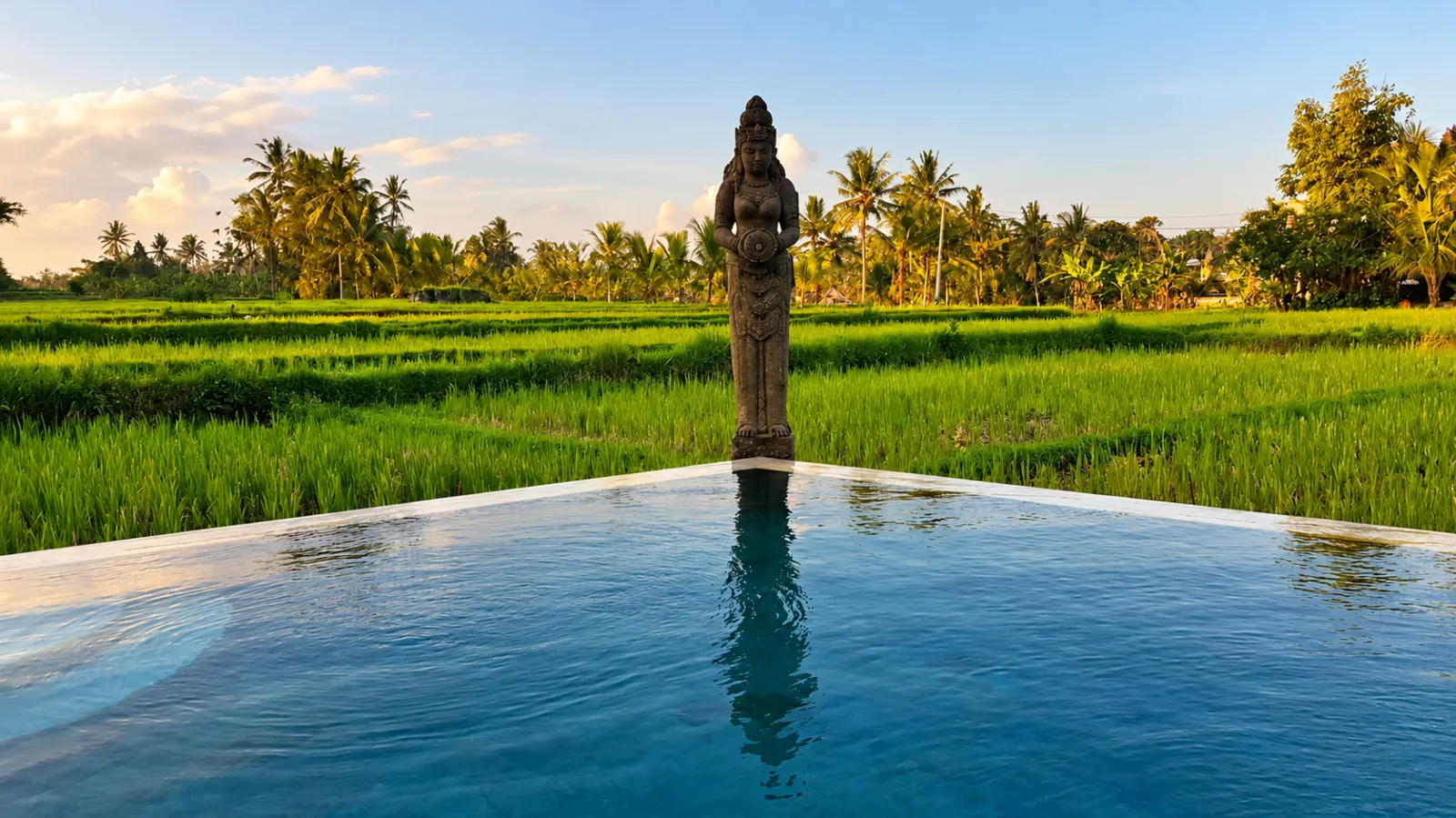
Most yogis find themselves in Ubud, in the central part of the island, rather than in the southern surfing towns and nightclubs. Ubud is cooler, more green, and slower. The area is surrounded by rice terraces and river valleys, and the town is small enough to explore on foot. There are large, well-known studios which offer classes from dawn until evening, and there are also small shalas located in family homes where a teacher gives a class to six people. Vegetarian food can be found everywhere and is cheap. It is easy to spend a week practising every day without spending a great deal of money.
02Being a student again
It is surprising to many new teachers to find how much they miss simply receiving instruction. In fact, each class during a training serves as a lesson in the art of teaching; you observe the cues, the sequence of events, and the way adjustments are made, while at the same time part of your mind stays busy taking notes. When the class is over, there is real relief in walking into a class with nothing to analyse and you can just get on with practising.
A retreat which lasts for a week is a good method of recapturing that feeling. There is still a daily routine, typically involving yoga in the morning before the heat, a long breakfast with the group, an outing or a free afternoon, and in the evening something more gentle such as yin, meditation or breathwork. However, no one is assessing you and there is no need for you to show off a pose. You can skip a session to go to sleep, and a great many people do on the second or third day when the tiredness from the training finally catches up with them. For a large number of new teachers, it is during this week that what they have learned actually begins to settle in.
Bali also provides the opportunity to take part in its culture rather than merely observing it. If you stay in a particular area, you could learn how to prepare the daily offerings with a local family, cook Balinese food, or take part in a water purification ritual at one of the temple springs located north of Ubud, where people stand beneath a row of fountains and offer prayers at each one. For a person who has been reading the Gita and the Yoga Sutras for weeks, it can be a quiet source of emotional impact to see a living Hindu tradition being practised so openly and in such a different way from that in India.
03What it costs
Bali can be just as expensive or just as simple as you like; in Ubud there are wellness resorts which charge several thousand dollars for a week and the yoga is included as one of the various treatments on the spa menu. There are also small retreats run by people who have lived there for years and who offer a low price with an atmosphere more like that of a house shared among friends than a hotel.
We run one of those places. Firefly Retreat is a small yoga retreat in Bali located in the rice fields a few minutes outside Ubud. A full week costs €350 if you share a room or €482 if you have a private room, and this includes the room, vegetarian meals, daily yoga and the cultural visits. We have been running the retreat for over thirteen years and most of our guests come on their own, all of them arriving on the same day so that the group spends the entire week together from the first evening.
No matter where you go, you should find out what is actually covered, since with airport pickup, meals and organised visits cheap prices cease to be cheap.
04A few things worth knowing
The dry season lasts approximately from April to October and is therefore the busiest period. Between November and March it rains in the afternoons, typically heavily and for about an hour or two, after which the sky clears. Many of the yogis favour this time of year since the rice fields are at their most vibrant green, there are fewer tourists and the prices decrease.
Take lightweight clothes that dry quickly since no clothes dry out in Ubud during the wet season; a sarong and a sash are required for visits to the temples and as you’ll have to take off your shoes so frequently, slip-on sandals are more convenient. For people coming from India, the food will seem familiar in certain respects but will also be quite different in other ways; rice forms the basis of all meals, but the spices are milder and coconut, palm sugar and fresh chilli sambal are used in large amounts.
Allow yourself some time; if you’re able to remain for more than a week, then by all means do so. Following an intense training session, the body needs a certain amount of time to keep up with all that the mind has absorbed. Bali is a very good place in which to do this.
Bali comes after the training. If you are still choosing where to do the training itself, come and train where the practice has always lived.
Explore the 200 Hour Training