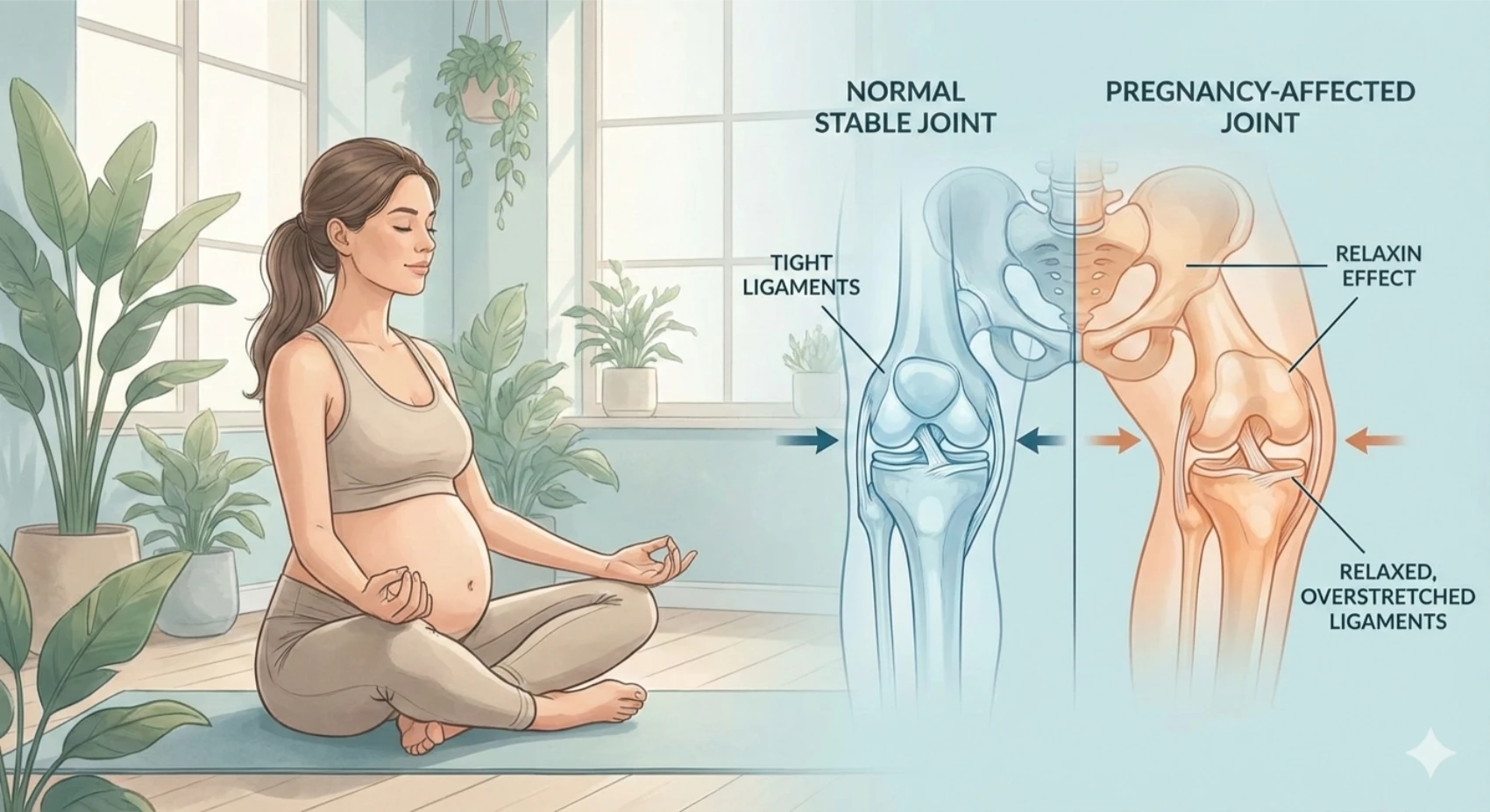

Pregnancy makes the body deceptively flexible — and that flexibility is, in a real sense, exactly the danger rather than the benefit it appears to be. Relaxin loosens ligament throughout the entire system, not only through the pelvis, and every joint from ankle to neck becomes measurably less stable as a result. This is the complete safety guide: what joint laxity actually means for practice, how to prevent a fall as balance shifts, which poses genuinely need to be dropped rather than merely modified, the warning signs that call for stopping immediately, and exactly when a doctor's clearance is not optional.
01Joint Laxity and the Overstretching Risk
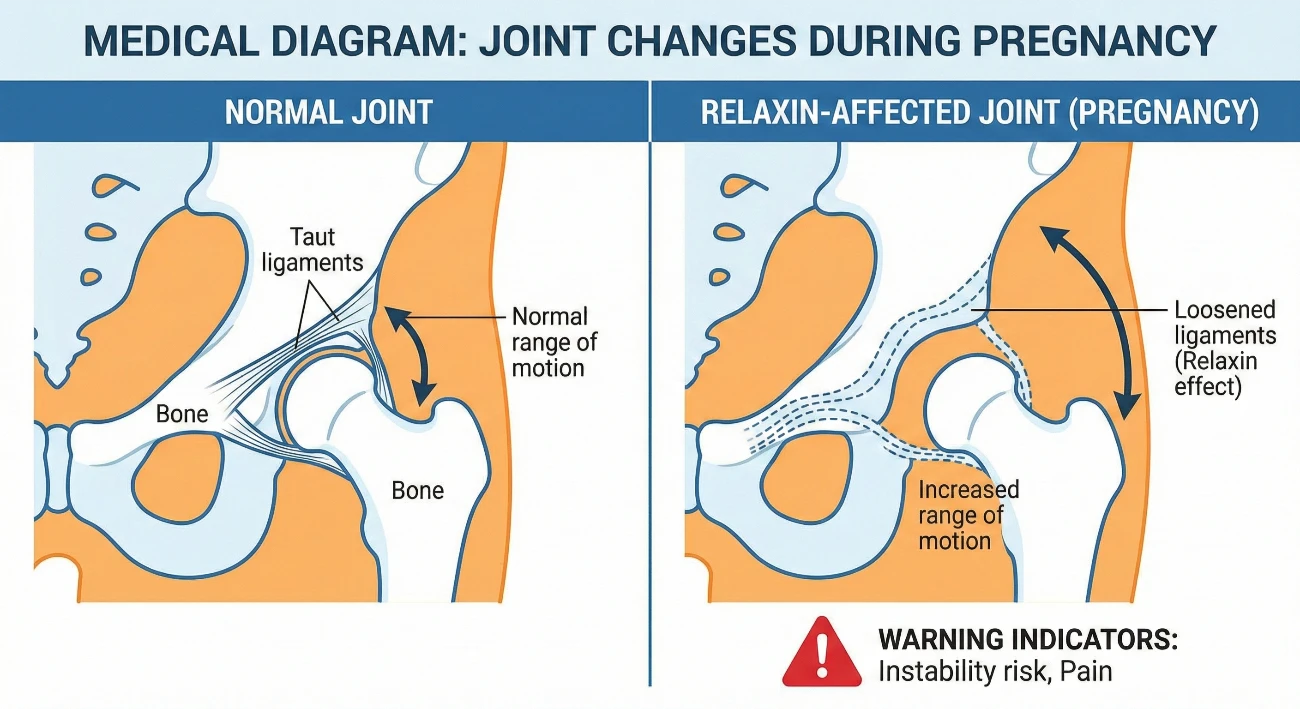
The new bendiness of pregnancy is not true flexibility — it is joint instability wearing the appearance of suppleness, and stretching deeply into that artificial range genuinely damages a ligament that will not recover easily after delivery. Relaxin levels rise by roughly three hundred percent during pregnancy, and that prolonged exposure means overstretching damage compounds across months rather than resolving on its own, sometimes creating a chronic joint problem that persists years after birth.
The knee becomes particularly vulnerable — hyperextension in a standing pose, locking the knee back, strains the joint capsule directly and can leave knee pain lingering well past pregnancy’s end. That surprisingly deep forward fold suddenly achievable in the second trimester feels wonderful in the moment, but it is setting up a chronic sacroiliac joint pain for the postpartum period, since the ligament is stretching beyond its natural range rather than the muscle simply lengthening safely. Dr Diane Lee, physiotherapist and pelvic health specialist, notes that pregnancy-related joint laxity takes four to six months postpartum to normalise, longer still if breastfeeding, and damage done during pregnancy measurably affects that recovery window.
Protecting against overstretching comes down to a few consistent habits: working at roughly seventy percent of maximum range rather than the full range technically available that day; holding a pose for three to five breaths at most rather than lingering; actively engaging the muscle throughout rather than passively sinking into the stretch, since the muscle should support the joint rather than releasing completely around it; and using a prop — block, strap, wall — to stop well before the end range of motion, which is intelligent safety rather than a crutch. The pubic symphysis, the cartilage joining the pubic bones, can separate excessively from a wide-legged pose, so keeping the legs no wider than hip-distance in most standing positions is worth treating as a hard rule rather than a suggestion. For anyone experiencing genuine joint discomfort, a broader look at yoga for back pain can offer relief strategy, though pregnancy-specific guidance always takes priority over general advice.
02Balance and Fall Prevention
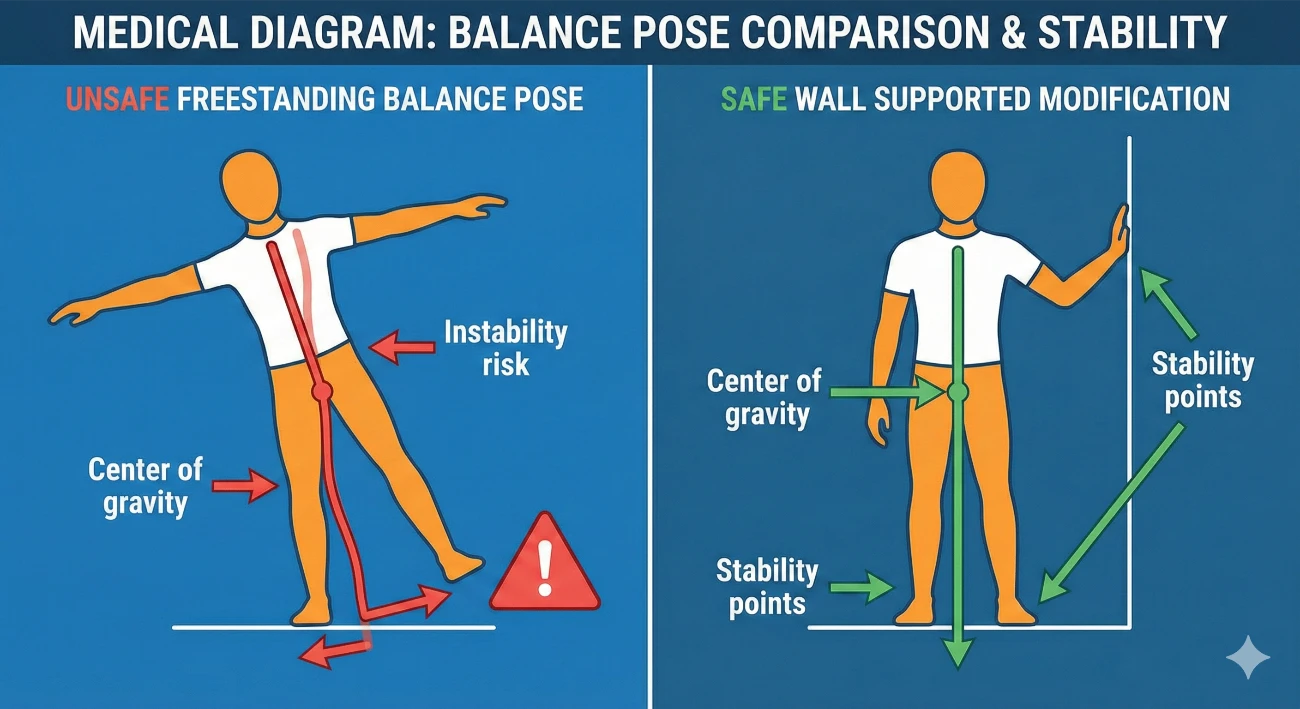
The changing body creates a genuine fall risk deserving serious attention, not a passing worry. The centre of gravity shifts forward progressively as the belly grows, changing balance in a way the brain has simply not learned to compensate for yet. Research in the Journal of Pregnancy found that falls affect twenty-seven percent of pregnant women, and while most falls do not harm the baby directly, they can cause placental abruption, preterm labour, or a maternal injury serious enough to matter.
Balance poses require real, complete modification through pregnancy — that Tree Pose held easily before now needs wall support, full stop, no exception for a good day. Proprioception, the body’s awareness of its own position in space, becomes measurably less reliable, since the same hormonal change loosening the joint also affects the sensory receptor that helps maintain balance in the first place.
Preventing a fall comes down to a consistent set of habits: a wall touched by shoulder or hand for every balance pose, treated as essential practice rather than an optional aid; a wider stance, feet hip-distance or beyond, for every standing pose, since a narrow stance increases fall risk dramatically; slow, deliberate transitions rather than quick ones, especially moving from floor to standing; a hand kept near the floor in a pose like Triangle, offering instant support at the first sign of a wobble; and eyes kept open through every standing pose, since pregnancy is not the moment to remove visual input through a closed-eye balance practice. Dr Raul Artal, past chair of ACOG’s Committee on Obstetric Practice, emphasises that fall prevention should be the primary consideration in prenatal exercise, full stop — flooring matters considerably too, with practice kept to a non-slip surface and bare feet or proper yoga shoes rather than socks, which reduce traction exactly when it matters most.
03Poses and Movements to Avoid
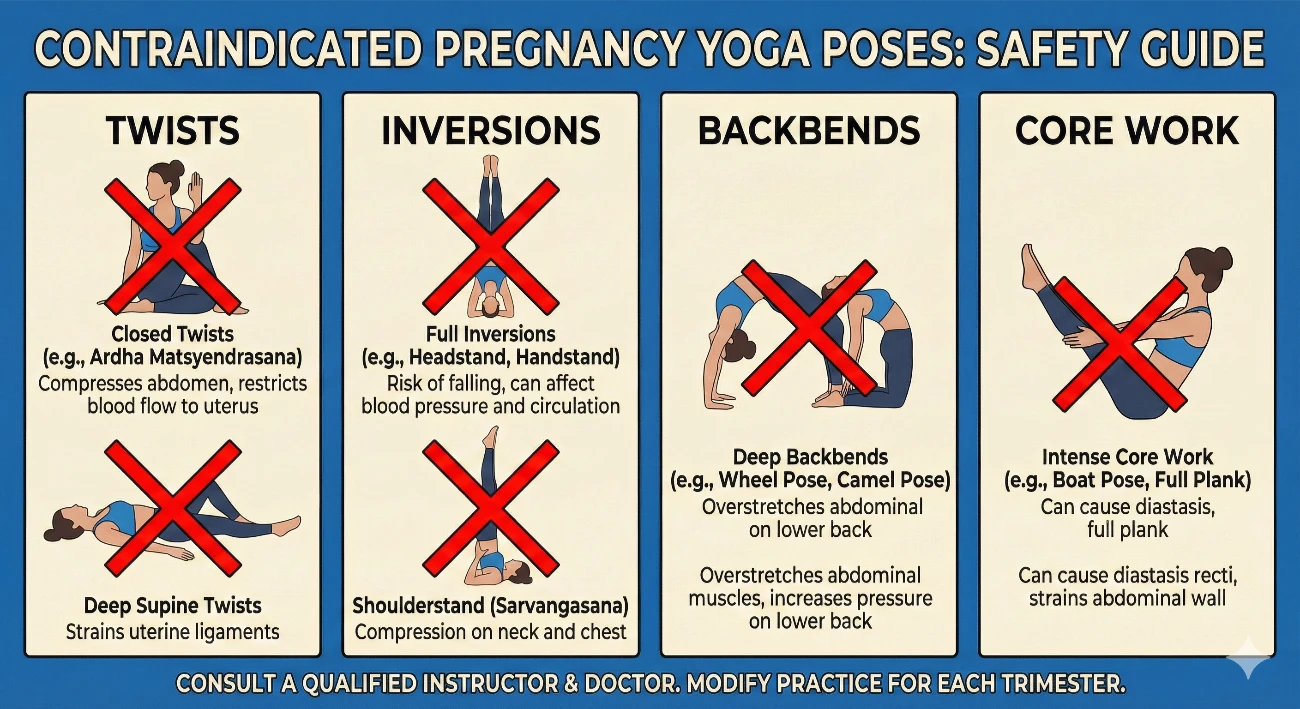
Certain poses carry a risk that outweighs any real benefit during pregnancy, and understanding exactly why helps make an intelligent decision when practising independently rather than following a rule blindly.
A deep twist should be avoided completely — a closed twist compresses the uterus directly, and even an open, gentle twist belongs only to early pregnancy; by the second trimester, all twisting is worth eliminating entirely. Lying flat on the back should stop after sixteen to twenty weeks, since the supine position allows the growing uterus to compress the vena cava, reducing blood return to the heart and, with it, blood flow to both mother and baby together. Intense core work — Boat Pose, a full plank hold, chaturanga, a crunch — creates intra-abdominal pressure that worsens diastasis recti, the natural separation of the abdominal muscle pregnancy already produces on its own; forcing an intense contraction through that separation interferes directly with a process the body is trying to manage. A full inversion — headstand, shoulder stand, forearm stand — risks a fall and creates an unusual blood-pressure change, and stopping immediately upon confirming pregnancy is the standard recommendation rather than a cautious overreaction. A deep backbend — full Wheel, Camel, a deep Cobra — should be avoided or heavily modified, since the abdominal stretch involved can stress the linea alba directly. Hot yoga of any kind, Bikram or a heated vinyasa above roughly twenty-seven degrees Celsius, is avoided entirely, given the genuine risk overheating carries for fetal development. And intense pranayama — breath retention, rapid breathing such as kapalabhati or bhastrika — should be modified or avoided, since both reduce oxygen supply to the baby without any offsetting benefit. Research in the International Journal of Yoga Therapy found that women who avoided contraindicated poses through pregnancy experienced fifty percent fewer musculoskeletal complications postpartum than those who did not.
04Warning Signs During Practice
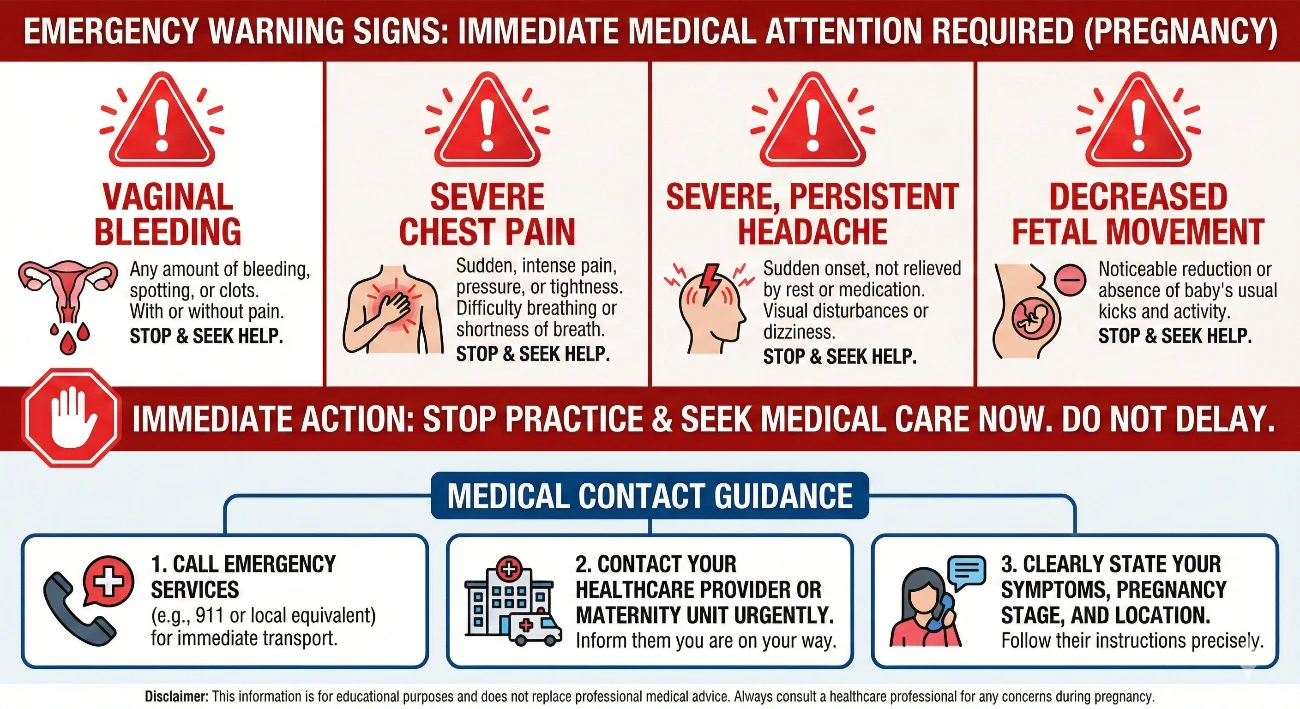
The body sends a fairly clear signal when something is genuinely wrong, and learning to recognise it protects both mother and baby rather than being dismissed as overreaction.
Practice should stop immediately, with medical care sought right away, for any vaginal bleeding or spotting, severe or persistent cramping or a regular contraction before thirty-seven weeks, a fluid leakage, a severe headache paired with a vision change (which can indicate preeclampsia), chest pain or heart palpitation, severe shortness of breath, or decreased fetal movement. A somewhat lesser but still real set of signals — dizziness or lightheadedness, persistent nausea during practice, an unusual pain through the abdomen, pelvis or back — call for stopping and resting first, then assessing whether the symptom continues before deciding whether to resume. Midwife Ina May Gaskin notes that women who learn to genuinely trust their body’s signal during pregnancy tend toward better birth outcomes overall — listening carefully here is not overthinking, it is exactly the right level of vigilance for the situation.
05When Medical Clearance Is Required
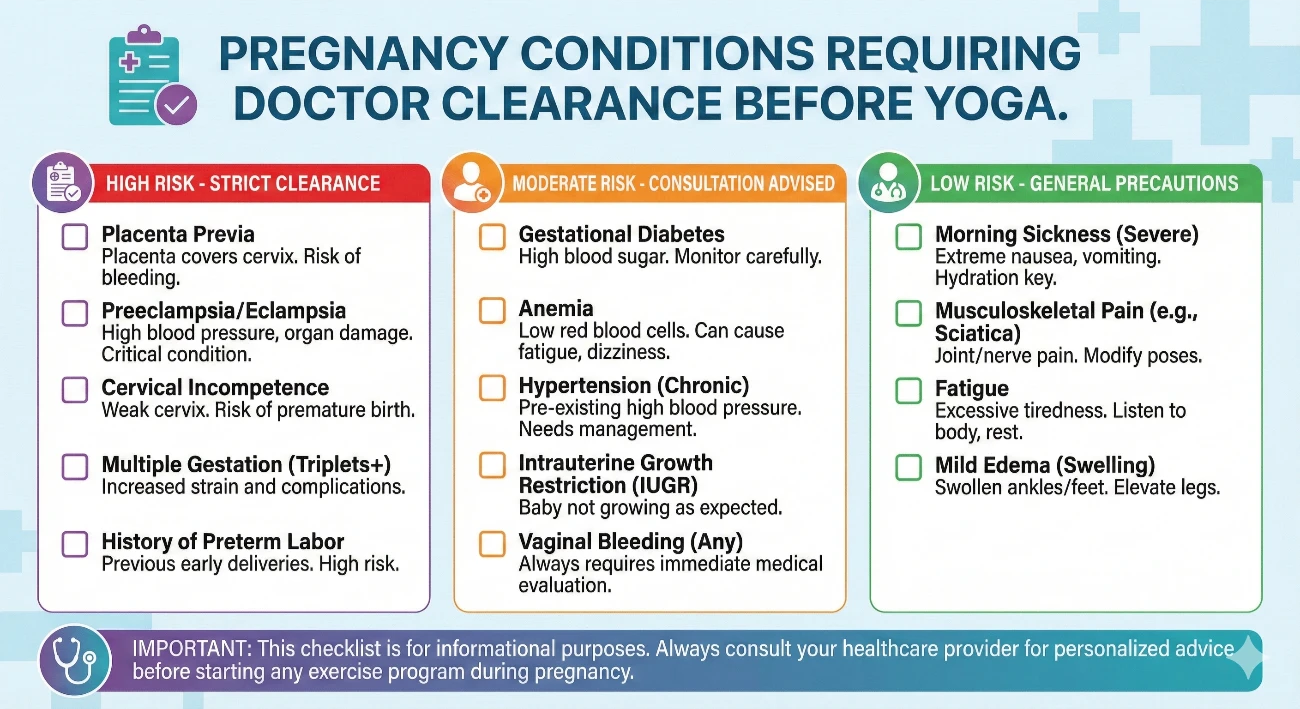
Certain situations call for a healthcare provider's explicit approval before beginning or continuing yoga at all — yoga should never be assumed automatically safe for a given pregnancy without that check.
Clearance should come first for placenta previa, a history of preterm labour, a multiple pregnancy such as twins or triplets, preeclampsia or pregnancy-induced hypertension, an incompetent cervix, persistent bleeding, or severe anaemia. Medical clearance is also not a one-time permission slip — pregnancy changes week by week, and a complication can develop at any point along the way; even starting with clearance, a new symptom such as gestational diabetes or a change in cervical length calls for re-consultation rather than assuming the earlier approval still applies.
Be specific with a healthcare provider rather than asking generally. “Can I exercise?” invites a vague answer; “can I practise prenatal yoga, specifically this kind of sequence?” gets a genuinely useful one instead.
“The new bendiness of pregnancy is not true flexibility. It is joint instability wearing the appearance of suppleness — and it deserves exactly that much caution.”
The heart of it
- Relaxin loosens every joint, not just the pelvis, making a genuinely deep stretch a real risk rather than a sign of progress.
- Every balance pose needs wall support through pregnancy, without exception for a particularly good day.
- A deep twist, full inversion, intense core work and hot yoga are avoided outright, not merely modified.
- Bleeding, severe headache with vision change, chest pain or decreased fetal movement call for immediate medical attention.
Practise pregnancy yoga safely, guided by experienced prenatal teachers.
Reserve Your Seat