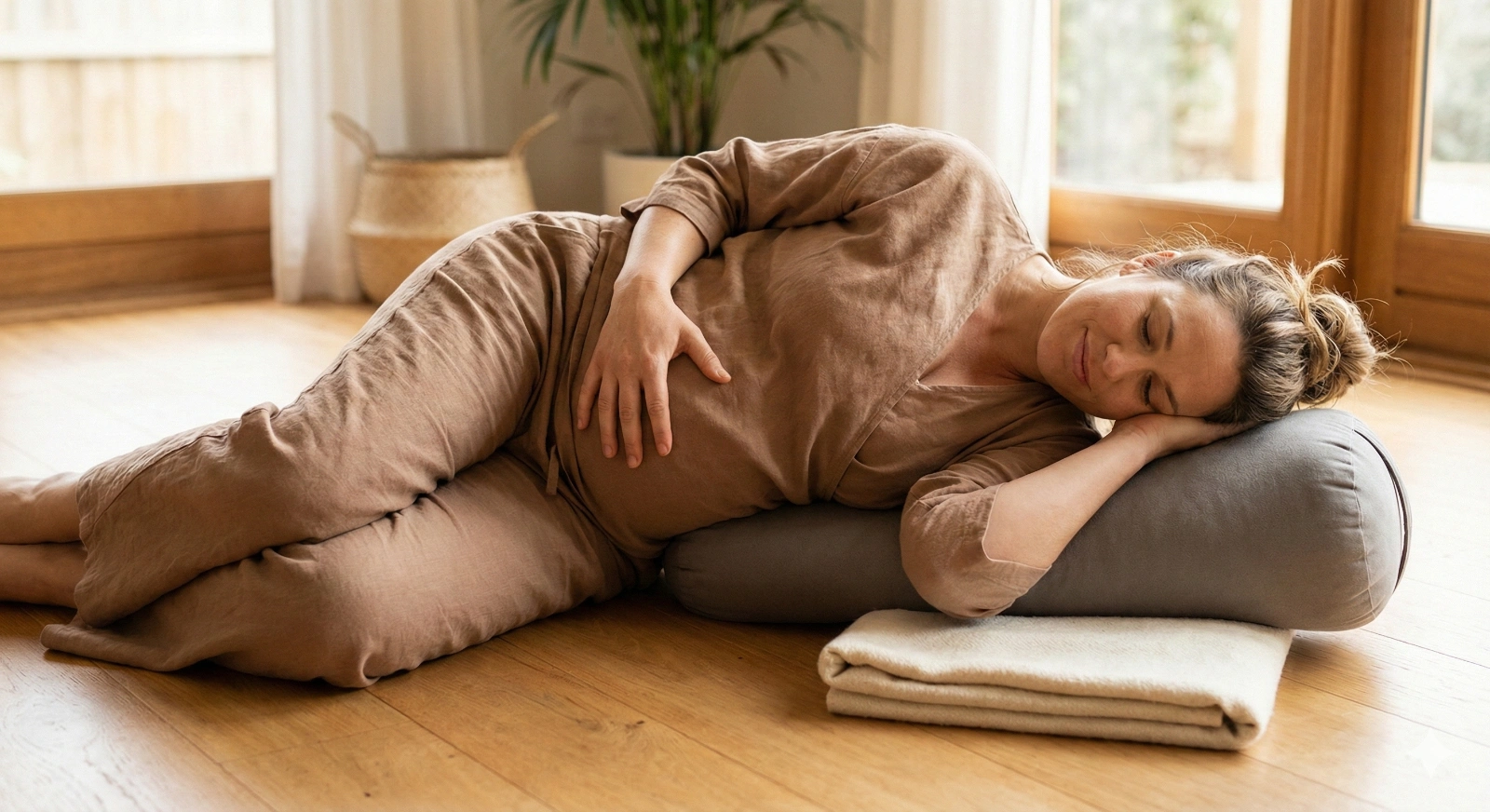

Back pain affects nearly seventy percent of pregnant women, though it does not have to be allowed to control the pregnancy the way it so often ends up doing by default. The growing belly pulls the spine into an increased curvature, and that shift creates compression through the lower back that radiates outward through the hips and pelvis in turn. The good news: a targeted pose creates space exactly where it is needed, addressing the root cause through intelligent movement rather than simply masking the discomfort until it fades on its own. This is the complete, practical guide to relief — back and pelvic pain, fatigue, swelling, posture, and the daily routine that ties it all together.
01Relief for Back and Pelvic Pain
Pelvic girdle pain shows up differently from an ordinary backache — felt in the pubic bone, the SI joints, or deep through the hips specifically when walking or turning over in bed. This happens because relaxin loosens the ligament holding the pelvis together, and the joints move more than they normally should, creating inflammation and pain as a direct result of that extra movement.
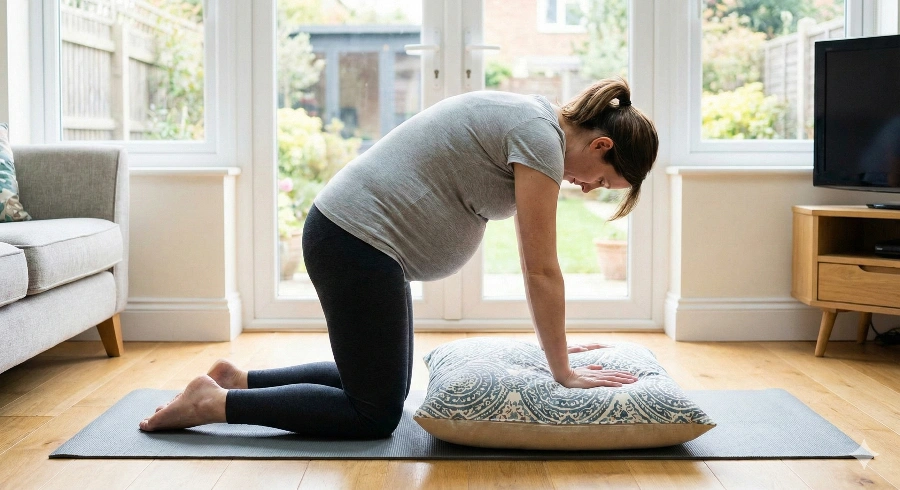
Cat-Cow becomes a genuine ally here. On hands and knees with a cushion under the belly for support, inhale to gently arch the back, lifting the chest and tailbone; exhale to round the spine, tucking the tailbone and dropping the head; move slowly and mindfully through ten to fifteen rounds. Child’s Pose with wide knees releases the lower back almost completely — kneeling with the knees wide apart, big toes touching, sinking the hips back toward the heels, forehead resting on a bolster or stacked blanket, the belly settling comfortably between the thighs while the back lets go of its held tension. Research in The Spine Journal found that pregnant women practising yoga twice weekly experienced a fifty percent reduction in lower back pain intensity compared with those receiving standard care alone.
A side-lying hip opener targets SI-joint pain specifically — lying on the left side with a pillow between the knees, the top knee bent and resting on a bolster positioned in front, breathing deeply for two to three minutes before switching sides, creates a gentle opening through the hip and pelvis without any real strain attached to it. A supported squat opens the pelvis while relieving sacral compression — standing facing a wall or sturdy chair, feet wider than hip-width and toes turned slightly out, holding the support while slowly lowering into a squat with the back kept upright throughout. What nobody quite mentions is that breath matters just as much as the position itself — deep breathing activates the parasympathetic nervous system, which directly reduces both pain perception and muscle tension together.
02Managing Fatigue and Heaviness

Pregnancy exhaustion feels genuinely different from ordinary tiredness — bone-deep, and often overwhelming in a way that catches people off guard. The body is building an entire human while still maintaining its own function fully — blood volume rises by fifty percent, the heart pumps harder, and every system works overtime simultaneously.
A Legs-Up-the-Wall variation, before twenty weeks, reverses blood flow and reduces leg heaviness directly; after twenty weeks, this modifies to a side-lying position with the legs elevated on pillows instead, to prevent vena cava compression. A gentle standing side stretch creates space for breathing and wakes up flagging energy — feet hip-width apart, right arm reaching overhead while leaning gently left, held for three to five breaths, then switched. Research published in Evidence-Based Complementary and Alternative Medicine found that pregnant women practising gentle yoga report a thirty-five percent improvement in energy level compared with a non-practising peer group.
A seated spinal rotation, an open twist only, away from the belly and never into it, energises the spine directly — sitting on the edge of a chair with feet flat and knees wide, rotating gently away from the belly on each side. Energy work during pregnancy is really about supporting the body’s enormous ongoing effort with gentle encouragement, not about pushing through fatigue the way an ordinary workout might. A modified Downward Dog at the wall stretches the entire posterior chain sustainably — standing an arm’s length from a wall, hands placed at shoulder height, feet walked back, hinging at the hips to form an L-shape without any real weight-bearing demand on the wrists or spine.
03Reducing Swelling and Circulation Issues
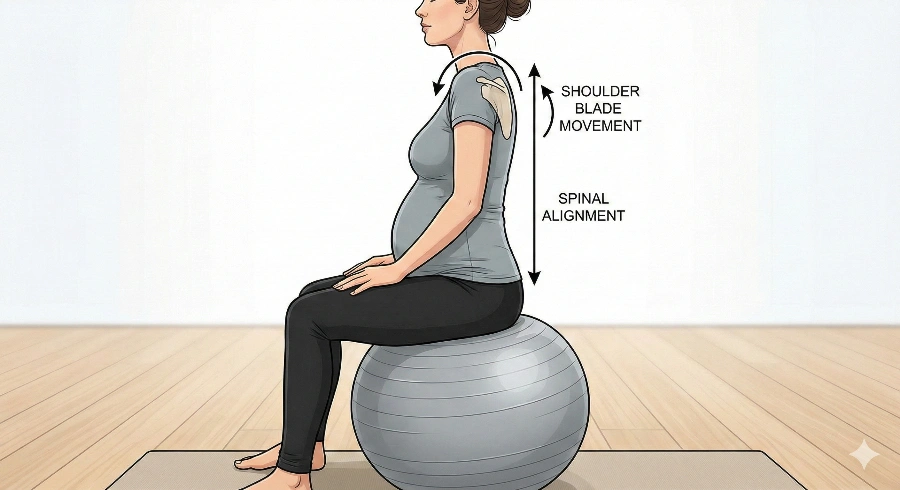
Swollen ankles and fingers affect nearly seventy-five percent of pregnant women, especially by the third trimester. The body retains extra fluid to support the increased blood volume, and the growing uterus can compress a major blood vessel along the way, compounding the swelling further.
Ankle circles and flexes while lying down mobilise accumulated fluid directly — lying on the left side, circling the top ankle slowly in both directions, then flexing and pointing, ten to fifteen repetitions per side. Supported Child’s Pose with elevated hips encourages lymphatic drainage — kneeling with a bolster in front, folding forward and resting the torso over it, the hips sitting higher than the heart so gravity can genuinely assist the fluid’s return.
Gentle side-lying leg lifts engage the leg muscle to help pump fluid along — lying on the left side, slowly lifting the top leg six to eight inches, holding briefly, and lowering, ten to twelve repetitions. A seated forward fold with chair support improves circulation without any real compression — sitting on a chair with feet wide, pillows on the thighs, hinging forward while the heart stays level with the hips, an ideal position for circulation specifically. Hand and wrist circles address upper-body swelling too — arms extended, fists made and fingers spread wide, wrists circled through — a simple practice that prevents exactly the hand swelling that makes a ring feel suddenly tight.
Swelling that appears suddenly, affects the face, or arrives alongside a headache warrants immediate medical evaluation, since these can indicate preeclampsia rather than ordinary pregnancy swelling.
04Postural Discomfort Solutions
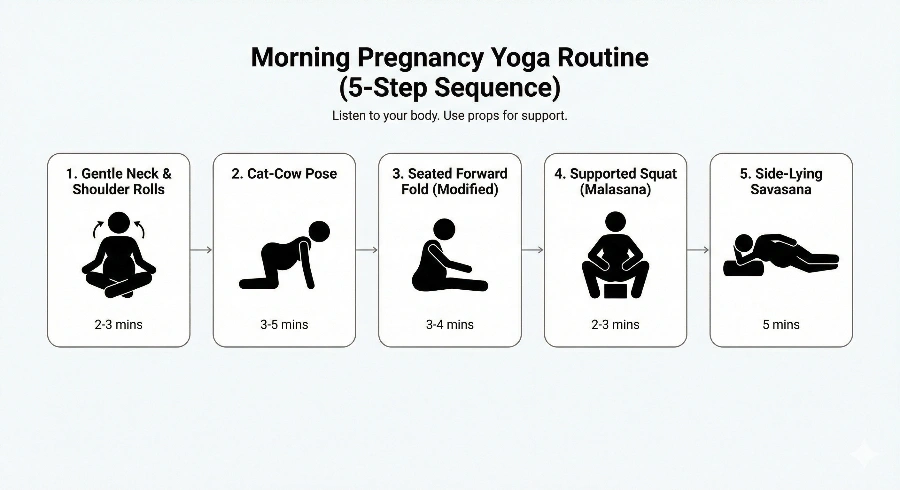
Posture changes dramatically as the centre of gravity shifts forward through pregnancy, and the body compensates by arching the lower back, rounding the shoulders, and jutting the head forward almost without anyone noticing it happening gradually. Fighting these adaptations directly tends to be considerably less effective than simply supporting the body through them instead.
Shoulder rolls and chest openers counteract the forward rounding — rolling the shoulders up and back eight to ten times, then clasping the hands behind the back to gently lift the chest and draw the shoulder blades together. Wall angels strengthen the upper back directly — standing with the back against a wall, arms raised into a goalpost position, slowly sliding them up and down for eight to ten repetitions. Seated hip circles on a yoga ball mobilise the pelvis and relieve stiffness — sitting on the ball and circling the hips slowly in both directions, lubricating the SI joints and releasing tension held there. Research in The Journal of Women’s Health Physical Therapy found that pregnant women practising postural-awareness exercise report forty percent less upper-back and neck pain than those who do not. A gentle neck stretch — tilting the ear toward the shoulder, holding three to five breaths, repeating on the other side — releases the tension a forward head posture reliably creates.
05Daily Relief Practices

Consistency matters considerably more than duration here — a ten-minute daily practice provides more cumulative benefit than a single weekly hour-long session ever could, and a sustainable routine that can genuinely be maintained beats an ambitious one that quietly falls away after the first difficult week.
A morning wake-up sequence, five to seven minutes: a full-body stretch in bed on the left side, ten rounds of Cat-Cow, and ten breaths in wide-knee Child’s Pose. A midday tension release, three to five minutes: a standing side stretch, a shoulder roll, and a gentle seated open twist, preventing discomfort from quietly accumulating across the rest of the day. An evening relaxation sequence, ten to fifteen minutes: supported Child’s Pose for two to three minutes, a gentle leg lift, and five minutes of complete relaxation in a supported side-lying position to close the day properly.
These small, scattered practices prevent discomfort from building the way a single long session, done occasionally, never quite manages to. As pregnancy moves through its trimesters, the routine itself is worth revisiting and adjusting rather than treated as fixed from the first week to the last.
“A targeted pose creates space exactly where it is needed. This is not masking the discomfort — it is addressing the root cause through intelligent movement.”
The heart of it
- Pelvic girdle pain and ordinary back pain call for different poses; know which one is actually present before choosing.
- Ten minutes daily outperforms one long weekly session for cumulative relief through pregnancy.
- Sudden swelling with facial involvement or a headache warrants immediate medical attention, not home remedy.
- Posture is best supported through pregnancy’s changes, not fought against them directly.
Find natural, effective relief for pregnancy discomfort with experienced prenatal teachers.
Reserve Your Seat