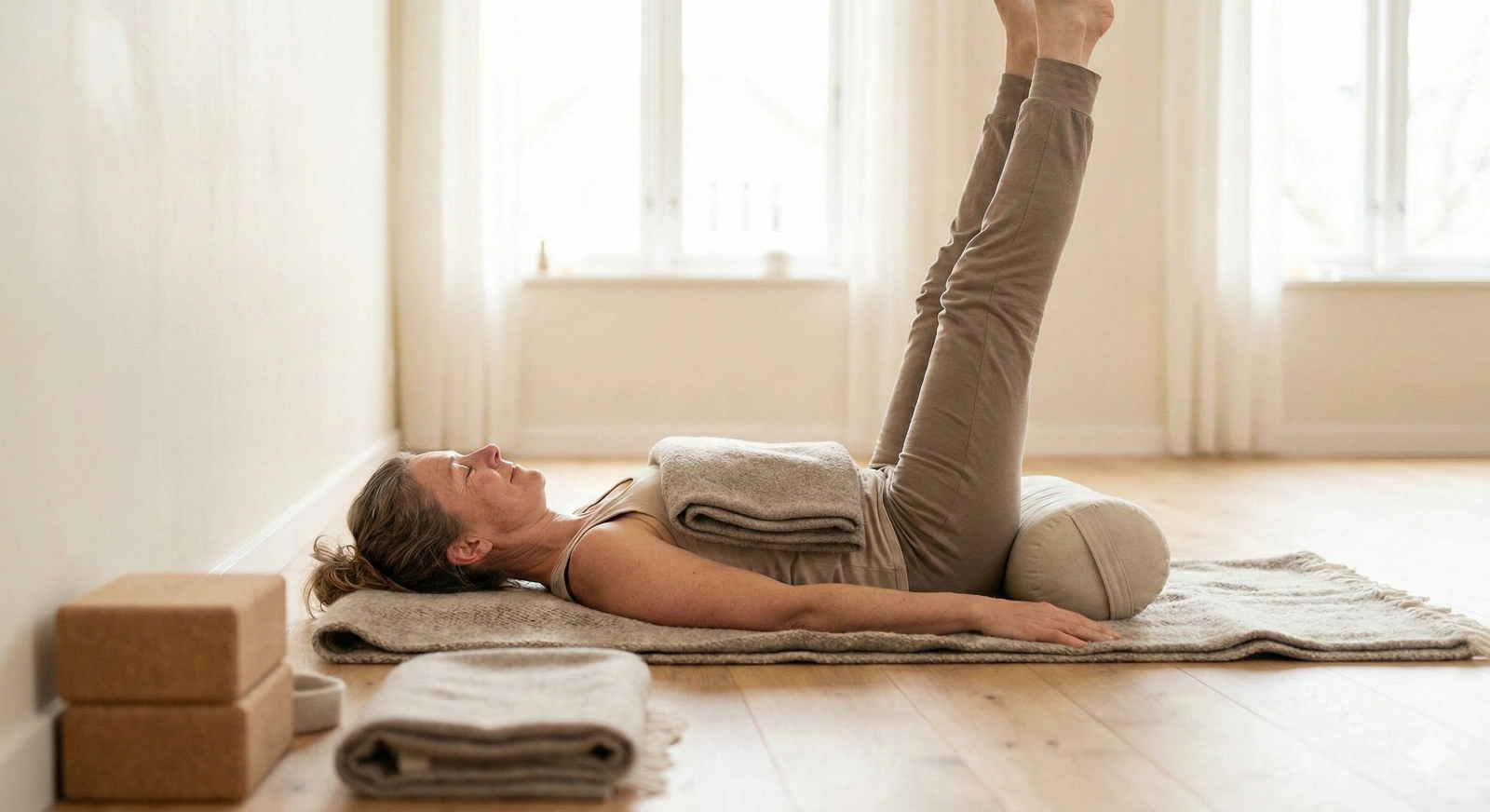

The body has been running on emergency mode for far too long. That constant hum of anxiety, the difficulty unwinding at night, the sense of never quite being able to catch a full breath — none of it is a character flaw. It is a sign the nervous system needs recalibration, and therapeutic yoga might be exactly what an overworked set of nerves has been quietly asking for all along. This is the complete guide to what nervous system regulation actually means, how therapeutic yoga reaches it directly, and how to build a genuinely sustainable daily practice around it.
01Recognising the Signal
What follows covers the actual mechanism connecting yoga to the nervous system, the specific practices that move it most reliably, why interoception matters more than most people realise, why a slower practice is often the genuinely harder one, and how to actually measure progress in a domain that rarely shows up on a scale or a tape measure the way physical fitness does.
02What Nervous System Regulation Actually Means
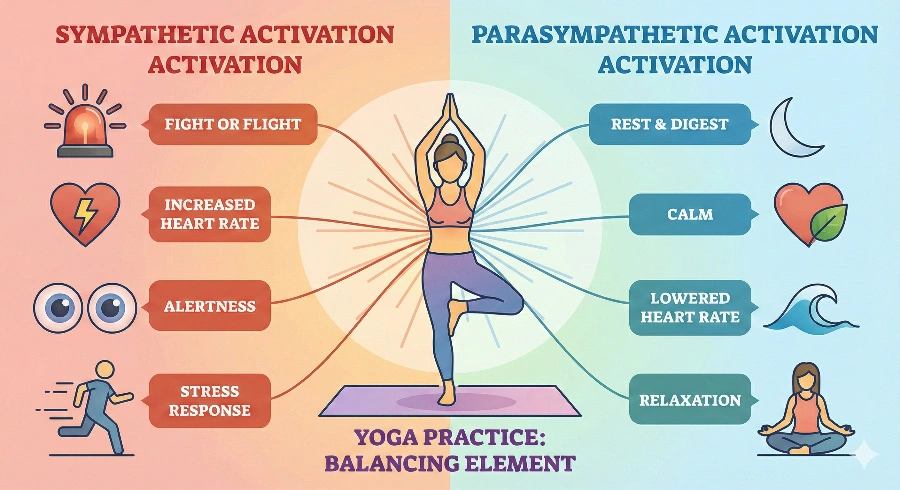
The nervous system operates like a sophisticated control centre with two primary modes. The sympathetic branch, the gas pedal, activates the fight-or-flight response — heart rate rises, digestion slows, muscle tenses, and the whole body readies itself for action. The parasympathetic branch, the brake, does the opposite, triggering the rest-and-digest mode where actual healing, repair and genuine relaxation take place.
The real problem for most people is not that either system is broken; it is that modern life keeps almost everyone stuck in sympathetic overdrive, punctuated by occasional collapse into exhaustion, but rarely a genuine, restorative parasympathetic state in between. Regulation, properly understood, does not mean living permanently in the calm state — it means being able to access both states appropriately and move smoothly between them as the moment actually calls for.
03How Therapeutic Yoga Reaches the Nervous System
Therapeutic yoga works differently from ordinary exercise. Where an intense workout activates the sympathetic system directly, therapeutic yoga specifically targets parasympathetic activation through a deliberately intentional practice rather than an incidental one.
The vagus nerve is the body’s primary parasympathetic highway, running from the brainstem through the heart, lungs and digestive organs in turn. Therapeutic yoga stimulates vagal tone through a specific breathing pattern, a gentle movement, and a prolonged exhale held consistently across a session — and a higher vagal tone corresponds directly to better stress resilience and emotional regulation over time. Dr Stephen Porges’s Polyvagal Theory describes three distinct states the nervous system can occupy: safe and social, the ventral vagal state; fight-or-flight, the sympathetic state; and shutdown, the dorsal vagal state. Yoga, at its best, helps a person access that first state directly, the one in which healing actually happens.
Breath is the only autonomic function that can be consciously controlled, which makes it an unusually powerful entry point into the whole system. Slow, deep breathing with an extended exhale activates the parasympathetic response directly; fast, shallow breathing does the opposite, signalling danger to a system that is often already primed to receive exactly that signal. In therapeutic yoga this knowledge is used quite deliberately — a three-part breath or an ujjayi breath becomes a genuine tool for self-regulation, not simply a relaxation technique borrowed for its pleasant feeling.
04Essential Practices
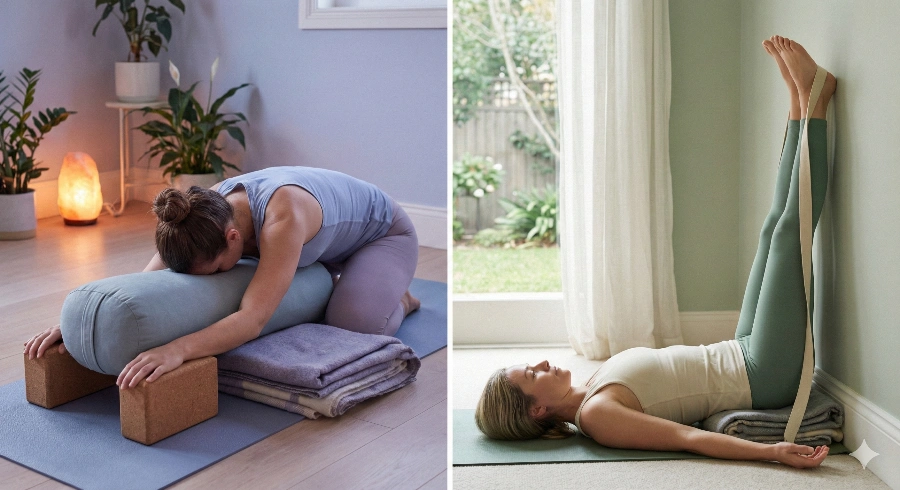
Restorative poses use a prop to fully support the body, and when physical effort drops to near zero, the nervous system receives an unambiguous message: you are safe, you can rest now. In supported Child’s Pose, a bolster placed lengthwise between the knees with the torso draped over it, head turned to one side and arms relaxed, held for three to five minutes while the exhale lengthens naturally, creates a gentle compression on the belly that stimulates the vagus nerve directly. In Legs-Up-the-Wall, lying on the back with the legs extended up a wall and the hips close to the baseboard, a folded blanket under the hips for comfort, held five to ten minutes while breathing slowly through the nose, this mild inversion shifts blood flow and signals the parasympathetic system in a genuinely reliable way. For anyone managing stress-induced insomnia specifically, a dedicated yoga for stress relief approach combines this same nervous-system regulation with targeted practice for mental calm and emotional balance.
Breathwork offers a second, more active route to the same state. In 4-7-8 breathing, inhale for four counts, hold for seven, exhale for eight — the extended exhale is the key element, activating the vagus nerve directly; four rounds before bed, or at any moment anxiety begins rising, and the heart rate noticeably slows within minutes. In alternate-nostril breathing, nadi shodhana, close the right nostril and inhale left for four counts, close the left and exhale right for four, inhale right, switch, exhale left, continued for five to ten minutes, both hemispheres of the nervous system come into a genuine balance with each other. Research published in the International Journal of Yoga found this practice significantly reduces heart rate and blood pressure while increasing parasympathetic activity measurably.
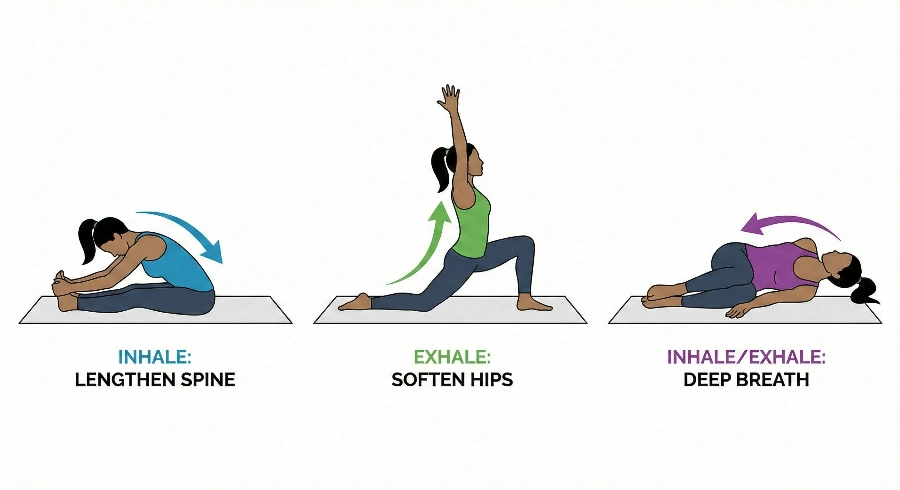
Mindful movement rounds out the set. Unlike a vigorous flow, a therapeutic sequence moves slowly with real awareness, each transition becoming an opportunity to notice sensation without judgement rather than simply a means of reaching the next pose. Gentle Cat-Cow, on hands and knees, moving between spinal flexion and extension for two minutes, breath matched to movement — inhale to extend, exhale to flex — creates a genuinely meditative state through rhythm alone. Standing Forward Fold with support, hinging at the hips against a wall or chair for two to three minutes, calms the nervous system by reducing visual stimulation and gently encouraging introspection instead.
05The Role of Interoception
Interoception is the ability to sense an internal body signal — hunger, thirst, heart rate, muscle tension — and many people with a genuinely dysregulated nervous system have surprisingly poor interoceptive awareness. They miss the early stress signal entirely until they are in full panic, or they have grown so disconnected from bodily sensation that recognising genuine safety becomes just as difficult as recognising danger.
Therapeutic yoga rebuilds this awareness directly. Lying still and scanning the body teaches the identification of a subtle sensation well before it escalates into something larger and harder to manage. Body-scan meditation is foundational here — starting at the toes, slowly bringing attention up through each part of the body in turn, simply noticing without trying to change anything at all. This practice strengthens the neural pathway between body and brain over time, and gradually tension gets caught earlier, before it has the chance to settle into something chronic.
06Why Slower Is Actually Harder
The mind wants to race ahead, solve the next problem, plan the coming week. A slow, restorative practice feels genuinely uncomfortable at first precisely because it removes every distraction, leaving nothing but the self — thought, sensation, emotion, with nowhere left to hide from any of it. This is exactly where the real work actually happens.
Lying still in a supported Fish Pose for ten minutes without fidgeting is, in its own quiet way, training genuine nervous-system resilience — proving to the body that stillness does not equal danger, a lesson many bodies have simply never learned. For anyone carrying a trauma history, this can be especially difficult; the body has often learned that hypervigilance itself equals safety, which makes working with a trauma-informed teacher genuinely important, since “relaxing” is not always relaxing for a nervous system wired specifically for protection rather than rest.
Exploring the therapeutic side of yoga more seriously? A dedicated yoga teacher training increasingly integrates nervous-system regulation directly into its curriculum, teaching students to create a genuinely healing space for themselves and for others they go on to teach.
07Measuring Progress That Doesn’t Show on a Scale
Unlike physical fitness, where a muscle visibly grows or a flexibility measurably increases, nervous-system regulation shows up in a genuinely different, subtler set of shifts: falling asleep more easily than before, recovering from a stressful event faster than it used to take, a resting heart rate that gradually decreases, a deeper breath that arrives naturally rather than being forced, and the ability to feel an emotion fully without being overwhelmed by it in the process.
Tracking these changes in a simple journal reveals a genuine pattern within roughly two weeks of consistent practice. Some people use a heart-rate-variability monitor for a more objective read on the same shift — a higher HRV indicates greater nervous-system flexibility, the capacity to move between sympathetic and parasympathetic state smoothly rather than getting stuck in either one.
08Common Obstacles and What Actually Helps
“I can’t quiet my mind” does not actually need solving, because therapeutic yoga was never about stopping thought in the first place — it is about changing the relationship with thought, letting it pass like a cloud rather than fighting its natural activity outright; the nervous system calms considerably once that fight stops.
“I feel more anxious during practice” describes something called activation, and it is actually a sign that stored stress is being processed rather than a sign that the practice is failing — working with a shorter hold at first, five breaths in a pose rather than five minutes, and gradually building capacity from there resolves this far more often than pushing through it does.
“I fall asleep immediately” usually just means chronic sleep debt is real, and the body will reasonably grab any rest opportunity it is offered — this is entirely fine temporarily, and as the sleep debt resolves, staying present through a longer practice becomes considerably easier on its own.
09Bringing This Into Daily Life
A full mat session is not actually required to regulate the nervous system — a micro-practice scattered through the day is remarkably effective on its own. Three slow breaths before a difficult conversation, thirty seconds of shoulder rolls with deep breathing right after checking email — these small resets interrupt a stress pattern before it accumulates into something larger, rather than waiting to address it after the fact.
A phone reminder for a midday breathing break, or stacking the practice onto an existing habit — breathwork while the coffee brews, a gentle stretch while brushing teeth — embeds this into a day that already exists rather than demanding an entirely new one be built around it. For anyone wanting more structured guidance, a practice like yoga nidra for deep sleep combines this same nervous-system regulation with a guided relaxation aimed at a genuinely profound restoration.
10The Bigger Picture
Nervous-system regulation through therapeutic yoga was never about achieving a permanent, unshakeable zen. It is about building resilience — the capacity to ride out life’s wave without capsizing under any single one of them. Stress, sadness and challenge will all still arrive regardless; the difference a regulated nervous system makes is that a person responds to them rather than simply reacting, feeling the feeling fully without being consumed by it, resting when rest is genuinely needed and activating when the moment actually calls for it.
This is the real gift underneath the whole practice — not an escape from life, but a fuller engagement with it from a grounded, resourced place rather than a depleted one. Start small: five minutes of Legs-Up-the-Wall today, a little slow breathing added tomorrow, a full restorative sequence attempted next week. The nervous system responds to exactly this kind of patient, unglamorous consistency, and gradually that constant background hum of anxiety softens into something that resembles peace far more than it resembles emergency.
“Relaxing isn’t always relaxing when your nervous system is wired for protection. Stillness itself is what needs to be relearned as safe.”
The heart of it
- Regulation means moving smoothly between sympathetic and parasympathetic states, not living permanently in either one.
- The vagus nerve, breath and restorative pose are the three most direct levers therapeutic yoga actually pulls.
- A slower practice is often the harder one precisely because it removes distraction and leaves only the self.
- Progress shows up in sleep, recovery time and emotional capacity long before it shows up anywhere measurable.
Learn to build genuinely healing, therapeutic sequences, guided by experienced teachers.
Reserve Your Seat