
Good sleep is built long before the head hits the pillow. The body carries the day’s tension into bed with it — tight hips from sitting, a jaw clenched from stress, a nervous system still faintly braced for the next demand — and no amount of willing yourself to relax undoes that on its own. A short sequence of the right poses, held slowly and without straining, tells the body something a bedtime scroll session never can. This is the complete guide to the postures, sequencing and environment that genuinely support deep rest.
01Why Specific Poses Matter for Sleep
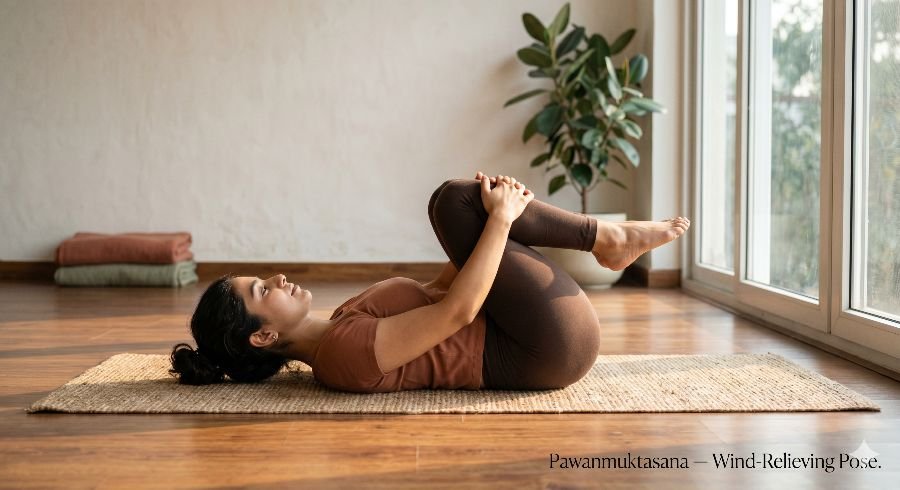
Certain postures work on sleep quality through mechanisms distinct from breathing alone — a forward fold compresses the abdomen gently and turns attention inward; an inversion, even a mild one, redistributes blood flow away from an overactive, thinking mind; and a hip opener releases a specific pocket of tension that accumulates from a full day of sitting and rarely resolves on its own. Held for several slow breaths rather than rushed through, these shapes give the nervous system time to actually register the shift toward rest.
02Legs-Up-the-Wall, the Single Best Pose for Sleep
If only one pose made it into a nightly routine, this would be it. Sit sideways against a wall, swing the legs up so they rest vertically against it, and let the arms fall open at the sides, staying for five to fifteen minutes. This gentle inversion drains fluid from tired legs, calms the nervous system directly, and requires no flexibility or strength whatsoever — making it one of the most accessible, reliably effective poses available for winding down.
03Reclined Bound Angle for Releasing the Hips
Lying on the back, bring the soles of the feet together and let the knees fall open toward the floor, supporting each knee with a cushion if the stretch feels sharp rather than gentle. This shape releases the hips and inner thighs directly, an area that holds a surprising amount of the day’s accumulated tension, and the openness across the chest that comes with it invites a fuller, easier breath than a curled-up position ever does.
04Seated Forward Fold for Turning Inward
Sitting with the legs extended, hinge forward from the hips with a soft bend in the knees, letting the head hang rather than forcing the reach toward the toes. This mild inversion of the torso has a genuinely settling effect on an active mind, and the gentle compression across the abdomen supports digestion, which matters more for sleep quality than it might first seem — a busy digestive system is a common, underrated saboteur of a restful night.
05Supine Twist for Releasing the Spine
Lying on the back, draw one knee toward the chest and guide it across the body to the opposite side, letting the opposite arm extend out and the gaze drift the other way. Held for a minute or two on each side, this gentle twist releases tension along the entire spine and has a specifically calming effect on the nervous system, making it a natural pose to include just before the final resting pose.
06Child’s Pose for a Sense of Safety
Kneeling with the big toes touching and the knees spread wide, fold forward and rest the forehead on the mat or a cushion, arms extended forward or resting alongside the body. This shape has a quietly protective, almost womb-like quality, and the slight pressure on the forehead is known to have a calming effect on the mind specifically, making it a genuinely good choice for anyone whose main obstacle to sleep is an anxious or overactive mental state rather than physical tension.
07Corpse Pose to Close the Practice
Lying flat on the back with the arms and legs relaxed away from the body, palms facing up, this final pose is deceptively simple and often the hardest one to do well — genuine stillness without fidgeting or planning tomorrow. Five to ten minutes here, letting the breath settle entirely on its own, integrates the effect of everything practised before it and forms the natural bridge into sleep itself.
08Putting Together a Full Bedtime Sequence
A workable order, taking roughly twenty minutes altogether: Child’s Pose for two minutes to settle in; Seated Forward Fold for two minutes to turn attention inward; Reclined Bound Angle for three minutes to release the hips; Supine Twist for two minutes on each side to release the spine; Legs-Up-the-Wall for eight to ten minutes as the centrepiece of the sequence; and Corpse Pose for the final few minutes to close. None of this needs to be rushed — the slowness is, in a real sense, the entire point.
09Supporting the Practice With the Right Environment
Even the best sequence works against itself in the wrong environment. A cool, dark room supports the body’s natural melatonin production considerably better than a bright or overly warm one; a phone left in another room removes the temptation to check one more notification mid-sequence; and a consistent bedtime, even on a weekend, keeps the body’s internal clock considerably steadier than an irregular one ever allows.
Practise this sequence on the bed itself if a full mat setup feels like too much effort at the end of a long day — the poses that matter most here do not require a hard floor.
“A short sequence held slowly tells the body something a bedtime scroll session never can. The slowness is, in a real sense, the entire point.”
The heart of it
- Legs-Up-the-Wall is the single most accessible, reliably effective pose for winding the body down before sleep.
- Hip openers and gentle twists release tension a straight, curled-up position in bed never reaches.
- A full sequence takes roughly twenty minutes and works best moved through slowly rather than rushed.
- The sleep environment — a cool dark room, a phone left elsewhere, a consistent bedtime — supports the practice rather than working against it.
Learn a complete practice for deep, restorative sleep, guided by experienced teachers.
Reserve Your Seat