
Yoga is a transformative practice that blends physical, mental and spiritual elements, offering a path to wellness for every kind of person who walks onto the mat. Its rich tradition spans seven main styles, each with its own approach and its own gift — and at Adhiroha in Rishikesh, the Yoga Capital of the World, all seven are taught as part of a genuinely complete education. If you are considering yoga teacher training in Rishikesh, understanding these seven styles is the first honest step, because the style you connect with shapes the teacher you eventually become.
01What Are the Seven Types of Yoga
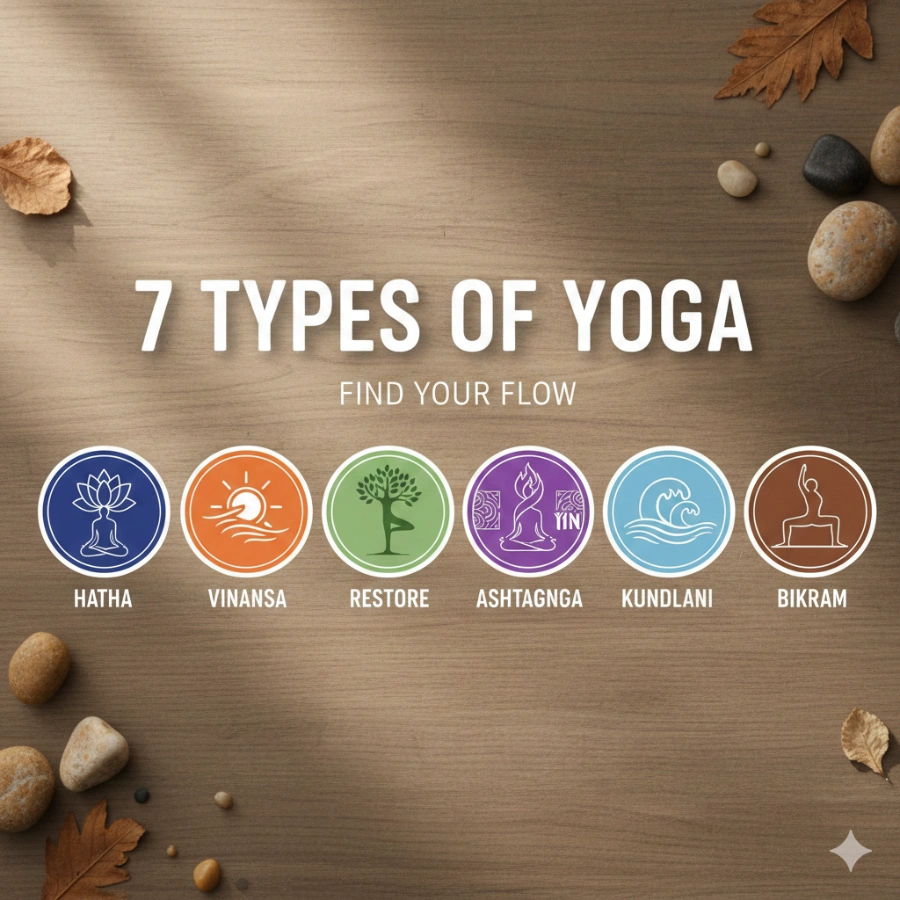
Yoga’s rich traditions offer distinct styles, each catering to a different goal — physical fitness, mental clarity, or spiritual awakening. The seven main types — Hatha, Ashtanga, Vinyasa, Iyengar, Bikram, Kundalini and Yin — each provide a genuinely different path to wellbeing, and none of them is objectively ‘better’ than the others; they simply suit different bodies, temperaments and goals.
What separates them is not the poses themselves — most styles share a common vocabulary of asana — but the pace, the sequencing logic, the use of breath, and the intention behind the practice. Hatha holds a pose so you can feel it. Ashtanga repeats a fixed sequence so you can measure yourself against it. Vinyasa keeps you moving so the mind has no room to wander. Iyengar corrects the geometry of the body down to the millimetre. Bikram uses heat as the teacher. Kundalini uses sound and breath to work on the nervous system. Yin simply asks you to stay still long enough for the deeper tissues to release. Once you see this, choosing between them stops feeling like a guess.
Historically, all seven trace back to the same root. Patanjali’s Yoga Sutras laid out the eight limbs; the medieval Hatha texts such as the Hatha Yoga Pradipika developed the physical practices; and the twentieth-century teachers of Mysore — particularly Krishnamacharya and his students — shaped almost every modern style you will meet in a studio today. Ashtanga, Iyengar and Vinyasa are, in a real sense, siblings from the same lineage.
Did you know? Each yoga type offers distinct benefits, making the broader practice accessible to everyone, from complete beginners to advanced practitioners refining decades of experience.
02Hatha Yoga
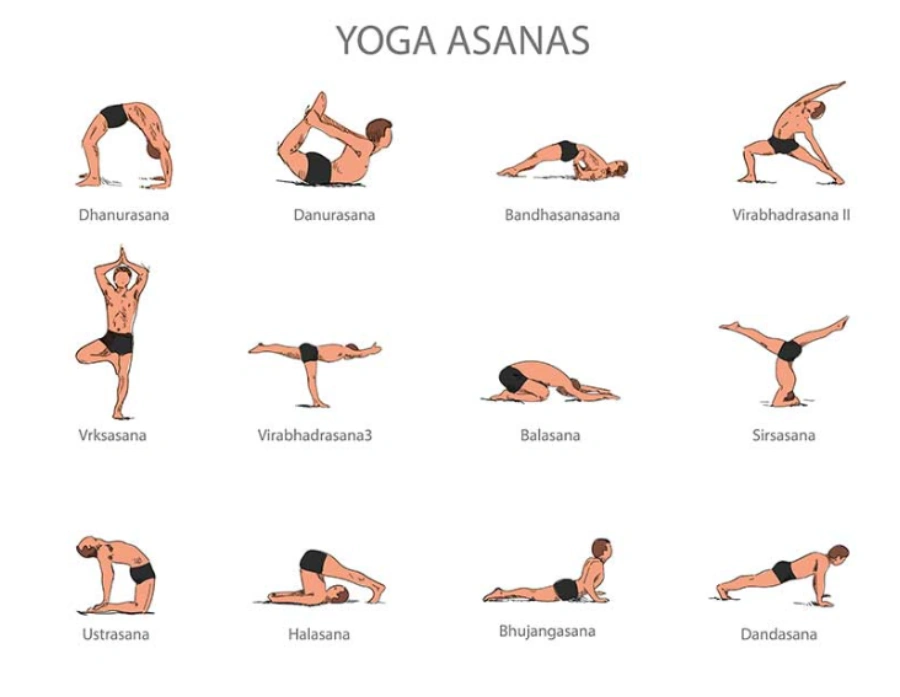
Hatha yoga, the foundation of most modern yoga practice, focuses on physical postures and breath control together to balance body and mind. Its slow, deliberate pace emphasises alignment and mindfulness, making it genuinely ideal for beginners. In Adhiroha’s Hatha classes, students learn poses like Mountain Pose and Child’s Pose that build both flexibility and real stress relief.
The word itself is often read as ha (sun) and tha (moon) — the balancing of opposing energies in the body. In practice, a Hatha class holds each posture for several breaths rather than flowing continuously, which gives you time to notice what is actually happening in your hips, shoulders and spine instead of rushing past it. That pause is the whole point.
A typical Hatha session includes: centring and breath awareness, gentle warm-ups, standing postures such as Tadasana and Trikonasana, seated forward folds, a backbend or two, a twist, and a full Savasana. Pranayama — usually Nadi Shodhana or Bhramari — is woven in rather than tacked on.
Best for: complete beginners, older practitioners, anyone returning after injury or a long gap, and students who want to understand the mechanics of a posture before speeding it up. Nearly every serious yoga teacher training in Rishikesh programme begins here, because Hatha is the grammar of everything that follows.
03Ashtanga Yoga
Developed by K. Pattabhi Jois, Ashtanga is a dynamic, physically intense practice with a fixed sequence of poses synchronised with breath, or vinyasa. Its progressive series build strength, stamina and focus in equal measure, and Adhiroha’s Ashtanga training places real emphasis on safe alignment and disciplined practice, making it ideal for those seeking a structured and genuinely challenging style.
The system is built on three tools working together, often called tristhana: ujjayi breath, bandhas (internal locks) and drishti (a fixed gaze point for each posture). Hold all three and the practice becomes meditative even while it is physically demanding.
Ashtanga is organised into six series. The Primary Series, Yoga Chikitsa, is understood as yoga therapy — it realigns and detoxifies the body. The Intermediate Series, Nadi Shodhana, works on the nervous system. The four Advanced Series are for a small minority of lifelong practitioners. Almost everyone spends years inside the Primary Series alone, and that is entirely as intended.
You will also hear about Mysore style, where students move through the sequence at their own pace in a shared room while the teacher gives individual adjustments. It looks chaotic from the doorway and turns out to be the most personal way the style is taught.
Best for: disciplined practitioners who want measurable progress, athletes, and anyone who finds comfort in repetition. Approach with care if: you have wrist, shoulder or lower-back issues — the repeated Chaturangas add up quickly without good technique.
04Vinyasa Yoga
Often called ‘flow yoga’, Vinyasa links breath with movement in a fluid sequence. Unlike Ashtanga’s fixed structure, it allows for creative transitions between poses, session to session. Included throughout Adhiroha’s teacher training, this style enhances cardiovascular health while still supporting genuine mindfulness.
Vinyasa grew directly out of Ashtanga, but the teacher designs the sequence rather than inheriting it. Most classes are built around Surya Namaskar A and B as a spine, then layered with standing postures, balances, backbends and a cooling close. Because the sequence changes, the body never fully settles into a pattern — which keeps things interesting, though it also means progress is harder to measure than in Ashtanga.
The defining skill in Vinyasa is not flexibility, it is breath-led transition: one movement per inhale or exhale, so the breath sets the tempo instead of the playlist. When students say a flow class felt meditative, this is usually why.
Best for: students who get restless holding poses, people training for general fitness, and future teachers who want to learn intelligent sequencing — a core skill assessed throughout the 200 hour yoga teacher training in Rishikesh curriculum.
05Iyengar Yoga
Founded by B.K.S. Iyengar, this style emphasises precise alignment and the thoughtful use of props such as blocks and straps. It supports injury prevention and a genuinely deeper awareness of each posture. At Adhiroha, Iyengar principles are woven into training to encourage safe, intelligent movement across every style.
Props here are not a beginner’s compromise — they are the method. A block under the hand in Trikonasana lets the chest open properly instead of collapsing; a belt in Supta Padangusthasana lets the hamstring lengthen without the spine rounding. The prop brings the pose to the student rather than forcing the student into the pose.
Iyengar classes also hold postures considerably longer than a flow class, with the teacher giving detailed verbal corrections throughout. This is why the style has such a strong reputation in therapeutic and rehabilitative settings, and why its alignment vocabulary has quietly influenced almost every other modern style.
Best for: anyone with an injury or structural imbalance, detail-oriented students, and trainee teachers — because learning to see a body accurately is the single most transferable skill in teaching.
06Bikram Yoga
Bikram yoga consists of a set sequence of poses practised in a heated room to enhance flexibility and support detoxification. While Adhiroha focuses primarily on traditional yoga systems, its teacher training explores the underlying principles of heat, discipline and repetition found in this style, so graduates understand it even where it is not the primary focus.
The classical format is fixed: 26 postures and two breathing exercises across roughly 90 minutes, in a room held near 40°C with high humidity. Every class is identical, which allows students to track change in themselves rather than in the sequence. The broader category of ‘hot yoga’ borrows the heat but not the fixed script.
Heat increases tissue pliability and makes the practice intensely cardiovascular, but it also masks the body’s natural warning signals — which is exactly why sensible hydration, electrolytes and a willingness to sit down mid-class matter more here than anywhere else.
Approach with care if: you are pregnant, have low blood pressure, cardiac concerns, or a history of heat intolerance. Speak to a doctor before your first class rather than after it.
07Kundalini Yoga
Kundalini yoga emphasises spiritual awakening through breathwork, chanting, meditation and dynamic movement combined. The practice nurtures emotional balance and inner awareness in a way more overtly spiritual than most other styles, and Adhiroha integrates Kundalini technique into its curriculum to deepen this dimension of a student’s education.
A Kundalini class is structured around kriyas — set sequences of movement, breath, mudra and mantra aimed at a specific effect, such as building resilience or clearing mental fog. Repetitive movement held for a fixed count, Breath of Fire, and chanting are all standard, and the effect on the nervous system is usually felt long before it is intellectually understood.
The underlying model describes dormant energy at the base of the spine rising through the chakras. Whether you approach that literally or as a useful metaphor, the practical outcome most students report is the same: sharper emotional regulation and a noticeably steadier mind.
Best for: practitioners who want the meditative and philosophical side of yoga to be explicit rather than implied, and anyone working with anxiety, burnout or creative blocks.
08Yin Yoga
Yin yoga is a slow, meditative practice in which poses are held for extended periods, targeting connective tissue and promoting deep relaxation. At Adhiroha, Yin complements more dynamic styles like Ashtanga and Vinyasa, supporting recovery, flexibility and genuine stress relief on rest days.
Postures are typically held for three to five minutes, sometimes longer, with muscles deliberately relaxed so the load transfers to fascia, ligaments and joint capsules — tissues that respond to sustained, gentle stress rather than repetition. Poses carry their own names for this reason: Butterfly, Dragon, Sphinx, Caterpillar, Saddle.
The mental side is arguably harder than the physical. Staying with a sensation for four minutes without adjusting, checking the time or bailing out is genuine mindfulness training, and it is the reason many teachers pair Yin with a heavy Ashtanga or Vinyasa week.
Best for: stiff bodies, stressed nervous systems, athletes, desk workers, and anyone whose practice has become all effort and no ease.
“There is no single ‘correct’ yoga. There is only the style that meets you where you actually are today.”
09Which Style Suits You? A Quick Comparison
If you are still weighing your options, the table below reduces each style to what actually matters when choosing: how hard it is physically, how fast it moves, and who tends to thrive in it.
| Style | Pace | Intensity | Best Suited To |
|---|---|---|---|
| Hatha | Slow | Gentle to moderate | Beginners, returning practitioners |
| Ashtanga | Brisk, fixed | High | Disciplined, strength-focused students |
| Vinyasa | Flowing, varied | Moderate to high | Fitness-minded, restless minds |
| Iyengar | Slow, precise | Moderate | Injury recovery, detail lovers |
| Bikram | Steady, fixed | High (heat) | Heat-tolerant, routine-driven students |
| Kundalini | Repetitive | Moderate | Emotional and spiritual focus |
| Yin | Very slow | Low physically, high mentally | Recovery, stress, stiff bodies |
Most long-term practitioners end up combining two or three styles — a dynamic practice for strength, and a slow one for recovery. You do not have to pick just one for life.
10Learn All Seven at Adhiroha
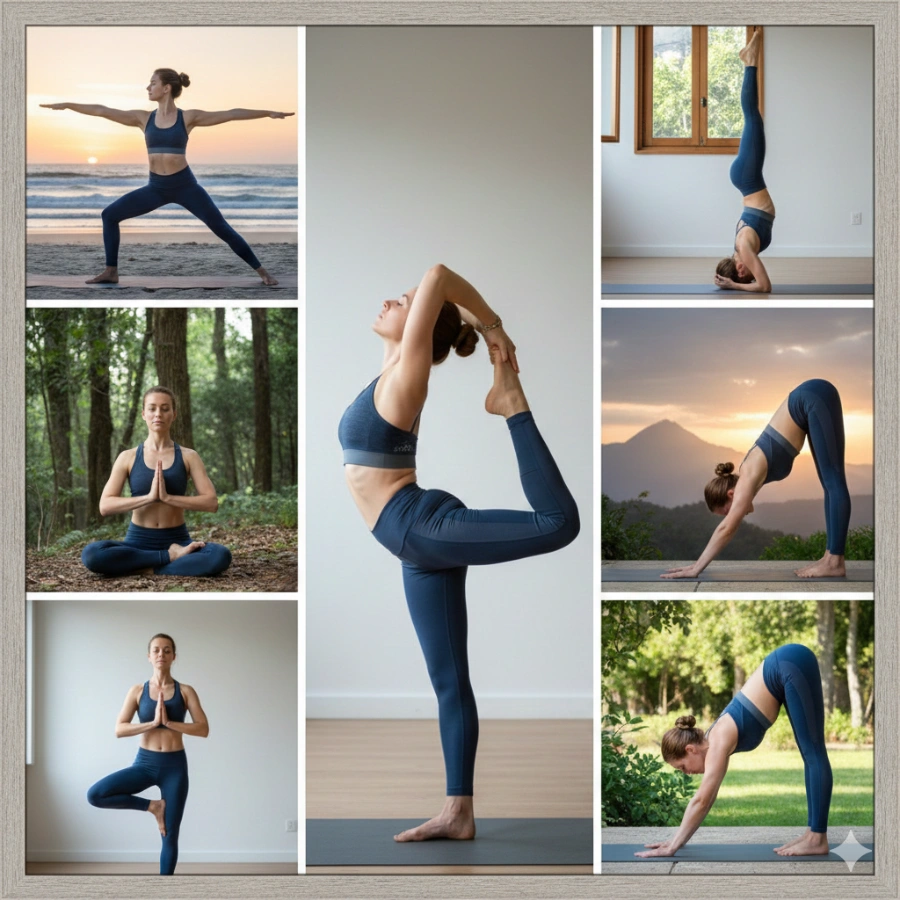
Adhiroha’s yoga teacher training in Rishikesh is certified by Yoga Alliance and India’s Ministry of Ayush. The programme covers core styles such as Hatha, Ashtanga, Vinyasa and Yin in depth, while introducing Iyengar, Bikram and Kundalini concepts alongside them. Training includes asana, pranayama, meditation, philosophy and teaching methodology, all supported by sattvic meals and a genuinely peaceful learning environment.
For most students, the natural entry point is the 200 hour yoga teacher training in Rishikesh — the internationally recognised foundation certification that qualifies you to register as a teacher and to teach professionally worldwide. It is designed for committed practitioners rather than advanced ones; you do not need to touch your toes or hold a headstand to begin.
What the 200-hour syllabus covers:
- Asana practice — Hatha and Ashtanga Vinyasa across daily morning and evening sessions
- Pranayama and kriya — breath techniques and traditional cleansing practices
- Anatomy and physiology — how the body moves, and how it gets injured
- Yoga philosophy — Patanjali’s Sutras, the eight limbs, and the Bhagavad Gita in context
- Alignment and adjustment — Iyengar-informed hands-on correction
- Teaching methodology — sequencing, cueing, voice, class management and practicum
- Meditation and mantra — daily practice alongside Kundalini technique
Because the styles are taught side by side rather than in isolation, graduates leave able to read a room and choose the right approach for the students in front of them — the difference between someone who has memorised a sequence and someone who can genuinely teach.
Exploring multiple styles during training helps you discover your own personal teaching and practice strengths, rather than guessing from the outside.
11Frequently Asked Questions
Which type of yoga is best for beginners?
Hatha, almost always. Its slower pace gives you time to learn alignment before adding speed or intensity. Iyengar is an equally good choice if you are working around an injury, and Yin is a gentle option for stiffness and stress.
Do I need to know all seven styles to become a yoga teacher?
No, but you should understand them. Your certification will be grounded in one or two core styles — usually Hatha and Ashtanga Vinyasa — while exposure to the rest lets you adapt to different students. This is exactly how the 200 hour yoga teacher training in Rishikesh is structured.
How flexible do I need to be before starting a teacher training?
Less than you think. A regular practice of a few months and a willingness to work consistently matter far more than any particular pose. Flexibility is an outcome of training, not a prerequisite for it.
What is the difference between Ashtanga and Vinyasa?
Ashtanga follows a fixed sequence that never changes, so you measure progress against a constant. Vinyasa is teacher-designed and varies session to session, which keeps it fresh but makes progress harder to track.
Why do so many people choose Rishikesh for teacher training?
Rishikesh sits at the foothills of the Himalayas on the banks of the Ganges and has been a centre of yogic learning for centuries. The combination of an established teaching lineage, an unusually quiet environment and Yoga Alliance-certified schools is why yoga teacher training in Rishikesh draws students from across the world every year.
Is a 200-hour certification enough to teach professionally?
Yes. The 200-hour level is the internationally accepted foundation qualification for teaching. Advanced 300-hour training builds on it later, once you have some real teaching hours behind you.
12Planning Your Journey
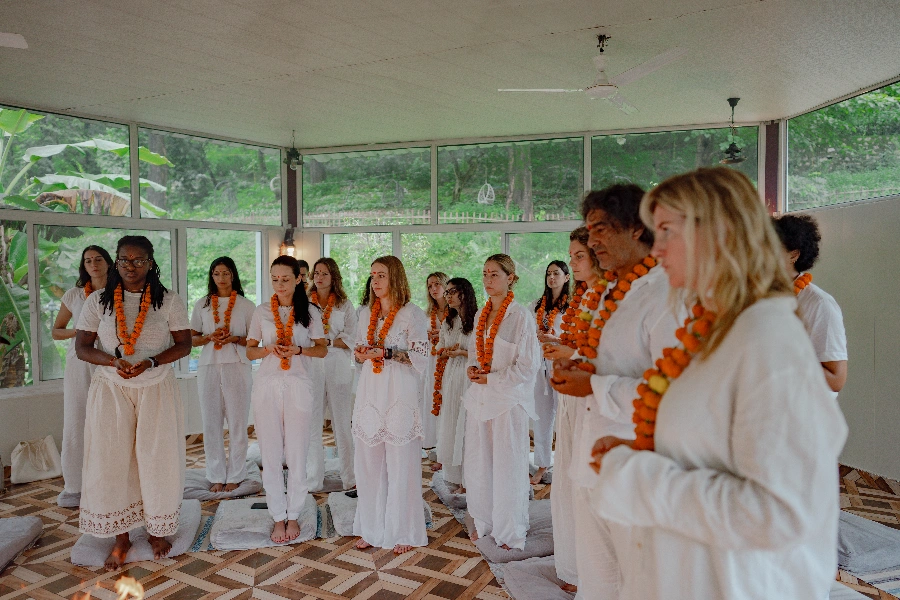
October to March offers the most comfortable weather for practice in Rishikesh. Dehradun (DED) is the nearest airport, with pickup available on arrival, and maintaining a regular practice beforehand makes it easier to ease into unfamiliar styles once you are here. Comfortable clothing, a journal and a reusable water bottle cover most of what you actually need to pack.
Getting here: Dehradun airport is roughly an hour away by road. Rishikesh and Haridwar both have railway stations, and Haridwar is the better-connected of the two for long-distance trains. Buses run regularly from Delhi, taking around six to seven hours.
Seasons at a glance: October to March is cool, clear and ideal, though January mornings are genuinely cold. April to June is hot but workable with early sessions. July to September brings the monsoon — green, quiet and dramatic, with occasional travel disruption.
Practical preparation: build to a steady practice three or four times a week in the months before you arrive, and start waking earlier — most residential courses begin around 6 a.m. Bring layers, a light shawl for meditation, any regular medication, and a copy of your passport and visa. Rishikesh is a vegetarian, alcohol-free town, which suits the rhythm of training better than most people expect.
13Discover All Seven With Adhiroha
Hatha, Ashtanga, Vinyasa, Iyengar, Bikram, Kundalini and Yin each offer a genuinely different path to physical, mental and spiritual growth. At Adhiroha in Rishikesh, guided by expert yoga training teachers India, you can learn these styles authentically through immersive yoga teacher training and retreats built around them. Begin your journey via Adhiroha’s Application Form, explore resources like Yoga for Stress Relief and Meditation Techniques for Beginners, or contact info@adhiroha.com for more information.
If you are ready to move from practising to teaching, the 200 hour yoga teacher training in Rishikesh is where that transition usually begins — and every one of these seven styles has something to teach you along the way.
The heart of it
- The seven main styles each serve a different goal — none is objectively superior.
- Hatha, Ashtanga and Vinyasa form the core physical practices most students begin with.
- Iyengar, Bikram and Kundalini each add a distinct dimension — alignment, heat, or spirit.
- Yin balances the more dynamic styles and supports genuine recovery.
- A 200-hour certification is the standard foundation for teaching any of them professionally.
Discover which style truly fits you, guided by teachers who know all seven.
Apply Now