
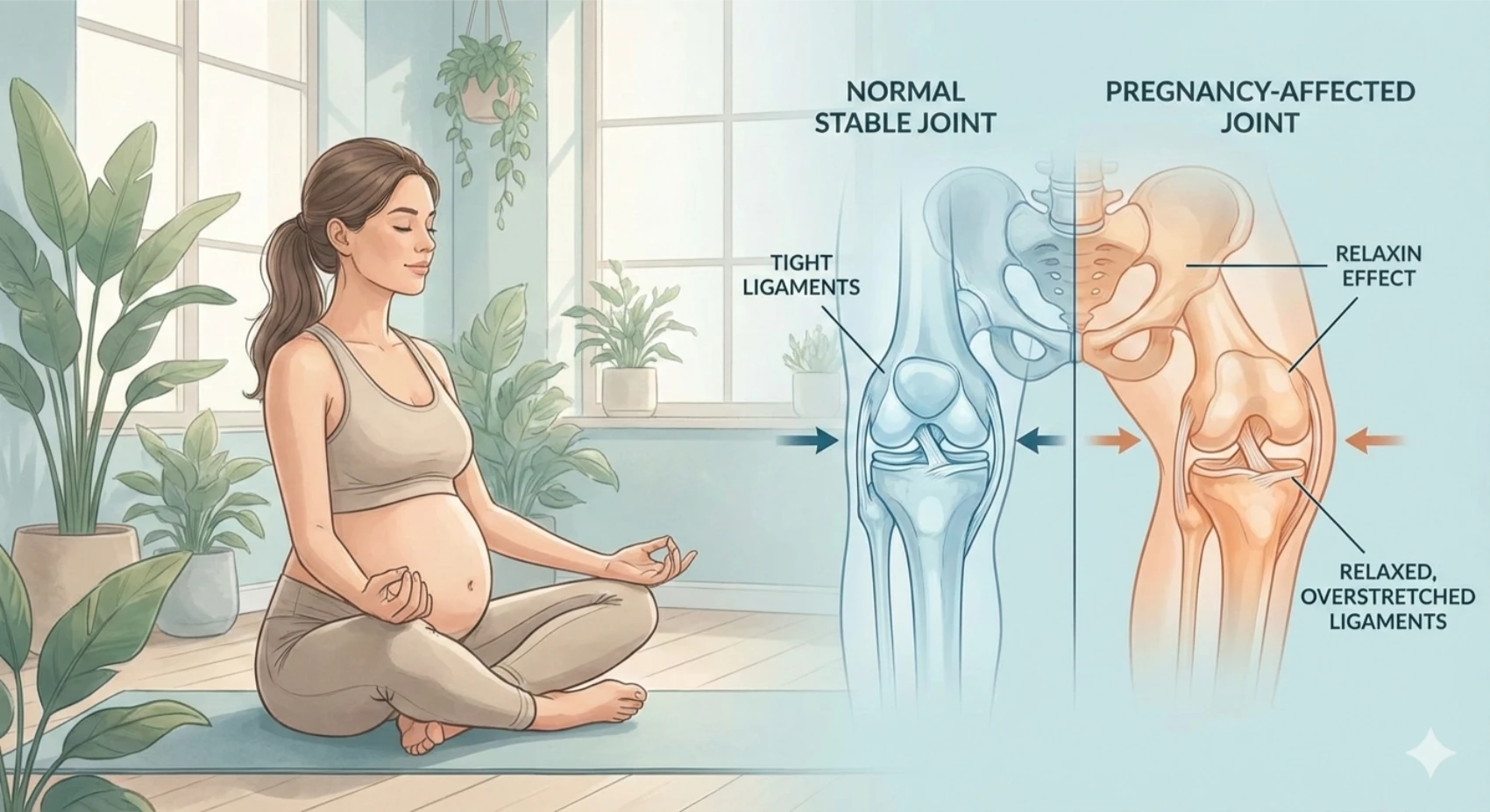
Joint Laxity and Overstretching Risks
Pregnancy makes you deceptively flexible—and that's actually dangerous.
Your body produces relaxin, a hormone that loosens ligaments throughout your entire system. This isn't limited to your pelvis—every joint from ankles to neck becomes less stable.
You might be wondering why increased flexibility creates problems. The issue is that your newfound bendiness isn't true flexibility. It's joint instability masquerading as suppleness. When you stretch deeply into this artificial range of motion, you're damaging ligaments that won't recover easily postpartum.
Relaxin levels increase by 300% during pregnancy. This prolonged exposure means overstretching damage compounds over months, creating chronic joint problems that persist years after delivery.
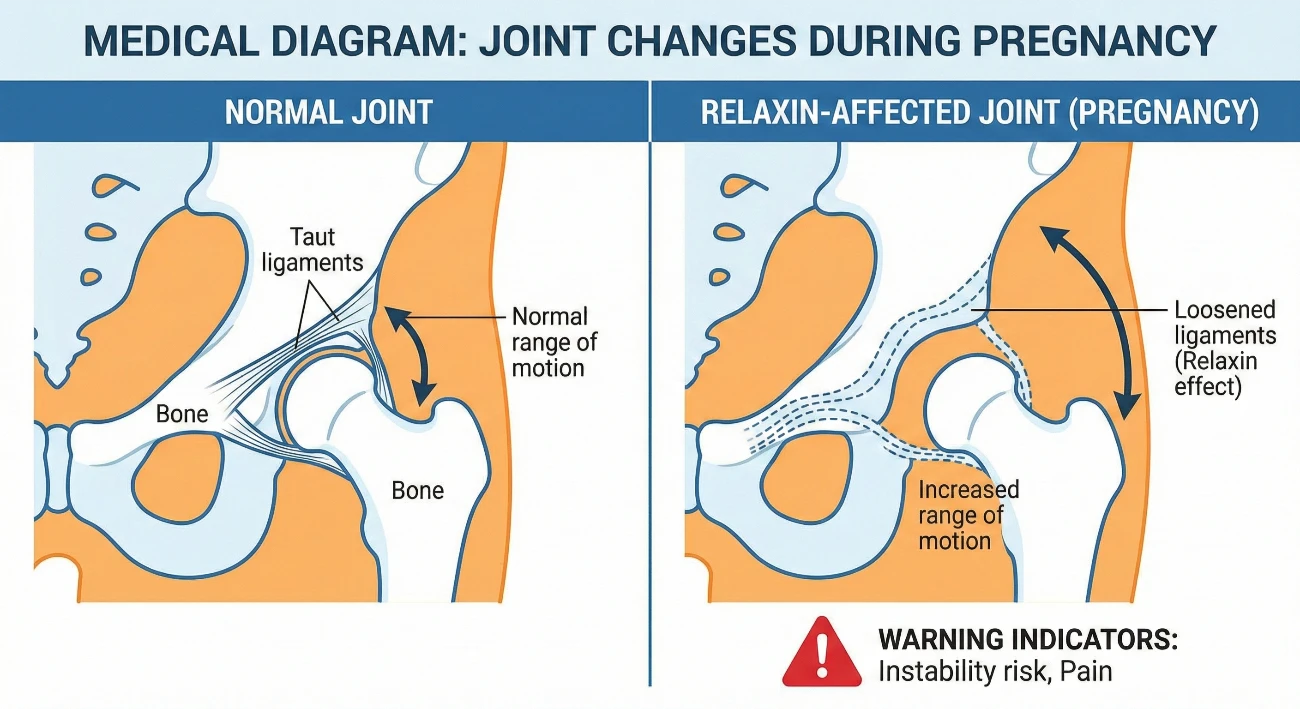
Your knees become particularly vulnerable. Hyperextension in standing poses—locking knees back—can strain the joint capsule. This creates knee pain persisting long after pregnancy ends.
Here's what most people miss…. That amazing forward fold you can suddenly achieve? It feels great in the moment but sets you up for chronic sacroiliac joint pain postpartum. Your ligaments are stretching beyond their natural range.
According to Dr. Diane Lee, physiotherapist and pelvic health specialist, pregnancy-related joint laxity takes 4-6 months postpartum to normalize, longer if breastfeeding. Damage done during pregnancy affects recovery significantly.
How to protect yourself from overstretching:
- Work at 70% of your maximum range: When you feel you could stretch deeper, stop well before that point. Pregnancy yoga isn't about achieving maximum flexibility.
- Hold poses for shorter durations: Stay in stretches for 3-5 breaths maximum. This prevents ligaments from stretching beyond safe limits.
- Engage muscles actively: Rather than passively sinking into stretches, maintain muscle engagement throughout. Your muscles should support joints rather than releasing completely.
- Use props to limit range: Blocks, straps, and walls help you stop before reaching end range of motion. These aren't crutches—they're intelligent safety tools.
Your pubic symphysis—the cartilage joining your pubic bones—can separate excessively from wide-legged poses. Keep legs no wider than hip-distance in most standing positions.
If you're experiencing joint discomfort, exploring yoga for back pain resources can provide relief strategies, though pregnancy-specific guidance always takes priority.
Balance Issues and Fall Prevention
Your changing body creates genuine fall risk that demands serious attention. Your center of gravity shifts forward progressively as your belly grows. This changes your balance in ways your brain hasn't learned to compensate for yet.
According to research in the Journal of Pregnancy, falls affect 27% of pregnant women. While most falls don't harm baby directly, they can cause placental abruption, preterm labor, or maternal injury.
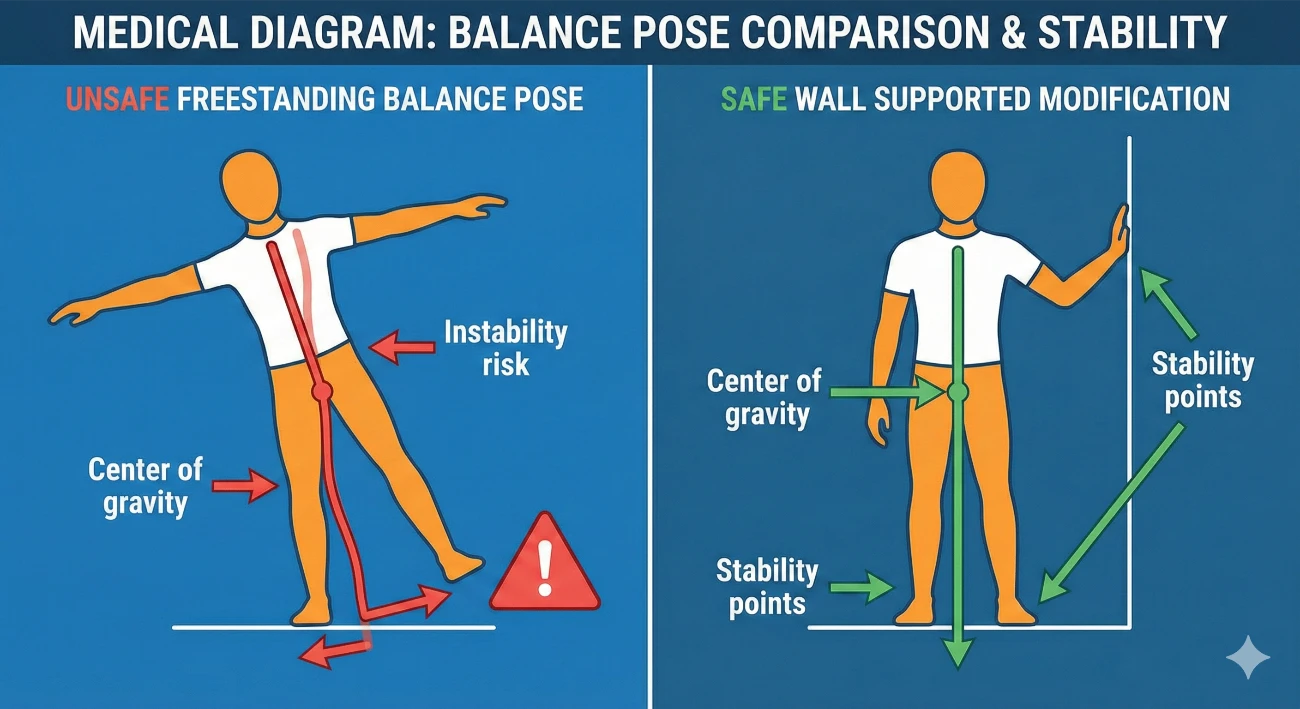
Balance poses require complete modification during pregnancy. That tree pose you held easily before? It now needs wall support, period. Your proprioception—your body's awareness of where it is in space—becomes less reliable. Hormonal changes affecting your joints also impact the sensory receptors that help you balance.
How to prevent falls during practice:
- Use walls for every balance pose: Stand with your shoulder or hand touching the wall. This isn't optional—it's essential safety practice.
- Choose wider stances: Keep feet hip-distance or wider for all standing poses. Narrow stances increase fall risk dramatically.
- Move slowly and deliberately: Quick transitions increase fall risk. Take extra time moving between poses, especially from floor to standing.
- Keep one hand near the floor: In poses like triangle, having a hand on a block provides instant support if you wobble.
- Avoid closed-eye balance work: Keep eyes open during all standing poses. Pregnancy isn't the time for removing visual input.
Dr. Raul Artal, past chairman of ACOG's Committee on Obstetric Practice, emphasizes that fall prevention should be the primary consideration in prenatal exercise. Flooring matters significantly. Practice on non-slip surfaces only. Avoid practicing in socks—bare feet or proper yoga shoes provide better traction.
Poses and Movements to Avoid
Certain poses create risks that outweigh any potential benefits during pregnancy. Understanding why specific poses are contraindicated helps you make intelligent decisions when practicing independently.
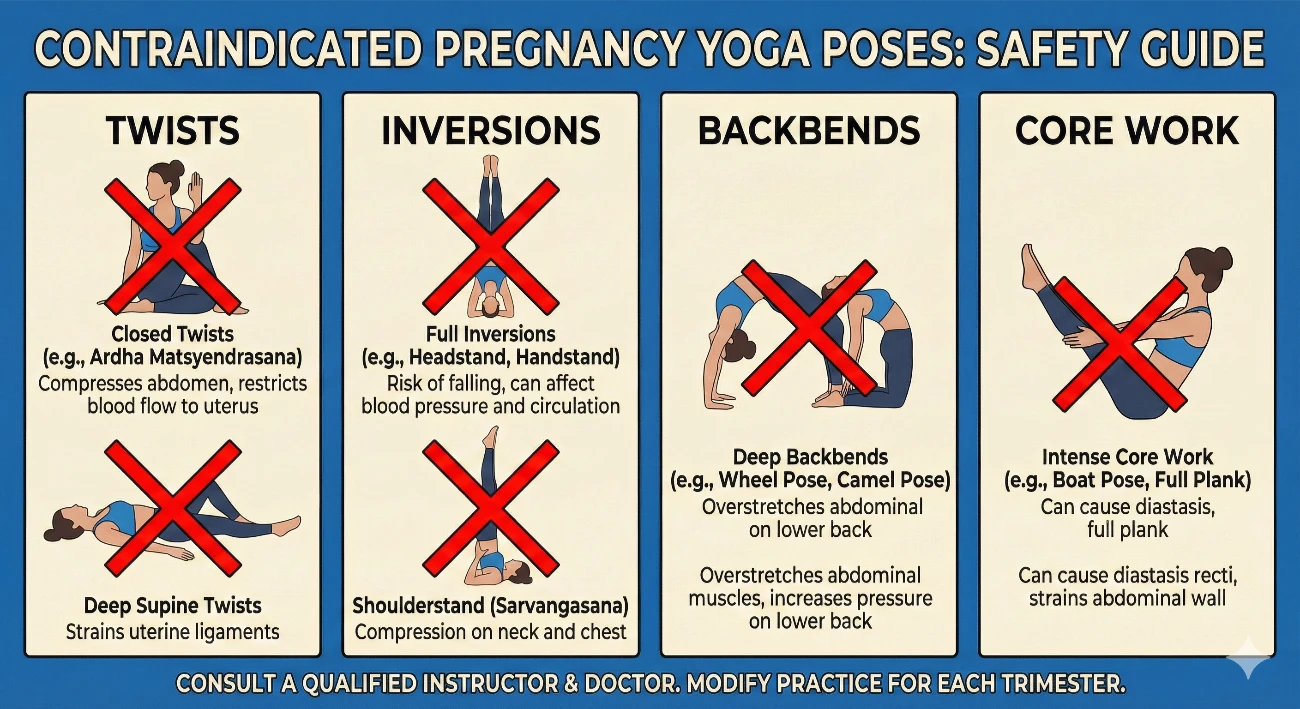
Major Contraindications:
- Deep twists—completely avoided: Closed twists compress your uterus directly. Even open twists should be gentle and performed only in early pregnancy. By second trimester, eliminate all twisting entirely.
- Back-lying poses—avoided after 16-20 weeks: Supine position allows your growing uterus to compress the vena cava, reducing blood return to your heart. This decreases blood flow to both you and baby.
- Intense core work—avoided throughout: Boat pose, full plank holds, chaturanga, and crunches all create intra-abdominal pressure that worsens diastasis recti. Your abdominal muscles are separating naturally—forcing them to contract intensely interferes with this process.
- Full inversions—avoided from conception: Headstands, shoulder stands, and forearm stands all risk falls and create unusual blood pressure changes. Stop immediately upon confirming pregnancy.
- Deep backbends—avoided or heavily modified: Full wheel, camel pose, and deep cobra create abdominal stretching that can stress the linea alba.
- Hot yoga—completely avoided: Bikram, hot vinyasa, or any practice above 80°F creates genuine fetal development risks.
- Intense pranayama—modified or avoided: Breath retention and rapid breathing (kapalabhati, bhastrika) reduce oxygen supply to your baby.
According to the International Journal of Yoga Therapy, women who avoided contraindicated poses during pregnancy experienced 50% fewer musculoskeletal complications postpartum.
Warning Signs During Practice
Your body sends clear signals when something is wrong—learning to recognize them protects both you and baby. Some symptoms require immediate practice cessation and medical evaluation.
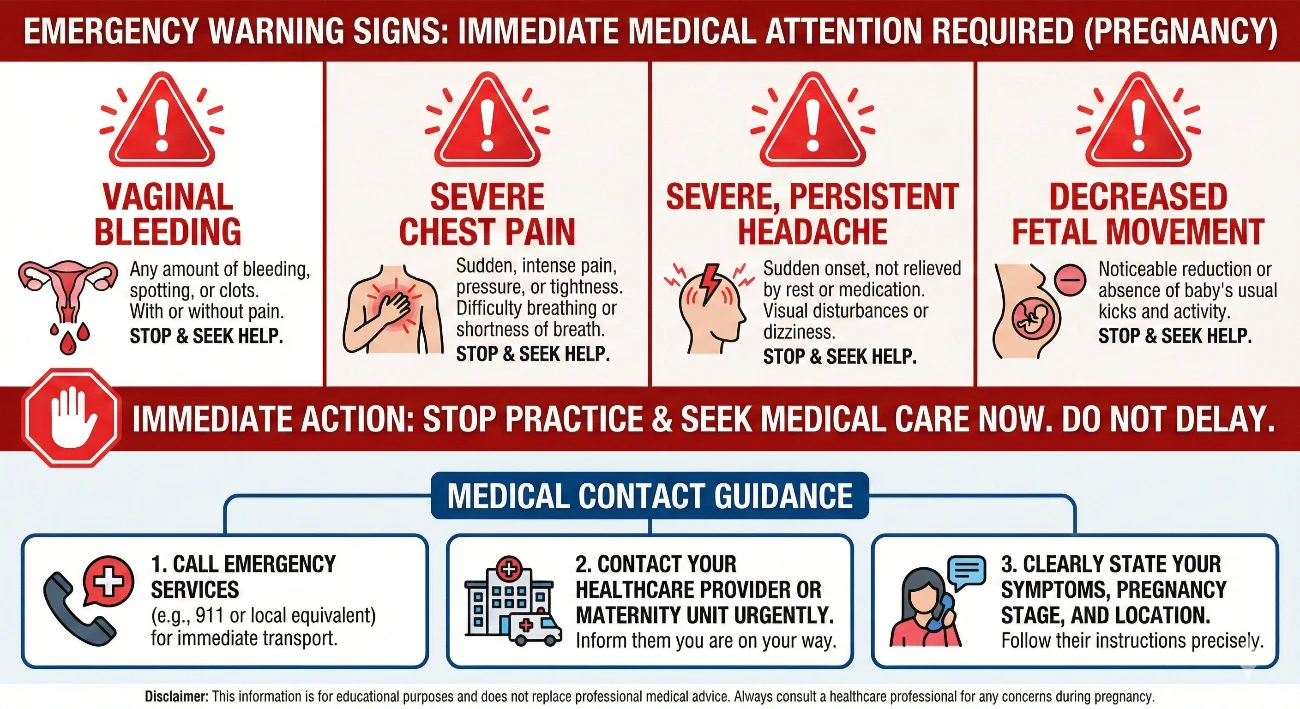
Stop immediately and seek medical care for:
- Vaginal bleeding or spotting.
- Severe, persistent cramping or regular contractions before 37 weeks.
- Fluid leakage.
- Severe headache with vision changes (can indicate preeclampsia).
- Chest pain or heart palpitations.
- Severe shortness of breath.
- Decreased fetal movement.
Stop practice and rest, then assess:
- Dizziness or lightheadedness.
- Persistent nausea during practice.
- Unusual pain in abdomen, pelvis, or back.
According to midwife Ina May Gaskin, women who learn to trust their body's signals during pregnancy have better birth outcomes. Listening carefully isn't overthinking—it's appropriate vigilance.
When Medical Advice Is Required
Some situations absolutely require your healthcare provider's explicit approval before beginning or continuing yoga. Never assume yoga is automatically safe for your pregnancy.
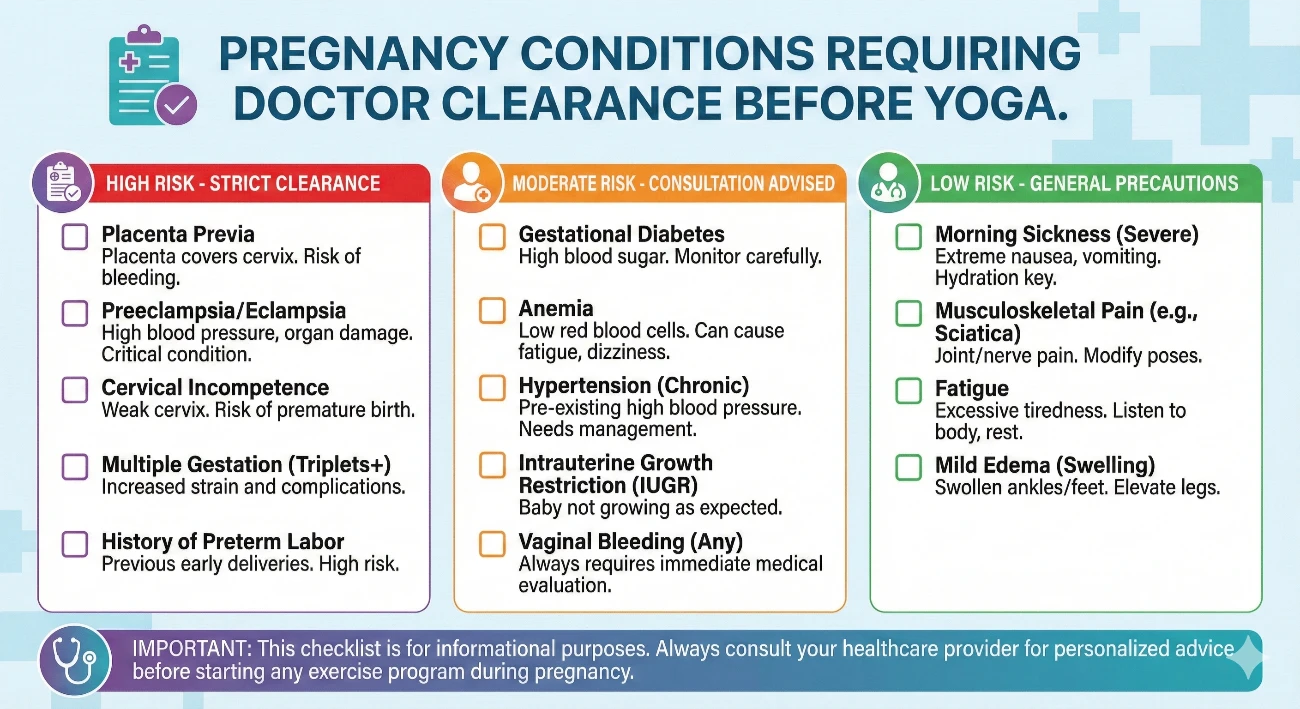
Conditions requiring clearance before practice:
- Placenta previa.
- History of preterm labor.
- Multiple pregnancy (twins/triplets).
- Preeclampsia or pregnancy-induced hypertension.
- Incompetent cervix.
- Persistent bleeding.
- Severe anemia.
Medical clearance isn't one-time permission. Your pregnancy changes weekly, and complications can develop at any point. Even if you started with clearance, new symptoms like gestational diabetes or cervical length changes require re-consultation.
The conversation with your provider should be specific. Don't just ask "Can I exercise?" Ask "Can I practice prenatal yoga?" and describe what that entails.
FAQs
-
What yoga poses are not safe during pregnancy?
Avoid deep twists (closed or open), back-lying poses after 20 weeks, intense core work like boat pose or full planks, full inversions including headstands and shoulder stands, deep backbends like wheel pose, belly-down positions, hot yoga, and unsupported balance poses. Jump transitions, breath retention practices, and any pose creating abdominal compression should also be eliminated. The key is avoiding compression, overheating, fall risk, and overstretching throughout pregnancy.
-
Which position to avoid during pregnancy?
Avoid lying flat on your back after 16-20 weeks as this compresses the vena cava and reduces blood flow to baby. Skip deep twisting positions that compress your uterus, belly-down positions, and extreme stretches that exploit relaxin-loosened joints. Avoid unsupported standing balance poses due to fall risk, and skip inverted positions. After 20 weeks, even legs-up-the-wall should be approached cautiously.
-
Which position is not good during the third trimester?
Back-lying position is most problematic in third trimester due to vena cava compression. Deep forward folds create belly compression. Narrow-stance standing poses increase fall risk. Deep squats without support can create excessive pelvic pressure. Closed positions that compress your growing belly should be avoided. Stick to side-lying, supported seated, gentle standing with wall support, and hands-and-knees positions.
-
Can certain positions hurt my baby?
Direct harm from yoga positions is rare because your baby is well-protected by amniotic fluid and uterine walls. However, certain positions create risks: back-lying after 20 weeks reduces oxygen supply, deep twists create uterine compression, overheating from hot yoga can affect fetal development, and falls from balance poses could cause placental abruption or preterm labor. The bigger risk is maternal injury or stress that indirectly affects baby.
-
What not to do when pregnant in the 2nd trimester?
Stop all back-lying poses after 20 weeks, avoid deep forward folds that compress your belly, eliminate jumping movements, skip hot yoga completely, avoid unsupported balance work, and don't push into deep stretches despite feeling flexible. Skip intense core work, avoid overstretching your relaxin-loosened joints, don't practice through fatigue, and never ignore warning signs like dizziness or cramping.